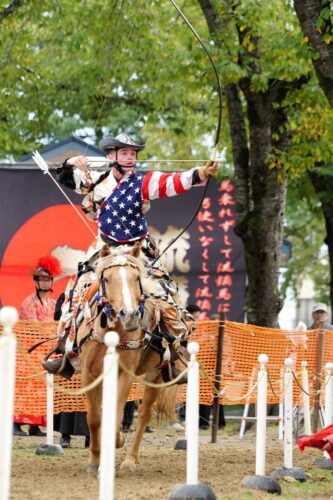
“I think I loved horses before I was even conscious,” says Carey Norland, a Eugenean who, at the age of 26, has recently received one of his — and the world’s — most valued credentials as an equestrian.
“I actually got into archery before I got into riding, because archery is significantly cheaper.” They say that as a child, “like many people who have an inclination towards horse archery, I tried to make bows out of things, and I would take big redwood sticks home and tie shoestrings on them and try to turn that into a bow.”
After doing mounted archery for 10 years, Norland learned about yabusame. Yabusame is a form of traditional Japanese horseback archery, where participants make high speed runs down tracks between 180 and 200 meters. They shoot three wooden targets with arrows while controlling their horse with their knees because their hands are occupied. It is performed donning full traditional garb and equipment. There are three different schools of yabusame, Nanbu, Ogasawara and Takeda, with their distinctions lying in small variations between form, garb and style.
In October 2025, Norland traveled to Towada, Aomori, in Japan for the World National Yabusame Championships, where they competed and won first place with a perfect score. As a result, he received two endorsements to become a Grade 2 instructor, which is the highest rank in the practice. In February 2026, Norland will become the world’s only certified Nanbu yabusame instructor from North America.
Yet, when Norland planned his trip to Japan, he did not know he would be competing at all, and had never done competitive yabusame. In fact, he was under the impression that he would simply be going to study.
“Until recently, like within the last decade, foreigners have not been allowed to do yabusame,” says Norland, who has been a mounted archer since 2016, but “fell in love with yabusame as soon as I found out about it.”
In July 2025, Norland participated in the first Nandu yabusame clinic outside of Japan. It was taught by Ayuko Kamimura, the first female yabusame instructor in history.
Norland says that they love yabusame because it “is not a sport of precision, but it is an art and a pursuit of bettering oneself and calming your spirit, and honoring the spirits around you and the audience watching. It really resonates with me.”
More than anything, yabusame is a ritual. According to the Japan Yabusame Federation, which is the organization that oversees yabusame and approves participants into their rankings, “Yabusame is a sacred ritual where the archers…do not just compete over their martial skills, but as they shoot arrows in prayer, it is regarded as of a highly spiritual nature.”
After the clinic, Norland was ranked as a beginner, categorized as Grade 3. In order to obtain the highest rank of Grade 2 and eventually become an instructor, he knew he had to participate in a myriad of competitions and receive endorsements from two upper level yabusame instructors. While he practiced in the clinic, Norland says that Kamimura approached him and asked “if I wanted to come and study in Japan.”
Norland told her that not only would he love to do that, but that he was also interested in instructing yabusame, “which is a huge ask,” he says.
“Originally the whole purpose was for me to go and to study,” he says, “because I love yabusame. I wanted to get to know yabusame more and try my best.” But six weeks before they were supposed to take that trip, Kamimura “dropped the bombshell on me that I’d be participating in not just a competition — because they wanted me to do a competition — but the World Yabusame Championships.”
Needless to say, “I was shaking in my little boots.”
He went to Japan two weeks prior to study, and had a one-day trial run. Then, during the three-day competition, “it was really just down to focusing up.”
Having been a mounted archery instructor for five years and playing music for their whole life, Norland says that the two skills are intertwined. “First of all, going slowly is about the most important practice that you can make when you are working with an animal and bridging that communication gap.”
He also says that “Riding so hugely hinges on rhythm, and timing. The rhythm of a horse is very, very important for mounted archery, because that rhythm is the foundation for your shooting.”
During both the practice clinic and the second day of the competition, Norland says he had a moment where he got so nervous at a target that he began to shake. “And I breathed into it, and I opened my eyes, and I could see these big shadowy shapes in the mountains.” Yabusame is a Shinto ritual that honors “the spirits that are there in the trees and the ground and the earth,” he says. “I just knew that these were mountain spirits that had come to see the yabusame. And so I took that moment to just really relax and focus in on making a beautiful performance.” He placed first with a perfect score.
After his performance, Norland says they got off the horse and found Kamimura crying. She told him, “‘You showed beautiful yabusame.’ And that was the biggest damn win of anything: That I represented yabusame.”
The next day, he was scheduled to meet with Kamimura and Shigekatsu Kikuchi, the vice president of the Japan Yabusame Federation, where they would deliberate and decide if Norland had earned Grade 2 instructor status. When Norland showed up to the meeting, he was the only one there. It had already been decided.
In February, he will begin teaching yabusame at Ridgeline Mounted Archers, where he is the owner, trainer and head coach, and he is also scheduling travel clinics for 2026. Mounted archers from all walks and styles, he says, “go a little bit crazy. Sometimes we’re just like, ‘I feel the spirit of the universe flowing through me with every shot.’”
To inquire about lessons in Nanbu yabusame and mounted archery, reach out to Carey Norland at RidgelineMountedArchers@gmail.com.