
Behavioral health advocates rejoiced when Lane County and PeaceHealth, 15 months ago, declared they would build a joint 126-bed center on International Way in Springfield’s Gateway area.
The facility would sharply expand the metro area’s mental-care safety net, with 24-hour-a-day temporary emergency beds and recliners for youth and adults, and long-term secure inpatient beds for people with severe disorders such as schizophrenia or bipolar disorder.
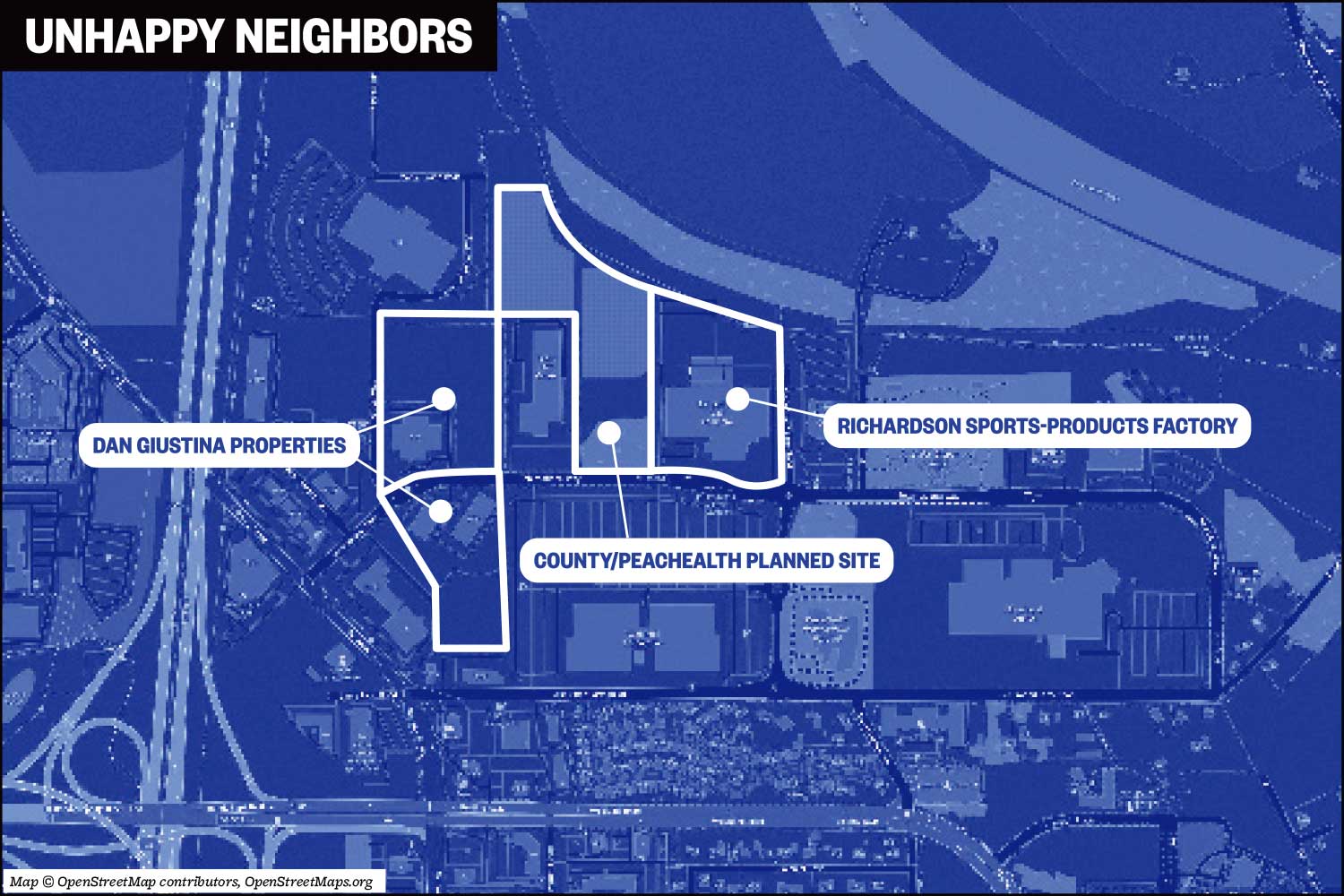
But two prominent local businessmen, real estate investor Dan Giustina and sports-products executive Kelly Richardson, did not cheer. Richardson’s 400-employee factory sits next to the proposed site and Giustina owns three industrial/commercial buildings plus vacant land abutting or near the site. And others were puzzled by the county’s and PeaceHealth’s site choice.
Why? Because Springfield’s zoning code clearly does not allow such a facility on the 18 acres that the county and PeaceHealth picked. The code zones the land “campus-industrial.” It’s reserved for manufacturing and other similar facilities that create jobs and boost the city’s economy, the code says.
And so began Lane County government’s unprecedented, tortuous and often secret drive to muscle aside Springfield’s zoning restrictions, and clear the way for the urgently needed facility.
At the same time, Giustina and Richardson lobbied the city of Springfield and the county, stressing that the city’s campus-industrial zoning prohibited overnight health care beds, a rule that effectively barred the county/PeaceHealth facility. Their opposition to that site peaked three months ago when they filed an unusual lawsuit against the county, PeaceHealth and the state.
A key turning point in the long struggle occurred last June. That’s when the county quietly secured a law from the Oregon Legislature — a “super-siting” law — that lets the county override Springfield’s “campus-industrial” zone’s restrictions and appeals processes on that 18-acre parcel. The county’s lobbyists narrowly crafted the law specifically for that site to sidestep NIMBY opponents.
Without the super-siting law, the county and PeaceHealth would have to persuade the Springfield City Council to rewrite its “campus-industrial” zoning rules, a complex and slow process with no sure outcome. More crucially, if not for super-siting, Giustina and Richardson could contest any rezoning the council passed, tying up the project for years in Oregon’s land-use appeals system.
But the businessmen, in their lawsuit, complain that the county never warned them it was quietly working to strip them of those rights. Their long-shot lawsuit aims to nullify the super-siting law.
And so, a dramatic mental-health-care expansion, a cause for celebration, has become mired in a sticky land-use dispute.
The dispute is also about stealth.
Without its new super-siting power, the county might be dead in the water on this vital project.
Yet almost all the maneuvering that gave the county that power took place behind the scenes, with virtually no public awareness or discussion.
The five-member Board of Commissioners never discussed or voted in public session to pursue super-siting legislation. Commissioner Laurie Trieger, a big advocate of the health project, tells Eugene Weekly she cannot recall who in early 2025 came up with the idea of getting a super-siting law for the county project. The concept may have emerged in closed-door meetings of county staff and a couple of commissioners — herself and Commissioner Pat Farr — or in discussions between county staff and legislative staff in Salem, she says.
“We have an obligation to do everything we can to accelerate this process to get this facility built. That’s why we did this,” Trieger says.
As for the county not alerting Giustina and Richardson to its intentions, Trieger responds: “I can’t and won’t comment on that,” because of the pending lawsuit.
Meanwhile, what does the Springfield City Council think about the new law? Councilors won’t comment. The council never publicly discussed the issue as the super-siting language was being worked on in the 2025 Legislature — even though the bill would override “campus-industrial” zoning rules the council itself had put in place, and even though the city’s lobbyists and lawyers privately haggled for months with the county about super-siting language.

A sprawling fight
What’s clear from interviews and public records is this: The county’s and PeaceHealth’s push for the big behavioral health center on that specific International Way parcel has sparked a complex power struggle.
It’s pulled in county commissioners and staff, Springfield city councilors and staff, PeaceHealth officials and Giustina and Richardson.
The two executives argue that the site the county picked should be preserved for industrial development, and that neighbors’ local land-use appeal rights should not be trampled. They’re uneasy about the planned facility’s clientele, saying it might include overnight RV campers.
The project has split the county board 4-1, with Commissioner David Loveall, who represents Springfield, the “no” vote. In October 2024, he voted for proceeding with the project at the International Way site. But in July 2025 he switched and voted against the county finalizing purchase of the site. The county “overstepped a little bit” in getting the super-siting law, and has antagonized Springfield councilors and residents, he told county staff and other commissioners. He also complained that the county needs to do more to address the facility’s traffic impacts and to prevent camping at the site.
Eugene Weekly asked Loveall for an interview on the topic. In a brief reply email, Loveall says he has “angst… towards the county for what they did to my fair city.”
“I will never stand by and witness malicious wrongs against anyone. … I was elected to stand up for all citizens’ rights EQUALLY,” he wrote, in an apparent allusion to the county’s treatment of Giustina and Richardson.
During a July 2025 commissioner board work session, Loveall also attacked PeaceHealth for “bullying their way into the campus-industrial zone unnecessarily,” noting that the hospital giant owns 75 acres of vacant, developable land next to its RiverBend hospital in Springfield. Giustina and Richardson have leveled that same argument.
Welcome, neighbor
The planned two-building facility might not be everybody’s notion of an ideal neighbor. The county’s building, a “crisis stabilization center,” would be open 24 hours a day, seven days a week, with 28 beds and 14 recliners. It would draw walk-in patients, drop-offs by police and drop-offs by mobile crisis vans, the county says. Its services would include treatment for addiction and substance abuse.
PeaceHealth’s 96-bed building would be an inpatient psychiatric hospital with strictly controlled access and egress.
The dual facility would be heavily used, serving an estimated 12,500 patients a year, including children and the elderly.
The county vows the center would fit in with its neighbors and be well run. Neighbors include not only the 400-employee Richardson Sports factory, but a FedEx sorting center, and office parks with health insurance companies and other occupants.
Oregon state Sen. Floyd Prozanski, who represents Springfield and part of Eugene, says the super-siting law was needed to avoid objections and delays.
“These types of facilities, there are a lot of people who don’t want it in their backyard,” he tells Eugene Weekly. The facility “needed to be expedited,” he says. Springfield officials last year knew the super-siting law was in the works. “They did not have any objection,” Prozanski says.
The super-siting language “is an example of the county and the state working as partners to achieve an outcome that serves the entire community,” Trieger says.
The super-siting language takes up just three-quarters of a page in a sweeping 68-page health care reform bill that Prozanski helped usher through the Senate. The language of the entire bill, including super-siting, was kept under wraps as it was being worked on up until the closing days of the Legislature in late June. It was then unveiled and rushed through, approved by Democrats in party-line votes. The super-siting section received almost no discussion, recordings of the sessions show.
The bill blindsided and dismayed Giustina and Richardson. Their suit, filed in Lane County Circuit Court, names the county, the city, the state and PeaceHealth. The businessmen allege the super-siting law violates their land-use appeal rights and other rights under other parts of Oregon law. They want a judge to rule that those laws take precedence over the super-siting law. The case is unfolding. The defendants all deny the Giustina/Richardson claims.
Giustina and Richardson declined to speak with Eugene Weekly.
With the new law in hand, the county has pressed ahead. Days after the bill was signed into law, the Lane County Board of Commissioners voted 4-1, over Loveall’s heated objections, to buy the site for $7.8 million from its longtime farming owners. The county completed its purchase of the old filbert orchard just days after Guistina and Richardson filed suit. The county, earlier this month, notified the city that it will proceed with the project and invoke the super-siting law.
Long time coming
Lane County has tried for more than a decade to build a center where a wide range of patients — distraught teens, unhoused people who are depressed, adults experiencing a panic attack, people with addictions — could get quick temporary care and counseling, a sort of emergency department for behavioral health. County staff say they evaluated more than 35 local sites for suitability.
The best was county-owned land on Martin Luther King Boulevard in Eugene, across from Autzen Stadium, they said, so they tentatively picked that spot. But game day traffic jams were a negative, they said.
Meanwhile, in 2023, PeaceHealth announced that as part of closing its University District hospital in Eugene, it would build a new 96-bed psychiatric hospital, preferably near its RiverBend hospital, to replace the old 36-bed secure psychiatric unit at University District.
The near-tripling of psychiatric beds would be a godsend for the region, behavioral health advocates said.
PeaceHealth identified the 18-acre filbert site on International Way and approached the county about building a joint facility, records show.
The site was mostly perfect. It was for sale. It was just a couple of miles from the RiverBend emergency department. It was close to major highways. It was big enough for the county and PeaceHealth buildings and parking. And it was inside Springfield’s urban growth boundary, so it could be built on.
The county staff, the majority of county commissioners, and PeaceHealth gushed about the benefits of the site and a joint facility.
The problem of the restrictive zoning was barely mentioned in county documents and meetings in the fall of 2024.
In an October 2024 meeting of county commissioners, the county’s capital projects manager, David Ward, told commissioners the county would “look at rezoning that property… we’re moving to rezone that, with a medical component.”
In the Legislature
In early 2025, the county quietly switched from the idea of asking the Springfield City Council to rezone the site to seeking the super-siting law.
After the Legislature convened in January, there ensued months of back-room wrangling between the county and city of Springfield legal staff and lobbyists over the super-siting language, public records show. Throughout, the county kept its language secret from the city, the city’s lobbyist told the Springfield City Council in a memo last summer. Among the city’s worries about the project: Would it increase traffic jams on city streets and the nearby Interstate 5/Beltline interchange?
The county disclosed its final super-siting language to the city only in the last days of the session in June, the city lobbyist wrote. In the end, though, the county “addressed our most critical concerns,” the lobbyist wrote. The lobbyist wrote that the city — it’s unclear who in the city — decided not to oppose the bill, even though “the city does not support super-siting policies in general.”
Once the bill was signed into law, Giustina and Richardson were left with a daunting option: to try to undo the law itself.
In their lawsuit, they fault the secrecy of the county and of the legislative process, and the scant time anyone — legislators, lobbyists, the general public — had to scrutinize the giant bill.
Giustina and Richardson are prominent names in Eugene-Springfield’s business elite. Giustina heads a family ownership group that owns dozens of major estate holdings throughout Eugene-Springfield and beyond, plus extensive timberlands. Richardson’s factory is touted as a national-level sportswear success story.
Full speed ahead?
Is the road ahead clear for the health-care project?
That’s hard to know.
The supersiting law left intact several technical local land-use hoops the county must jump through.
A key one is this: the Springfield City Council must vote on whether to annex the International Way site into the city limits. Until the property is annexed in, the county can’t legally build on it. Will the council oppose or support annexation? Does it even have the legal right to reject the annexation? There must be a public hearing before the vote. What will the public say?
The county earlier this month filed its annexation request, which will come before the council in the next few months. Annexation applications are typically routine: a landowner wants to annex, explains that the development will obey the city’s existing zoning and other rules, and then gets a unanimous thumbs-up from a happy council.
This annexation is anything but routine. In its paperwork, the county invokes the super-siting law to override the great majority of the city’s “campus-industrial” land-use rules and other restrictions. In effect, the county says, the city is obliged to annex the land and let the project proceed. Does the city agree? That’s not yet clear.
The City Council has the power to deny annexation if it finds a project is not consistent with the city’s zoning and other rules, says city spokesperson Elyse Ditzel. Also, the council can set conditions for annexation and “has the discretion to weigh competing or conflicting policies and determine which are paramount to the city,” she tells Eugene Weekly.
In its communications to the county, the city continues to complain the county has not sufficiently addressed traffic jams the facility might cause, city records show.
More questions
Many questions linger.
Loveall, Giustina and Richardson have asked: Why doesn’t PeaceHealth put the project on its own vacant land next to RiverBend? There, PeaceHealth owns a 35-acre tract of open, multi-family-zoned land that it has listed for sale. It also owns parcels ranging from one to eight acres, totalling 40 acres, that are separated from each other by a web of city streets and access roads.
A PeaceHealth executive told the county Board of Commissioners the joint facility could not be fitted onto any of those pieces. Loveall, Giustina and Richardson don’t buy that.
“The people I represent still have some heartburn with PeaceHealth not being overly transparent with the 75 acres of land they have, of developable property around [RiverBend],” Loveall told commissioners in a meeting last July. PeaceHealth pushed for the International Way filbert orchard site because hospital executives “haven’t figured out yet” what to do with their land, he said.
PeaceHealth anticipates selling the 35-acre residential tract and wants to keep the remaining 40 acres of small parcels “for future services which are required to be located immediately next to the emergency department or operating rooms,” says Alicia Beymer, chief administrative officer at RiverBend. The county stabilization center and PeaceHealth psychiatric hospital “do not require that proximity,” Beymer tells Eugene Weekly. PeaceHealth does not want RiverBend to become “landlocked,” she says.
As for Giustina’s and Richardson’s pitch that the filbert orchard should be preserved for industrial development? County leaders and staff don’t buy that.
The filbert orchard has been designated for industrial use for decades, and no buyer has materialized. Some other corporate or industrial uses in the Gateway area have fizzled: The Sony CD disc manufacturing plant shuttered in 2003 and laid off all its workers. The factory was bought by PeaceHealth and turned into a lab and offices. The former Royal Caribbean call center building has sat vacant for six years and is now for sale.
A religious-facilities loophole in Springfield’s campus-industrial zoning rules allowed the Church of Jesus Christ of Latter-day Saints to build a colossal temple on International Way, a fifth of a mile from the planned county project.
To rebut Giustina’s and Richardson’s arguments, county staff produced a study that found the 18 acres the county and PeaceHealth want for the health center are a fraction of the available campus-industrial-zoned land in Gateway.
The county project “is the continuation of the shift [away from industrial] rather than the initiation of the shift on International Way,” a county staffer told commissioners.
Residents of Springfield and the rest of Lane County “are suffering because we do not have a complete behavioral health care system,” says Commissioner Trieger. “This facility will benefit everyone. It will become a critical piece of our health care infrastructure.”
Bricks $ Mortar is a column anchored by Christian Wihtol, who worked as an editor and writer at The Register-Guard in Eugene 1990-2018, much of the time focused on real estate, economic development and business. Reach him at Christian@EugeneWeekly.com.