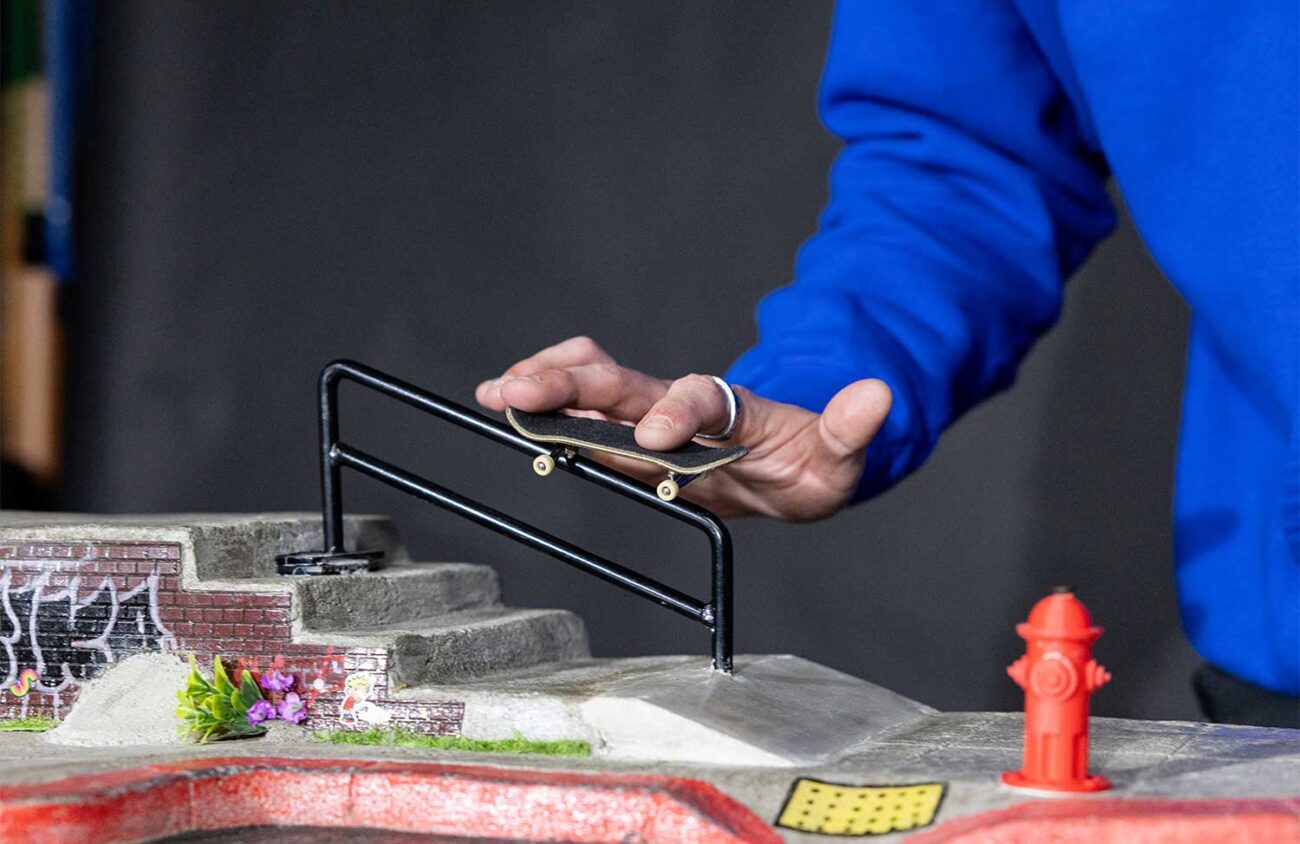
From cars and trains to dollhouses and clothing, people like nothing more than to find something they love and make it smaller. In fact, several Eastern philosophies link miniature objects to spiritual truth — case in point, fingerboarding.
Sitting at the intersection of hobby, craft and sports — fingerboarders use their middle and index fingers to ride scaled-down skateboards. The equally miniaturized courses feature ramps and urban landscapes, complete with curbs, railings and fire hydrants. They’re often built from foam and covered with thin layers of concrete.
It’s a niche pursuit, but dozens in Eugene and many more all over the world fingerboard. It’s the only kind of skateboarding that can be done in a typical indoor space and according to several people Eugene Weekly spoke with, the scene is growing.
Fingerboarding means different things to different people: Some compete, some ride the boards for fun and relaxation while others focus on building the scaled-down courses. Some do it just to master — in the parlance of skateboarding — “gnarly tricks.”
Mallory Curtis from Eugene has turned her passion for fingerboarding into a career. In her Friendly Street neighborhood home, she owns and operates Unique Decks. The company sells custom-made fingerboards with Curtis’ own designs on the boards — also called decks — made from five half-a-millimeter-thick layers of maple. She carefully glues them together and then forms the board in a custom mold before sanding the edges down.
With Unique Decks, like most fingerboards, the trucks — or the bit that attaches the wheels to the deck — are high-quality metal. Likewise, the wheels are plastic with actual tiny bearings, much like a full-sized skateboard. The average fingerboard is about 4 inches long and about 1 inch wide. Compare that to a skateboard, which is often about 32 inches long and about 8 or 9 inches wide.
Curtis supplements Unique Decks’ sales with her second company, The Fingerboard Factory, producing just the maple decks in large quantities. She then sells to other brands so that they can add their own custom design and peripherals like trucks, wheels and grip tape (the surface skaters stand on — or with fingerboarding, place their fingers on).
Ask an avid fingerboarder about “tech decks,” which are effectively the same thing, and they’ll call them entry-level toys, mass-produced with plastic decks, lower-quality trucks and wheels with no bearings. These toys typically cost about $20. Curtis’ boards, on the other hand, are definitely for the serious fingerboarder. She sells them online starting at $45 and promotes her business through Instagram. Custom or high-end fingerboards from name brands like Blackriver and Dynamic cost at least $100, and some rare, limited-edition fingerboards cost thousands.
Curtis’ fingerboarding colleague and friend, Spencer Hovland, 26, also from Eugene, has fingerboarded since he was a kid, and says he picked it up again around 18 or 19. Last April, he built a tiny concrete fingerboard park near the Ferry Street Bridge, available for the public to use. And about two years ago, he built his own portable fingerboard course, a shrunk-down cityscape with graffiti, curbs, steps and more, to land tricks on.
Those tricks are much the same as skateboarding tricks, like heelflips, spins, grinds and slides. Except in this case, they’re performed just with fingers. (Hovland used to skateboard, too, but refocused on fingerboarding in 2020 when he broke his wrist. Then, he gave up skateboarding for good three years later, when he suffered a bad fall, leaving half his face covered in road rash with holes in his lip and a broken nose.)
According to Curtis and Hovland, most fingerboarders also make videos, which they typically share online, and some fingerboarders make money from the content. Hovland shares his videos — created both indoors and outdoors — on Instagram under @Ride2RelaxFB.
Most often, they’re angled to show nothing but the board, the fingers, and the model course, ramp, or obstacle. With accompanying music, there’s a meditative quality as the small skateboard cruises serenely through a small world Hovland created.
Fingerboarders do compete, Hovland says, comparing fingerboard pioneer Mike Schneider to Tony Hawk, the champion skateboarder often credited with mainstreaming full-sized skateboarding in America. But like regular skateboarding, there’s some controversy around adding a competitive element to fingerboarding, as some feel it should be about personal achievement and community, unlike other sports.
Even so, Hovland says fingerboarding competitions, which happen all over the world, are judged on trick execution, but also on how well the fingerboarding creates the illusion that the trick is performed on two legs.
Daniel Cornwell is a nationally ranked fingerboarder who competes nationally and lives in Eugene. “I focus very heavily on filming clips and posting edits,” Cornwell says on Instagram as @dlc.fb. “I have grown a recent interest in making fingerboard obstacles out of cement,” he says, explaining he spends up to eight hours a day on the hobby.
Trucks, wheels and heel flips aside, Curtis calls fingerboarding a community. “I know people literally all over the world that I could just go sleep on their couch,” she says. “This is my art,” she adds, “basically, like my creative outlet.”
“It gives me a sense of freedom,” Hovland says. “I could never do this in real life,” he adds, referring to the tricks he performs and the varied tiny environments he performs them in. “So, I make a miniature version,” Hovland says.
“At the end of the day,” Cornwell says, “we are just a bunch of grown-ups pretending to be architects in a little world we made for our hands.”
To get your own Unique Decks board, visit UniqueDecks.co.