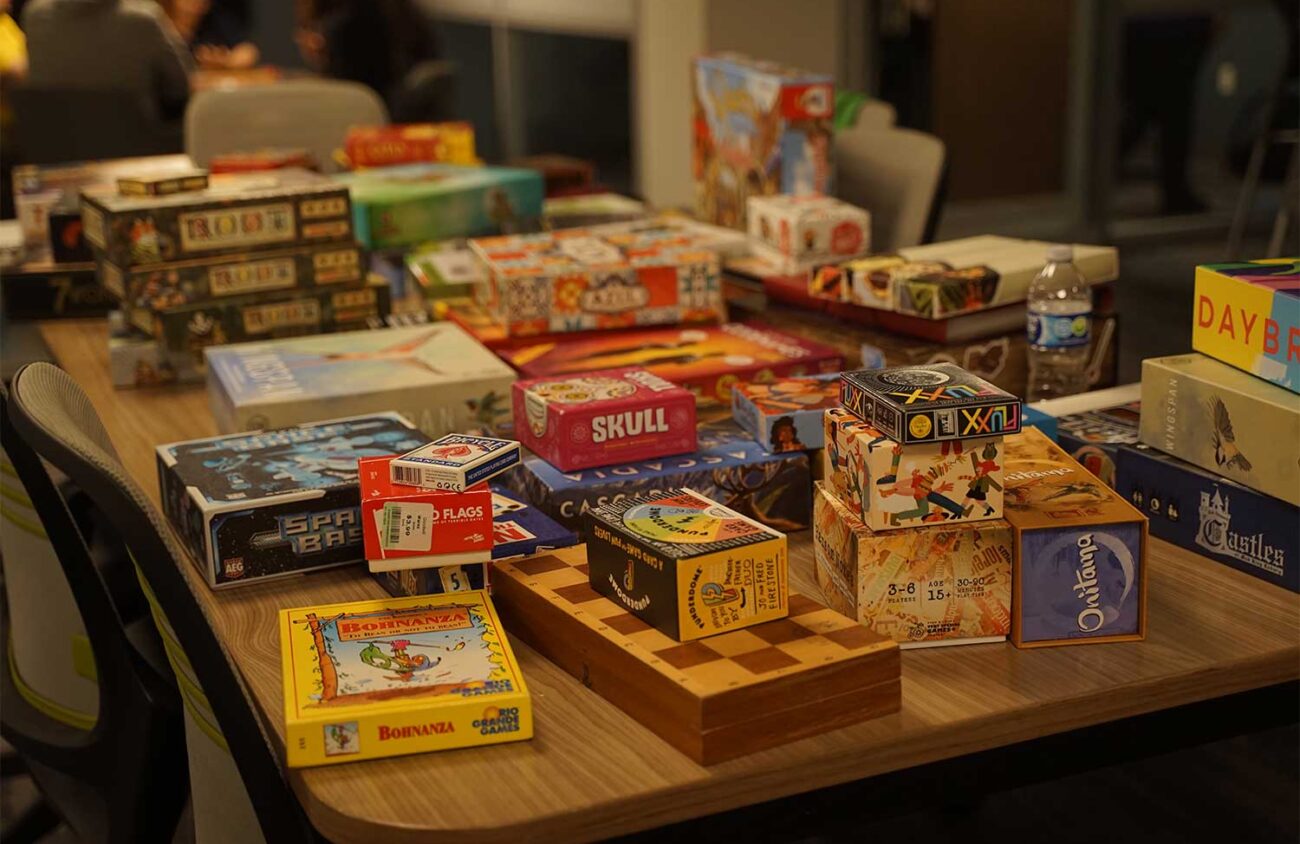
The year was 2021. Ryan Rudd shuffled his feet to avoid the playing cards and game pieces littered on the floor of his dorm room at the University of Oregon. Sitting at his desk, piled high with board games, Rudd scrolled through the club offerings. The Magic the Gathering Club was not quite up his alley, and the chess club was long dead. Rudd thought, “screw it.” He opened Engage, UO’s club portal and registered for a new club — the board game club.
Attendance remained in the single digits for the first year, but the damage was done. A seed was planted.
The Board and Card Gamers’ Association for Maximum Nerdery (BACGAMN) meets on Wednesdays at 6:30 pm in the Knight Library’s DREAM Lab. Open to students, faculty and community members alike, the club hosts over 30 participants a week. The group games until 10:30 pm, but people are known to show up early and continue for eight to 12 hours, say game masters Ellie Urbancic and Juniper Lui. The group contains a diverse membership, with an overwhelming number identifying as queer and neurodivergent.
“That’s been something really interesting and exciting to watch happen,” Urbancic says. “These people who don’t necessarily feel like they fit in all the time to have a community where they feel like companionship and a place they can get to know people over, like a common activity.” Urbancic, who identifies as autistic, says the structured community aspect of BACGAMN is extremely important to her college experience. “Board games kind of level the playing field, so to speak, and provide kind of a shared goal for everyone who’s involved,” Urbancic says.
Board games have specific sets of rules, and players communicate through those rules. In some games, players work together, while others require lying or trickery. Nonetheless, players are “locked in together,” Lui says.
Gaming groups get together week after week to play the same game. Club president Charlie Kirkendall says it, “helps you draw yourself to other people who are like-minded.”
Mike Urbancic, a teaching professor of economics at UO and Ellie’s dad, began advising the club in 2022. He’s noticed that board games simplify the social script, or the expectations neurotypical people have going into social interactions.
“With the support and comfort and confidence board games build, hopefully that’ll translate to other things socially beyond the games themselves,” Mike Urbancic says. He says his club advisor role helps him develop relationships with students on a one-on-one basis.
“These masses of folks are people with experiences and feelings and challenges,” Mike Urbancic says. “It’s important for me to remember how students are facing these challenges of their lives and how I approach my work.” The games range in strategy and difficulty. Ellie Urbancic says party games such as Splendor, Ransom Notes or Anomia are the most popular. Pros might challenge themselves to a game of Terraforming Mars or Twilight Imperium. Ellie Urbancic is partial to Daybreak, a cooperative game about stopping climate change, based on real-life efforts. Each card has a QR code that players can scan to learn more about the efforts. “Science communication and public outreach is definitely a strong interest of mine,” Ellie Urbancic says. “The amount of effort and detail that was put into crafting the game is really incredible.”