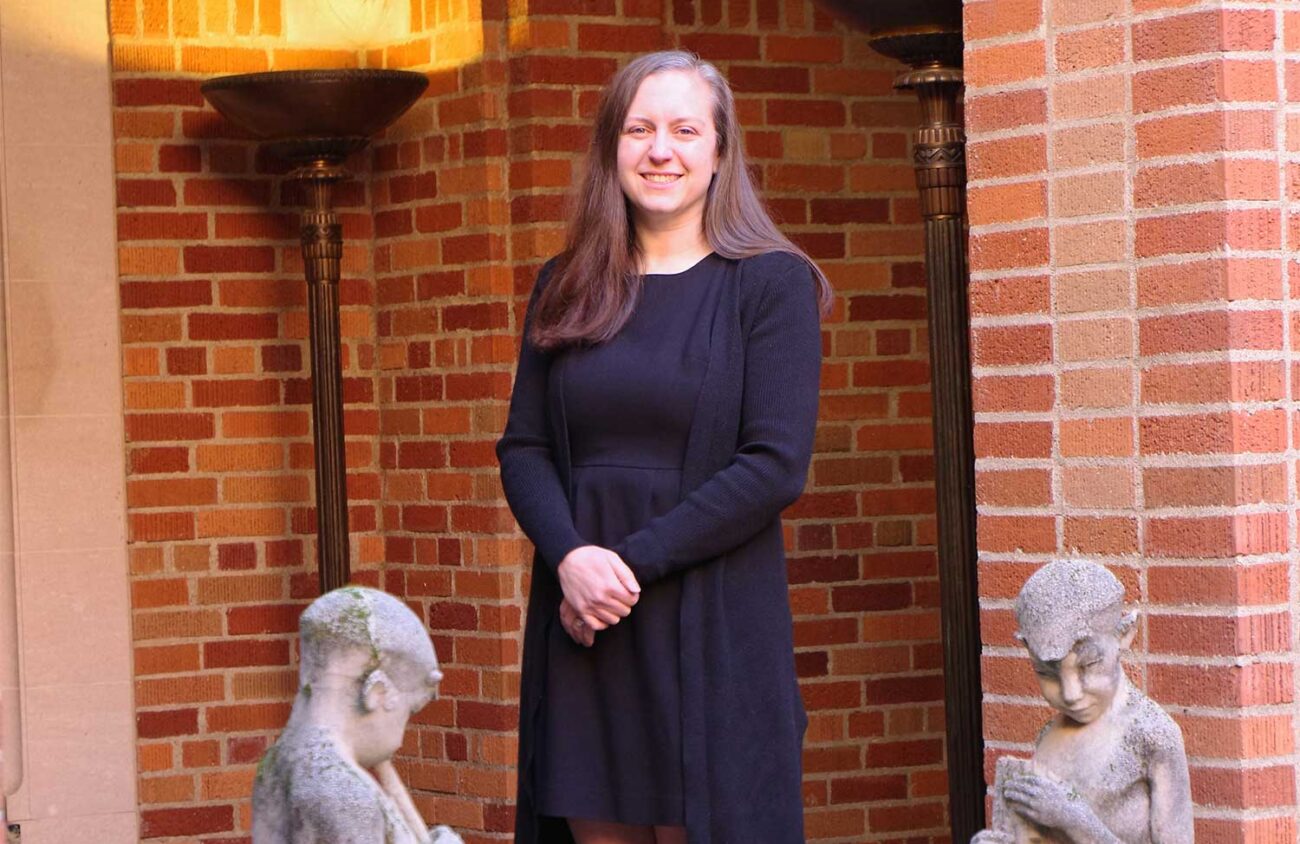
The folding chairs were not typical for the Barker Gallery.
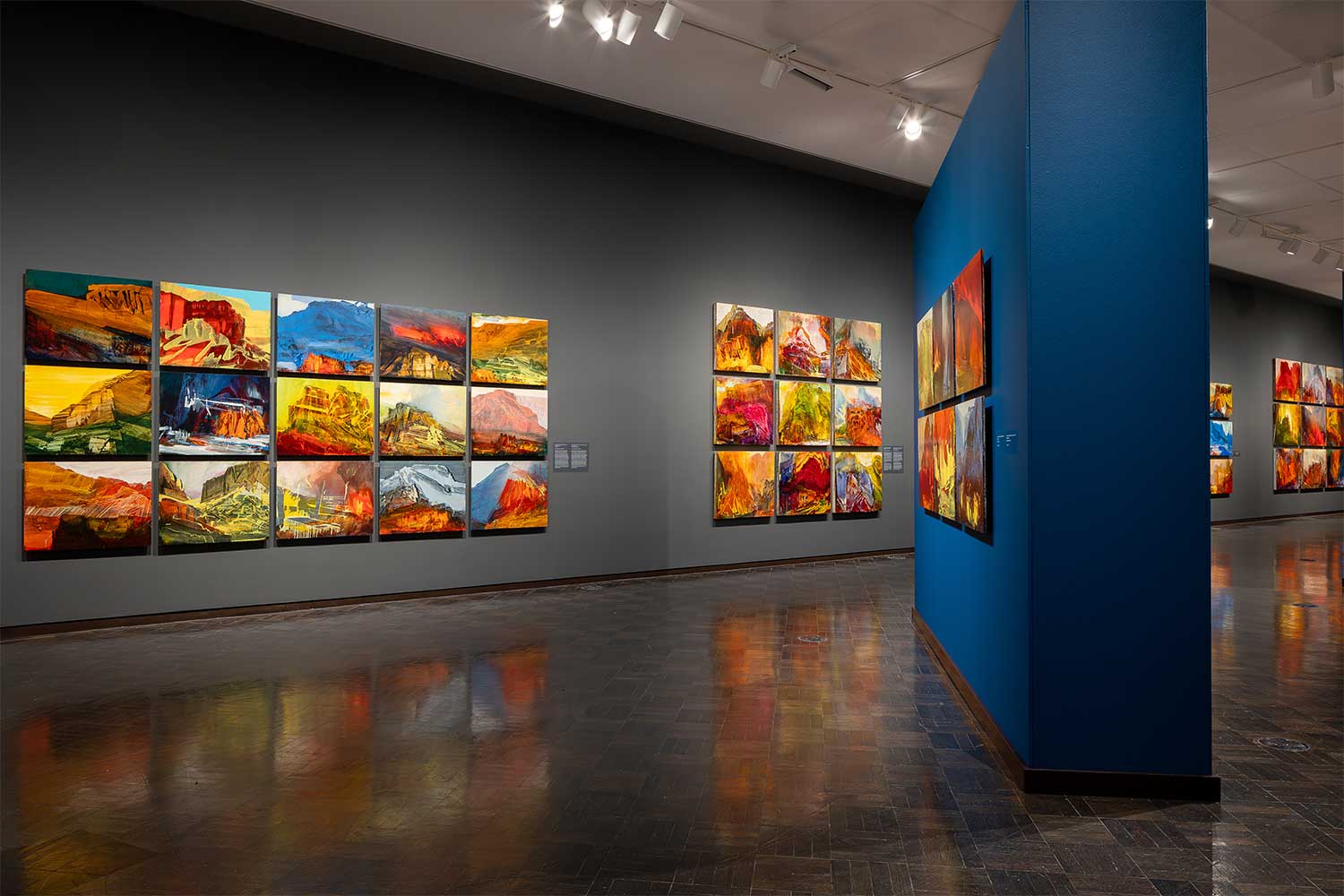
Visitors usually drift through the primary gallery at the Jordan Schnitzer Museum of Art quietly, contemplating the art before moving on. But on this January afternoon, chairs filled the center of the room beneath grids of paintings that glowed against the walls. When the seats ran out, people stood along the edges. They leaned in and listened to the informal conversation unfolding in front of them.
At the front sat the show’s young curator, Danielle Knapp and its older artist, James Lavadour. They had chosen this place for an interview with Eugene Weekly about what it’s like for a curator to prepare an exhibit of work by a well-known artist who has been painting for longer than she’s been alive.
Knapp, hair pulled into a tight bun, leaned forward and listened attentively. Across from her sat Lavadour, 74, and a member of the Confederated Tribes of the Umatilla Indian Reservation, in a cowboy hat and wire-rimmed glasses, his gray beard resting against his jacket collar. On the gallery walls, thick bands of electric orange, weathered yellow and deep charcoal surrounded them — colors drawn from the landscape of Eastern Oregon and his Umatilla Indian Reservation.
It was the closing weekend of James Lavadour: Land of Origin, a retrospective at the University of Oregon’s JSMA that Knapp spent three years creating. The exhibition gathered decades of the artist’s work into one room — paintings rarely seen together.
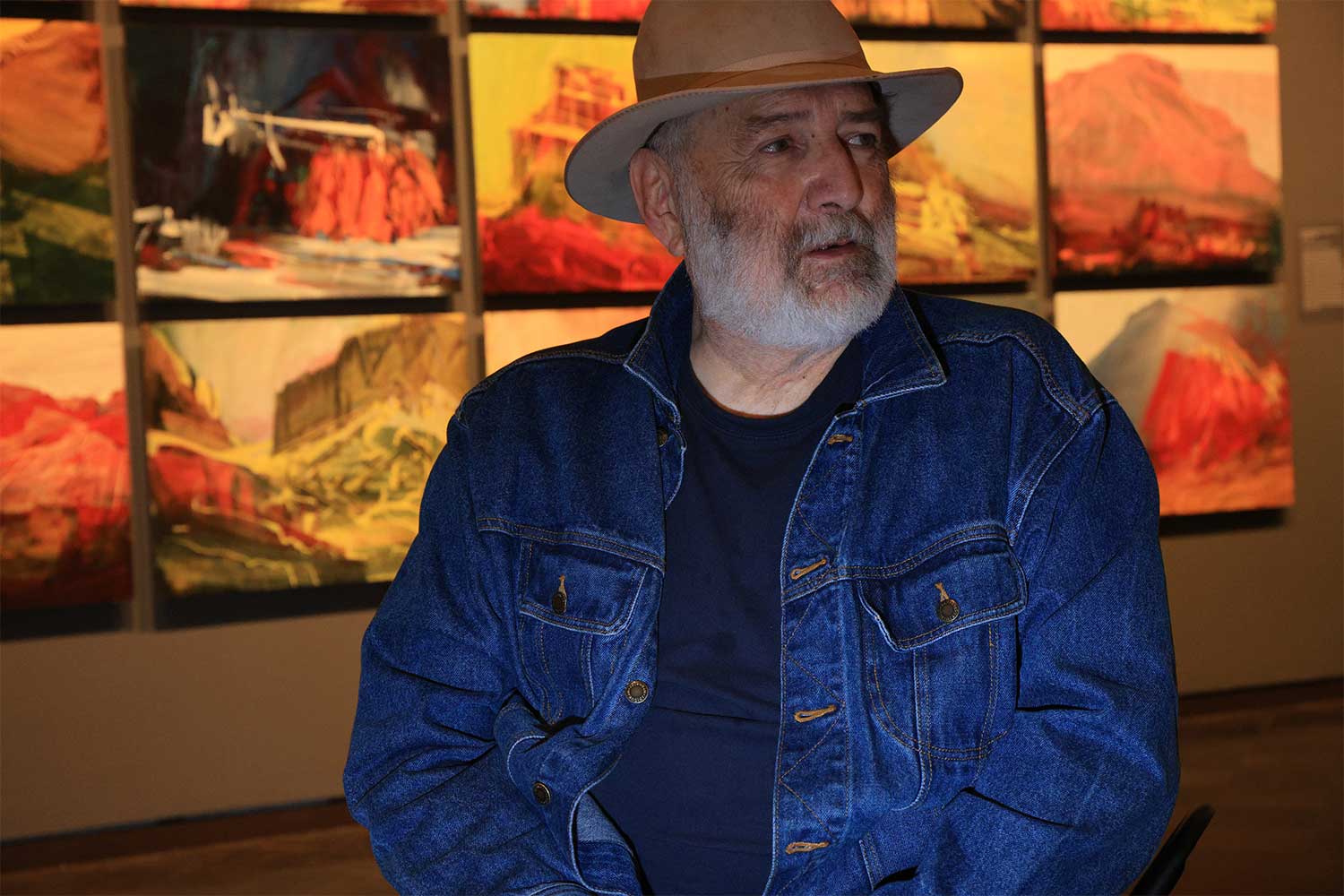
Knapp asked Lavadour what it felt like to look back at his entire career.
He paused and scanned the walls.“It was dreadful,” he said.
Most mornings, Lavadour greets the sunrise on his Umatilla homelands, walking or driving through the land before most people wake. Building the exhibition with Knapp interrupted that forward motion. It required him to confront decades of work at once, as paintings he had made separately now formed a conversation across time.
Knapp understood the weight of that request. Curating Land of Origin demanded years of research, negotiation and trust. Paintings arrived from private collections and institutions across the country. Each addition shifted the balance of the gallery. She adjusted spacing, reconsidered chronology and altered lighting. Lavadour retained final approval, but the installation required him to let Knapp shape how his life’s work would be understood.
As the visitors clustered around him — thanking him, asking questions, lifting phones for photos — the room felt alive, anchored by the paintings on the walls and sustained by the shared presence of the artist, curator and audience.
At the JSMA, Knapp holds the title of McCosh curator, a position named for painter and former University of Oregon professor David McCosh. She preserves and activates his legacy while connecting his archive to contemporary artists rooted in the region.
McCosh arrived in Eugene in 1934 after studying at the Art Institute of Chicago. He planned to stay one year, but remained until he died in 1981. He taught painting, drawing and lithography and helped establish the foundations of the university’s art department. His work — rooted in the rivers, valleys and fields of Oregon — helped shape the region’s visual identity.
The museum houses more than a thousand of his works: oil paintings, watercolors, drawings, prints, travel slides and oral history recordings. The archive offers an unusually complete record of McCosh’s life.
“Everything the artist made was right in front of me,” Knapp says. “That’s why this archive is such an incredible resource.”
Knapp did not set out to become a curator. As an undergraduate at Eastern Washington University, she planned to teach high school history. During her freshman year, she enrolled in an introductory art history course to fulfill a requirement.
“Studying art history felt like I was reading someone’s diary,” she says. “It felt like I was there.”
Encouraged by a classmate, she began visiting local museums and secured an internship at the Northwest Museum of Arts & Culture in Spokane, where she shadowed curator Ryan Hardesty. Her days revolved around the practical work of exhibitions: placing vinyl lettering on walls, preparing paintings for transport and watching how shows took shape piece by piece.
During one walkthrough, she stopped in front of a wall labeled “The Northwest School.” Paintings by Morris Graves, Kenneth Callahan, Mark Tobey and Guy Anderson surrounded her — artists grouped together after a 1953 Life magazine article dubbed them the “Northwest Mystics.” The label suggested a shared spiritual sensibility shaped by the region, though the artists resisted being flattened into a single category.
“I didn’t recognize a single name,” she said. “I was about to graduate with a degree in art history and I had never heard of the artists on the wall in my local museum.”
The realization unsettled her. A rich artistic history had unfolded around her, largely absent from her coursework. She shifted her focus away from the traditional art capitals of Paris and New York toward the rain-soaked landscapes and artists of the Pacific Northwest. She visited Eugene while exploring graduate programs and felt drawn to the UO’s art history department. She enrolled in the two-year MA art history program in 2007 and began interning at the JSMA, working closely with curator Larry Fong.
“When she was an intern, I realized she was incredibly prepared and inquisitive,” Fong says. “She was always asking challenging questions.”
Encouraged by Fong, Knapp began researching Pacific Northwest art in depth. That decision led her to McCosh’s work. Around the same time, the museum’s director at the time, Jill Hartz, launched a fellowship dedicated to researching McCosh’s archive. The position was intended to last one or two years. It expanded as the scope of the collection became clear.
What began as a fellowship evolved into Knapp’s long-term curatorial role.
As a curator, she creates the conditions for looking at paintings on a wall. She studies the distance between frames, tracks how light falls across paint and considers how chronology shapes understanding. She builds exhibitions so visitors move intuitively through space, guided as much by placement as by wall text. Museums do not simply store art; they shape how it will be seen, studied and remembered.
Land of Origin demanded that kind of attention on a larger scale.
Loans arrived from across the country. Each shipment forced new decisions about scale and sequence. Knapp weighed every addition against the limits of the Barker Gallery, rearranging the work again and again until Lavadour’s presence could be felt and the exhibition carried the weight she had been working toward.
Lavadour trusted Knapp’s vision.
“Danielle is an amazing researcher and writer,” he said. “I’m really honored that she put the time and effort into creating this.”
Eugene artist Margaret Coe, a former student of McCosh and longtime collaborator with Knapp, has observed that balance firsthand. In 2017, Coe worked with Knapp on Our Lives in Paint, an exhibition featuring her work alongside that of her late husband, Mark Clarke.
“She understands the material deeply, but she also makes artists feel seen,” Coe says. “I think of her as a representative of Northwest art.”
Every decision Knapp makes — from the works she identifies as career-defining to the language she uses to frame them — contributes to the historical record future scholars will inherit.
Knapp has begun laying the groundwork for a catalogue raisonné of McCosh’s work, a comprehensive scholarly record that will take years to complete. “The longer I work here, the more I realize how much I still have to learn,” she says. “And that’s the beauty of museum work. You get to be a student forever.”
On runs through Alton Baker Park or along the winding trails of Mount Pisgah, Knapp notices moments that echo the landscape McCosh spent a lifetime translating into art — the soft layering of greens, the gentle tonal changes across the ground and light drifting across the hills. She calls them “McCosh moments.”
Back in the Barker Gallery, visitors pressed closer to Lavadour. They thanked him and asked about his process. Knapp stepped aside and watched, shedding a few tears of gratitude.
For three years, she built the exhibition piece by piece. Now the paintings carried the room on their own. She wiped her eyes.
Soon, the chairs would disappear. The walls would clear. Another exhibition would take its place. But for that afternoon, the young curator and the old artist stood among the work that bound them together.
After its run at the JSMA, from August 9, 2025, to Jan. 11, 2026, Land of Origin began touring Northwest museums, with its next stop at the Northwest Museum of Arts and Culture in Spokane, where it will run through June.