By Declan Zupo
In early 2026, a student whistleblower leaked information from a closed-door meeting at the University of Oregon, where administrators proposed selling dirty energy generated from fracked gas to our local public utility, the Eugene Water and Electric Board, as sustainability. This program could raise campus emissions by 65 percent, further solidifying UO’s role as the single largest climate polluter in Eugene. Even worse, the whole partnership between these two public institutions occurred without public oversight or involvement.
You might have seen this in the local news, where the Office of Sustainability and EWEB have used a series of distorted talking points to cover up and complicate a very simple story.
So let’s get some facts straight.
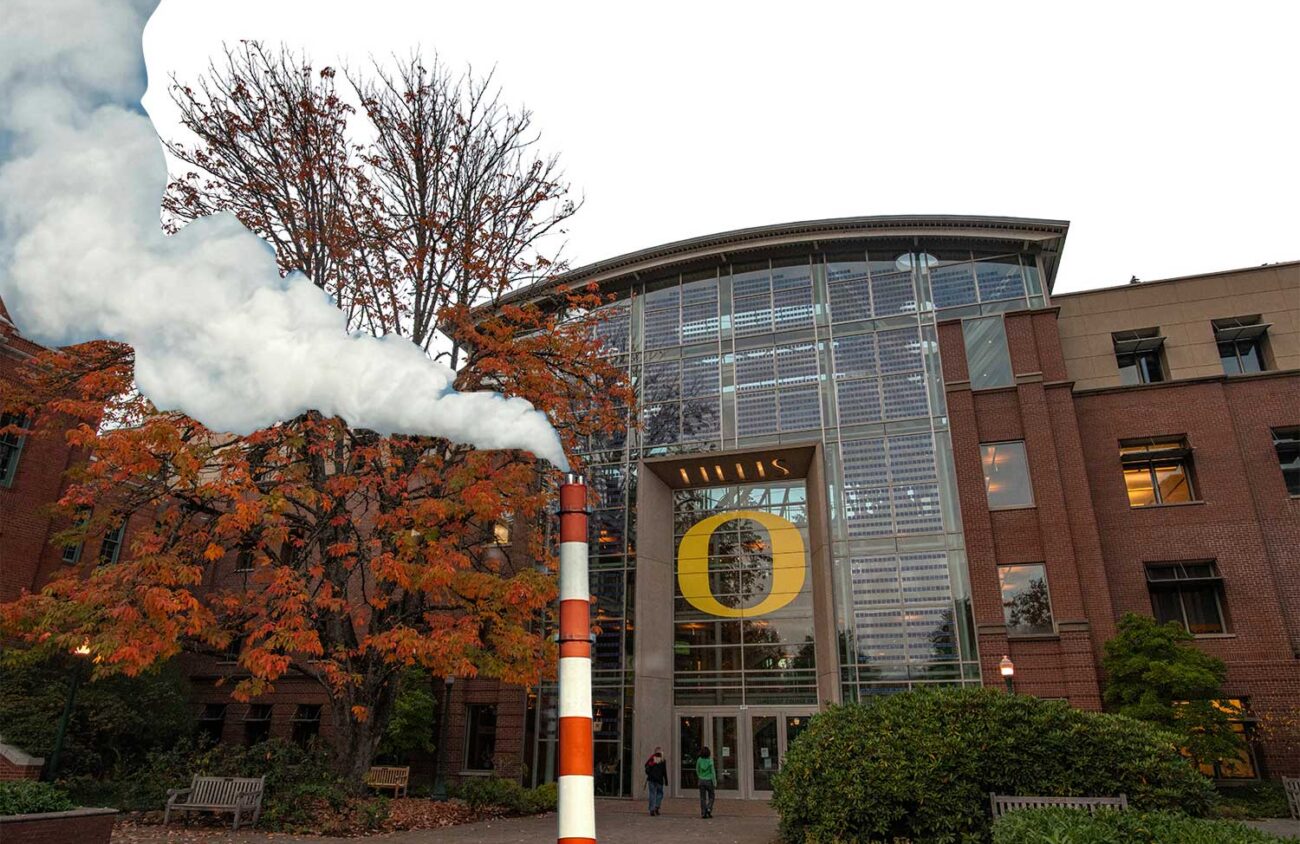
The University of Oregon is the single largest source of fossil fuel emissions in Eugene because it burns natural gas to heat the campus. This gas is purchased from NW Natural, a gas giant whose former board member, Tim Boyle, sits on the UO Board of Trustees.
Interestingly, Boyle founded and heavily funded the political action committee that lobbied for the UO board’s establishment in 2014. Fellow board members have insisted that Boyle’s relationship with NW Natural in no way influences our university’s continued reliance on natural gas.
Advocates are more skeptical.
For over a decade, students, faculty and community members have worked tirelessly to reduce emissions from the UO’s heating system, a methane-based system that is a hazard to public health and our environment. This relentless pressure led university administrators to marshal and fund a Thermal Transition Taskforce, which in turn led to multiple independent studies that laid out a roadmap for sensible decarbonization.
These findings were presented to the board in 2024 with a recommendation to electrify one of the university’s two gas boilers, whose combined emissions total nearly 25,000 tons of greenhouse gases a year. Partial electrification would result in an immediate 45 percent reduction in these emissions. This recommendation came alongside a letter from elected representatives, community leaders, students and faculty, as well as impassioned public comment demanding electrification as a first step toward campus carbon neutrality.
Two years have passed, and this pivotal vote to cut emissions by 45 percent remains in limbo. This is despite Paul Langley, head of campus utilities, admitting to students that the gas boiler set to be electrified has expired and is due for replacement.
In the absence of this critical vote, the UO Office of Sustainability, which once championed this decarbonization plan, is pursuing new “revenue-positive” sustainability measures; the new gas turbine pilot is one example. This turbine will create energy to be sold to EWEB during winter months, when Eugene’s grid could approach peak load. EWEB and UO sustainability argue that this is necessary because of a projected regional increase in energy demand driven by data centers and electrification. The rebuttal from community advocates and energy policy experts has been clear: This projection is not based in reality.
The study cited by the UO to justify this blatant backslide is regional, ignoring, among other things, the absence of data centers in Eugene, Eugene’s priority access to clean hydropower, the utilization of energy storage to curtail peak energy demand, and the possibility of moderating large loads to address emergent adequacy needs. Many of these measures have been used by EWEB in peak load events and represent accessible non-carbon-intensive solutions to meet local energy adequacy.
UO Sustainability and EWEB have failed to respond to these critiques, leaving students and community advocates to hold our public institutions to their imperative climate commitments.
This unilateral expansion of emissions seals UO’s failure to meet the goals outlined in its first and second Climate Action Plans, which called for carbon neutrality by 2050. For EWEB, this project is a direct deviation from its policy SD 15, which mandates a 95 percent carbon-free energy mix by 2030.
Even worse, these failures are playing out against the backdrop of a recent presentation to Eugene City Council showing that only one-fifth of the emissions reductions required to meet our 2030 climate goals have been achieved.
It is untenable that our public institutions remain a part of this problem.
This problem can no longer be left to UO students to address in their free time; elected officials at the state and local levels must take action to regulate our city’s biggest polluter.
To learn more and get involved in the fight for a clean energy future, visit @ClimateJusticeLeague on Instagram or email ClimateJusticeLeague@gmail.com. Declan Zupo is a Wayne Morse scholar and political science student completing his undergraduate degree at the University of Oregon, who has spent the last four years working to regulate Eugene’s single largest climate polluter, the UO.