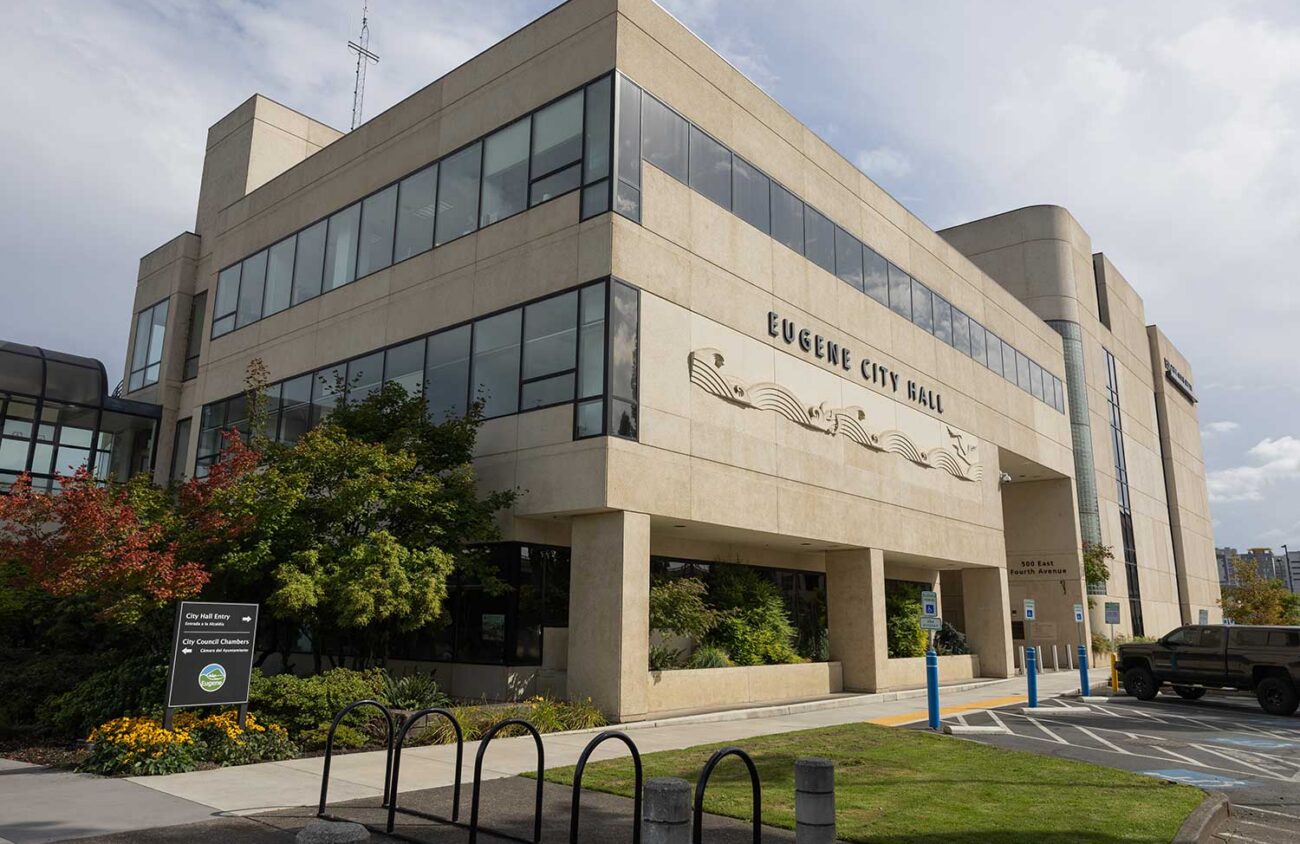
The Eugene City Council is holding a public hearing on a proposal to adopt a home energy score disclosure requirement. Advocates describe home energy scores as helpful to homebuyers by rating a home’s energy efficiency when it is listed for sale.
The University of Oregon, the Eugene Water and Electric Board and the city of Eugene rolled out a voluntary home energy scoring program for low-income homeowners and renters in 2017. This program is currently discontinued due to a lack of staffing, according to Sarah Stoeckl, UO’s associate director of sustainability.
In 2019, the Oregon Department of Energy announced a partnership with nonprofit Earth Advantage to offer a voluntary statewide scoring program. Eugene’s proposed ordinance would make energy scores mandatory for dwellings when they are listed for sale.
Advocates for the ordinance say it will save homeowners money, and could help the environment by incentivizing home buyers to seek residences with more energy efficient infrastructure. “The more information people have, the more informed decisions they can make about energy efficiency upgrades in their home,” says Meredith Tufts, coalition coordinator for environmental nonprofit Fossil Free Eugene.
On Sept. 21, the City Council plans to hold a public hearing on the proposed ordinance.
According to the U.S. Department of Energy, a home energy score is determined by an assessor who looks at approximately 50 data points such as the amount of insulation, how well ducts are sealed, whether the home uses a gas or electric water heater and the style of the roof.
These factors contribute to a final score between one and 10, with one being the least efficient and 10 being the most. When an assessor inputs data into an online scoring tool, a report is generated that provides not just the score, but also an estimate of how much money could be saved on bills by making improvements.
The only scoring model fully approved by the Oregon Department of Energy is the U.S. DOE’s model. Other scoring models are only conditionally approved.
The DOE report includes an individualized list of energy retrofit improvements that could pay back their cost in energy savings. According to the city of Eugene, each assessment currently costs the seller approximately $150 to $300.
Tufts says requiring an energy score for each home sold could help buyers take advantage of rebates and incentives they might have otherwise not been aware of. “For instance, if someone’s moving into a home that has delivered oil heat, there’s rebates available from the state to weatherize those spaces, but if they change that heat source to a heat pump first, then they wouldn’t be eligible for those,” Tufts says.
The State Home Oil Weatherization Program offers lifetime maximum cash payments of up to $17,600 for low income households seeking to improve eligible insulation measures and use fuel oil to heat their home. For above-low income households, the program offers a lifetime maximum of $6,600.
Mike Clark, Eugene city councilor for north Eugene’s Ward 5, voted to send the energy score ordinance to public hearing, but had voted against it in March. “I want to work to keep housing as affordable as humanly possible, and so I don’t want us to do anything that duplicates efforts and as a result increases costs that people have to pay for housing,” Clark says. He adds that on Nov. 2, a new home appraisal form will be rolled out.
The form uses a new data set that includes a section requiring the home appraiser to analyze the home’s energy efficiency. “I’m hesitant to mandate that buying a house costs more money if it’s information that’s going to be given to the person anyway,” Clark says, adding that he is unsure of how he’ll vote on the measure and has not had all his questions answered yet.
The public hearing is 5:30 pm Sept. 21 at City Hall, 500 East 4th Avenue. Register to testify by completing the “request to speak” form at Eugene.or.gov. Written testimony may be sent to the Eugene City Manager’s Office, 500 East 4th Avenue, Suite 302, Eugene, OR 97401.