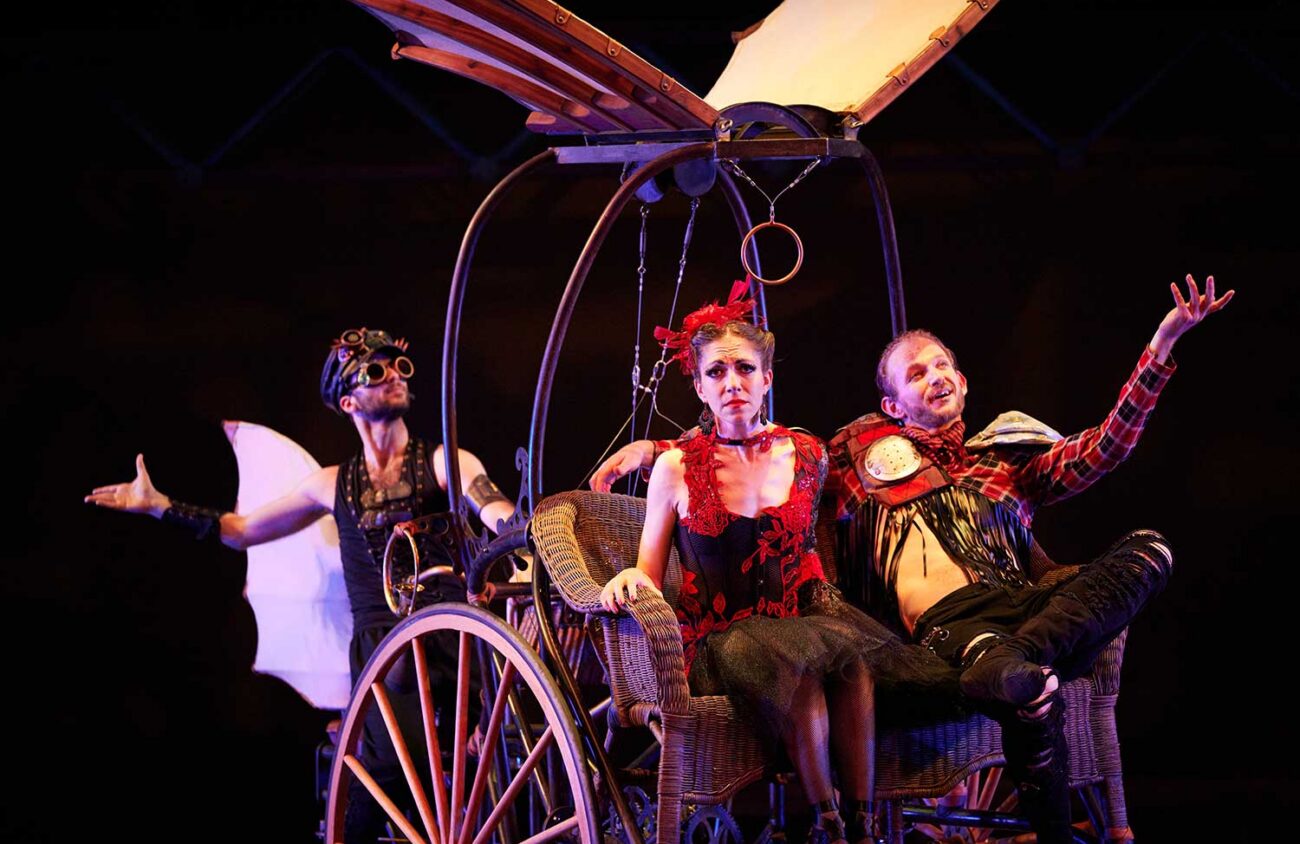
One of Shakespeare’s most controversial comedies has long been The Taming of the Shrew. It follows the story of Bianca, who is well-loved by all the land and lives joyfully at the hands of suitors vying for her attention. However, due to her protective father’s rule, Bianca can’t marry until her much-disliked and headstrong older sister Katherine finds a husband first.
In the original play, when Katherine is forced to marry, her husband trains her into submission until she becomes soft and good-natured — hence “taming” the “shrew.” When Bianca finally gets married in the show’s conclusion, she is revealed to be the more difficult wife.
Like all Shakespearean pieces, it has been updated and modernized in many ways — you might recognize the first half of the summary from the 1999 Heath Ledger romantic comedy 10 Things I Hate About You.
In 2021, Eugene Ballet’s founder Toni Pimble took the play into her expert hands, to reinterpret the often-considered misogynist play, into a stunning steampunk-inspired piece that explores agency in womanhood, emotional nuance and the importance of teamwork and falling in love.
The show ran in 2022, and four years later, Pimble returns as choreographer to lead the 2026-2027 season with Taming of The Shrew once again. Also returning are the two leads, married couple Danielle Tolmie as Katherine and Mark Tucker as her suitor, Petruchio — whom Pimble developed the 2022 ballet specifically around.
The show opens with Shakespeare himself writing viciously penning the story with a large feather quill, in garish 19th-century garb. Shakespeare stands up, and the music swells as he faces the audience — and is revealed to be a woman, played by Eugene Ballet’s associate artistic director Suzanne Haag, wearing a large, shimmering gown.
Immediately, it’s clear that this is going to be different.
Pimble’s take on Taming is based around the theory that Shakespeare had a ghostwriter named Emilia Bassano — an Italian Jewish woman in London who was an author and a playwright at the same time as Shakespeare.
In staging the interpretation through Bassano being the true author, Pimble leans into Katherine’s strength mixed with torment and hopelessness over being forced into an arranged marriage, while highlighting how Petruchio is financially desperate and thus needs to wed into her wealth. Pimble says this emphasis creates a story where “they are trying to figure out how to make that work, so that instead of killing one another, they end up loving one another.” Capturing this love and its complexity, she says, was her priority.
Part of how she accomplished this was through the music. Pimble handpicked pieces of music by French 19th century composer Louise Ferranc, who Orchestra Next director Brian McWhorter says is “criminally underperformed.” Pimble says Ferranc’s 19th century music lends to the show’s steampunk theming as opposed to setting it in Shakespearean times. “I don’t think there is an audience in the world that has been treated to so much of her music in one evening,” McWhorter says.
As far as the ballet itself, Tolmie delivers a deep and beautiful performance as Katherine. To bring humanity to a character who has been known for hundreds of years as by “shrew” more so than by her own name, is a large undertaking. The sass and fire she brings to Katherine’s more snarky scenes are powerful, and, when intentional, hilarious.
But there is another element that adds to Katherine’s strength: Tolmie gave birth to her third child in June, just three months before rehearsals began. She says that staying strong during her pregnancy so she could be back ready when the season started was at the front of her mind, but that the music and setting brought her muscle memory back to the forefront.
Of all the ballets that she’s done, “you get very, very few roles in your career that feel as meaningful as this one is to me.” She says that with portraying Katherine, “it’s very rare to have such an arc.” In ballet, she says characters are “one-dimensional like you’re sweet the whole time, you’re angry the whole time.”
By the end of the first act, she exhibits horror, embarrassment and depression as she realizes what her new life is about to look like. A solo performance before intermission gives the audience an intimate moment with Katherine, as she lets her guard down and shows us that even someone as strong and independent as her can truly be hurt.
Other standouts include Koatsu Yashima and Koki Yamaguchi as Bianca and her suitor Lucentio. Yashima truly steals the show, with moments of mechanical perfection as she spins like a doll in a music box, and others where she practically soars across the stage.
After four years, Taming has returned, fine-tuned, stylish and continuing to center women’s resilience.
Eugene Ballet’s Taming of The Shrew is 7:30 pm Friday, Oct. 30 and 2 pm Sunday, Nov. 1. Tickets start at $32 and are available at HultCenter.org.