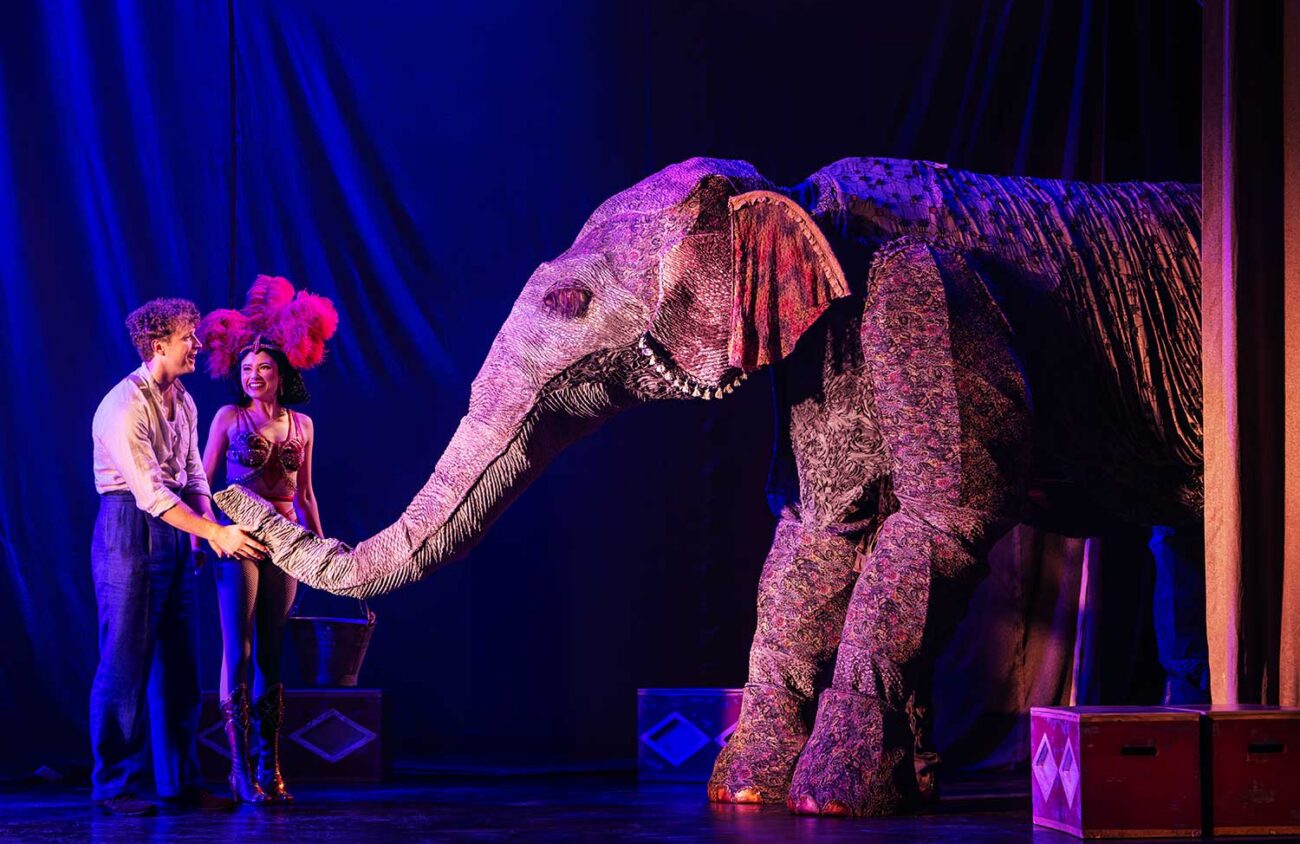
Setting up the large production of the Broadway show Water for Elephants on the Hult Center stage, Nov. 6 through Nov. 8 is a gargantuan task. The musical, based on the 2011 film of the same name (which in turn was based on the 2006 novel also of the same name) is about a young man who runs off to the circus, caring for the animals and falling in love.
While it has all the markers of your typical touring show, including a musical theater ensemble and a live orchestra, it also has a third element that is unique to this production: a circus team.
The production crew includes dozens of acrobats performing trapeze and aerial silks. It also includes intricate puppets of all shapes and sizes. This means that all the stunts are real, and all the animals are not.
Riley Gibson is the production stage manager, and his job is to ensure that the theatrics and circus elements blend together seamlessly, long before the curtain rises.
He says that in this show, “the circus is being used for storytelling and not just for visual appeal.” Since the circus goes beyond the spectacle, it’s extra important that the large scale production goes off without a hitch each time. Here’s the behind the scenes of how it all gets put together.
The Puppets
There are dozens of circus animal puppets throughout the show, both operated handheld onstage by actors, or manipulated offstage by professional puppeteers.
One of the most distinctive features of Water for Elephants is the pachyderm herself, Rosie. “Our large, incredible Rosie,” Gibson says, is a 200-pound elephant puppet made with a bamboo frame. On stage, she is operated by three people. “There’s someone between the front legs and someone between the back legs,” Gibson says. They strap themselves into her, and, in a sitting position each “have one hand in each of her legs, and like they move her legs as they walk.”
The third person is a puppeteer who is seen onstage, motivating her trunk (and she has three, separate trunks). All three of the puppeteers work to move her eyes, ears and tail.
“Rosie time is a fun experience because you learn to think of ‘how would this 2000 pound elephant walk? and how can I make that the same process, while I’m walking a tent?” Gibson says, “because it does feel like you’re sitting inside a large tent.” Rosie is so large, that when she’s not onstage, she’s hanging from behind the curtain to make room for the cast and crew.
Another large puppet is female lead Marlena (Helen Krushinki)’s horse Silver Star.
Most of the time, when Silver Star is onstage, the equine is controlled offstage by a puppeteer. But during a pivotal moment in the show, Silver Star has to casually be passed along to Krushinksi, because the normal puppeteer is also an aerial artist.
Krushinski says that learning how to puppeteer her horse while singing, acting and dancing is a difficult psychological feat, since she essentially has to play two characters at once. Puppet director Johsua Holden, who has worked on projects such as Sesame Street and The Metropolitan Opera, advised her to “make sure this animal is still alive and functioning when we’re in the middle of a scene,” which can be easy to forget. Krushinski says that Holden directed her “to coordinate the breathing of the horse with my actual breathing, which I think helps.”
When interacting with the many puppets, Krushinksi “would love to have a psychological expert come and evaluate on what it’s really like,” because when it comes to Silver Star, “I do feel love towards this animal, even though it’s a puppet,” she says. “Even though she’s brought to life by people, my brain is registering that there’s this animal in front of me, and it’s a really beautiful connection.”
The Acrobats
When it comes to the high-flying human elements of the show, “Our acrobats are separately professionally trained acrobats that have learned to perform song and dance for our purposes of the show,” Gibson says. Behind the scenes, he says there is a separate room for the onsite physical therapist, and plenty of space for the acrobats to get ready. “Someone is always stretching,” Gibson says. “Our acrobats are always warming up. It’s all about keeping their bodies warm to prevent injury and kind of just rehearsing and being aware what’s happening every day.” The acrobat ensemble rotates from day-to-day, and sometimes between performances.
“I’ve never met humans that are more in tune with how their bodies feel every day,” Gibson says, so when they feel they need to rest, they take it. However, different performers mean different needs and tricks, which are essential to have figured out for safety reasons. “It’s a little different than like a musical theater swap out because acrobatics is so like partner and group dynamic.”
The acrobats show up two hours before the performance. When they arrive at a new venue, “we’ll click through different light cues that take place during different tricks,” Gibson says, so the acrobats get a feel for where the light is coming from, and can adjust if it gets in their eyes. “We also have automated points that come down from the sky [ceiling] that hold our trapeze and different aerial apparatuses,” Gibson says.
“And, he adds, “we click through all of the automation cues to make sure that when the points are going up, they’re living at the exact height that we want them to.”
This is because predictability is essential — there are no landing pads or crash mats onstage during the performance. “Before we have someone perform live on stage in front of the audience, we know exactly how it’s going to behave when it’s going into effect.”
The only exception to this rule is Krushinkski, who had to learn trapeze specifically for this show. “I remember sitting on the metal bar for the first time,” she says, and the circus director told her, “‘Your body does not know that sitting on a metal bar is okay.’” Though she wasn’t afraid of heights, the process was physically painful because she says, “at first I was like, This hurts so bad, and holding onto ropes hurts so bad.” But she says, eventually, the circus director told her, “Your body’s just gonna get used to it and realize that this is a safe place to be.”
Now, Krushinski does trapeze eight times a week in cities all across the country. “It was really cool to be able to feel myself get more comfortable with it.”
Water for Elephants is 8 pm Friday, Nov. 6, 2 pm and 8 pm Saturday, Nov. 7 and 1 pm and 6:30 pm Sunday, Nov. 8. Tickets start at $54 and are available at HultCenter.org.