Lizzie Borden took an axe. Gave her mother 40 whacks. When she saw what she had done, gave her father 41.
We’ve all heard the chant. In 1892, Lizzie Borden’s stepmother and affluent father, Abby and Andrew Borden, were found horribly mutilated and dead in their Massachusetts house. No, it wasn’t 40 or 41 “whacks,” but the damage was substantial and gruesome. The murders were never officially solved.
The discovery of the bodies led to a media frenzy, especially as suspicion fell to their 32-year-old daughter. Knowledge of the crime spread from newspapers across the nation. People followed the delicious and wildly exaggerated gossip all the way up until Lizzie’s acquittal, where a jury deliberated for an hour and a half. They found that there was a lack of blood, murder weapon or witness, and thus, could not prove beyond a reasonable doubt that this posh Victorian woman could be capable of a double murder.
Meanwhile, audience clamor proved a thirst for stories of spilled blood in the media, and set the foundation for the true-crime consumption culture of today.
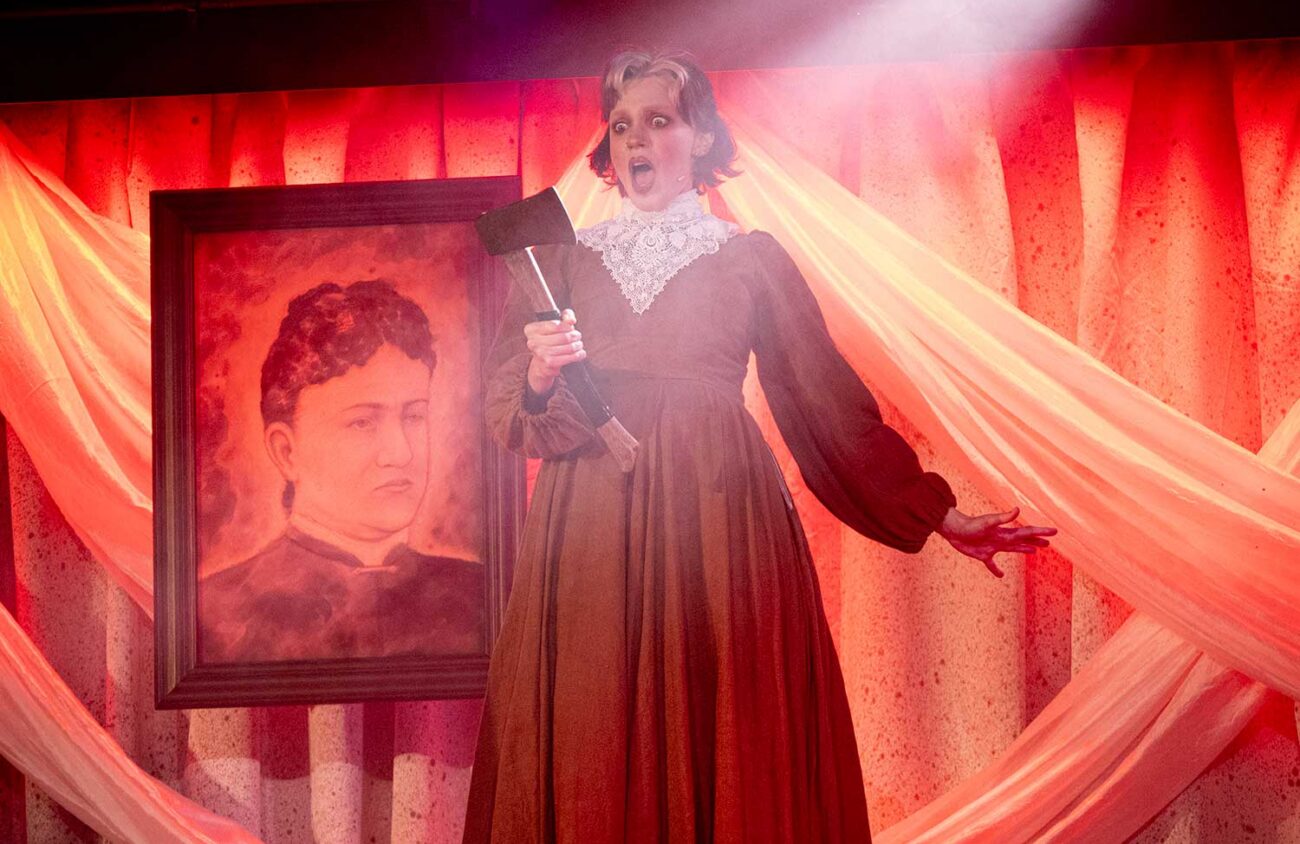
Oregon Contemporary Theater is staging its last weekend of LIZZIE: The Musical Nov. 5 through Nov. 8 directed by Brian Haimbach. This is a punk rock, all-girl adaptation of the story, and gives Lizzie a chance to tell her side, along with three other girls residing in and around The House of Borden (a theme that appears throughout) — including Lizzie’s alleged girlfriend Alice. This is the first time that OCT has ever made the decision to bring back a show with the exact cast and production team from its original run, which was just one year ago for Halloween 2025.
There is always something to be said about the ethics of depicting, and especially fictionalizing true crime stories. The show brings a real person to life and writes a version of what happened in a story where the facts are famously twisted and the world will likely never conclusively know what happened. True crime ethics will always be up for debate — especially because women are forever its main consumers.
Anyways, man, this show is fun. But more than that, it’s cathartic.
The cast is made up of only four women — and the parents matter so little, that no one even bothered to write characters for them. The performances by Abigail Moon (Lizzie herself), Jocelyn Kerr (Bridget, the housemaid), Kathleen Borelli (Emma Borden, Lizzie’s sister) and Kelly Finch (Alice, Lizzie’s friend and lover) are about as strong as the axe as said to have crushed Lizzie’s parents’ skulls 81 times over.
This is a show for everyone (except young children), but it is mostly a show for female rage and letting it all out. Rarely do women have a chance to take control of an entire room, where they get to scream, run, wield axes and let out every emotion with each fiber of their being. Sometimes they cry. Sometimes they kiss each other. Sometimes they lie. Sometimes they make poison and burn dresses. They’re just girls. This fantastic cast does all of this with grace and beauty — just as is expected of proper Victorian women.
Because the 1892 media decided, off the jump, to give its own version of events, so, too, does this play. The show does give its own verdict on whether or not she actually “did it,” but to LIZZIE: The Musical, facts are only secondary, and “innocent” and “guilty” are abstract concepts.
Moon, the most commanding performance on stage, portrays Lizzie as a woman who is struggling. When her parents die, her struggle ends. Anything after that is a piece of cake compared to the idea of being around them for one more second.
When she’s alone, her gorgeous, swan-like voice gives us emotional songs about how no one will ever see her or understand her, and how devastating that feeling is. Then, the feeling in the room amps up with hardcore rock about how freaking frustrating it is as well. It will never occur to her to ask for help. There is very little dialogue, so these musical ebbs and flows carry the show.
Moon also plays Lizzie with a certain amount of distance, which is particularly impressive. Though we, as the audience, can deeply understand how Lizzie feels, we can never truly connect with her either. But her sister and her friends come close, and that’s what matters most. Instead, we all marinate in the anger and unfairness in the world together — all set to the punk soundtrack accompanied live on stage by Orchestra Next, a vast transition from the gentle score they supplied at Eugene Ballet’s Taming of the Shrew just earlier this week.
Finch, Kerr and Borelli all have stand out moments as well. Kerr is haunting and witchy throughout the show, but particularly in her duet with Moon about making poison. Borelli emulates so much life and character every time she’s on stage, but her bewilderment at seeing her dead parents is unmatched in terms of relatability. Finch serves as the moral bright light in the play, and brings both an angelic voice and presence to every number.
The strongest parts of the show are when all four of the women are on stage together, scheming, arguing, holding each other and talking about the trauma of being surrounded by two dead bodies and dozens of journalists for 13 days in the sweltering summer heat. Not only is their chemistry and sisterhood bond through turmoil excellent and unbreakable, but these ladies also just plain look, act and sound fantastic together. Clearly, they’ve done this before.
Special props to set designer Amy Dunn, whose dark minimalist set perfectly aligned with the unreliability and sparseness that the characters and audience both experience. Costume designer Laura Tuffli also pulled out all the stops with both the character’s Victorian clothing and the massive aesthetic transition that happens partway through the show.
Who would ever suspect the girls in the House of Borden?
Lizzie: The Musical is 7:30 pm Thursday, Nov. 5 through Saturday, Nov. 7 and 2 pm Sunday, Nov. 8. Oregon Contemporary Theatre. Tickets are $24 to $54 and available at OCTheatre.org.