
MOVIE REVIEW ARCHIVE | THEATER INFO |
Meet the New Boss
He’s nothing like the old boss
by Jason Blair
A PROPHET (Un Prophète): Directed by Jacques Audiard. Written by Audiard, Thomas Bidegain, Abdel Raouf Dafri and Nicolas Peufaillit. Cinematography, Stéphane Fontaine. Music, Alexandre Desplat. Starring Tahar Rahim, Niels Arestrup, Adel Bencherif, Reda Kateb and Hichem Yacoubi. Sony Pictures Classics, 2010. R. 150 minutes. 
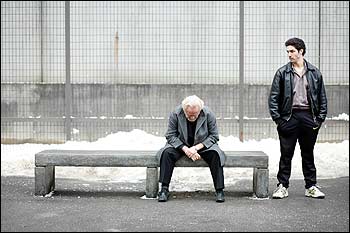 |
| Niels Arestrup and Tahar Rahim in A Prophet |
At the outset of A Prophet, a court appointed lawyer tells Malik (Tahar Rahim), “You’re an adult now. You go to the joint.” In a film as dense as A Prophet, the line has manifold implications. That a penitentiary won’t be unfamiliar to Malik is clear enough, given his shifty, surly demeanor, but any suggestion that Malik is an adult is entirely premature. His shoes are stolen moments after entering the jail yard, after which he’s badly beaten when he attempts to steal them back. He’s illiterate, physically undersized and — worst of all, at least within A Prophet — he’s half Muslim in a world where races don’t mix. When the French Corsican gang that runs the prison recruits him to kill another Muslim, they’re not only exploiting his identity; they’re forcing Malik, at an age he should be heading off to college, to kill or be killed by them. What follows is an epic tale of criminal maturation that can only be compared, like last year’s Gomorra, to the greatest mafia films of all time.
Malik never earns the respect of the Corsicans, a burly lot who call him a “dirty Arab,” but he proves indispensible to their leader, Césear Luciani (Niels Arestrup), an aging man who exerts a God-like influence over the prison. (Prison guards take orders from Césear, not the reverse.) When many of the low-level Corsicans are released, Malik becomes Césear’s personal assistant, a position which allows him access to the dealings of a criminal mastermind. When Césear arranges for Malik to leave the prison on furlough, Malik uses the precious hours to start a hashish ring. In order to succeed, he’ll need the backing of his fellow Muslims, a group he works increasingly hard to please — even as the prisoner Malik murdered, Reyeb (Hichem Yacoubi), now haunts him as a ghost. One of the first things Reyeb says to Malik is, “The idea is to leave here a little smarter …” Consider that obligation met.
At every turn, Malik must negotiate with men who want to reconcile his identity as a Corsican-serving Muslim. The more they think they recognize him, the more they misunderstand his ability to reinvent himself. In its commitment to the morality of violence; to the fluidity of every identity; to the arc of a Prince Hal-like servant who spurns his master, A Prophet is — to use a word rarely germane to current cinema — Shakespearean in its treatment of one boy’s journey into adulthood. With luck, cunning, desperation and intelligence (and in many cases, sheer ignorance of the stakes), Malik outgrows the narrow-mindedness of his handlers to emerge as a pure force of will not seen since Al Pacino toward the end of The Godfather. Paced by a soundtrack by Alexandre Desplat, the maestro behind Benjamin Button, The Queen and countless other compositions, A Prophet was awarded the Grand Prix (Second Place) at the 2009 Cannes Film Festival. In a year with perhaps the strongest entries ever for the Best Foreign Language Film Oscar, A Prophet was arguably the best of the bunch.
A Prophet opens Friday, April 2, at the Bijou.
A Note From the Publisher

Dear Readers,
The last two years have been some of the hardest in Eugene Weekly’s 43 years. There were moments when keeping the paper alive felt uncertain. And yet, here we are — still publishing, still investigating, still showing up every week.
That’s because of you!
Not just because of financial support (though that matters enormously), but because of the emails, notes, conversations, encouragement and ideas you shared along the way. You reminded us why this paper exists and who it’s for.
Listening to readers has always been at the heart of Eugene Weekly. This year, that meant launching our popular weekly Activist Alert column, after many of you told us there was no single, reliable place to find information about rallies, meetings and ways to get involved. You asked. We responded.
We’ve also continued to deepen the coverage that sets Eugene Weekly apart, including our in-depth reporting on local real estate development through Bricks & Mortar — digging into what’s being built, who’s behind it and how those decisions shape our community.
And, of course, we’ve continued to bring you the stories and features many of you depend on: investigations and local government reporting, arts and culture coverage, sudoku and crossword puzzles, Savage Love, and our extensive community events calendar. We feature award-winning stories by University of Oregon student reporters getting real world journalism experience. All free. In print and online.
None of this happens by accident. It happens because readers step up and say: this matters.
As we head into a new year, please consider supporting Eugene Weekly if you’re able. Every dollar helps keep us digging, questioning, celebrating — and yes, occasionally annoying exactly the right people. We consider that a public service.
Thank you for standing with us!
Publisher
Eugene Weekly
P.S. If you’d like to talk about supporting EW, I’d love to hear from you!
jody@eugeneweekly.com
(541) 484-0519