
Civil Righteousness
The Help helps white folk help themselves
by Molly Templeton
THE HELP: Directed by Tate Taylor. Written by Tate Taylor, based on the novel by Kathryn Stockett. Cinematography, Stephen Goldblatt. Editor, Hughes Winborne. Music, Thomas Newman. Starring Emma Stone, Viola Davis, Octavia Spencer, Bryce Dallas Howard, Jessica Chastain and Allison Janney. Walt Disney Studios, 2011. PG-13. 137 minutes. Two and a half stars.
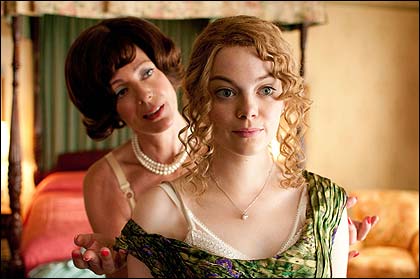 |
| Emma Stone (right) |
It feels like a tiny miracle that The Help’s stars are all women, yet no one’s treating the film like it’s wrapped in pink tulle and only meant for women to see on friend-dates with their fellow ladies. In a summer cinematic landscape of screaming victims and bland girlfriend clichés, The Help serves as a reminder that women’s roles aren’t limited to acting as accessories to men.
If only the film were satisfying for any other reason.
The Help follows a handful of fictional women in Jackson, Miss., in the early 1960s. Recent college graduate Eugenia “Skeeter” Phelan (Emma Stone, a little out of her depth), has come back to Jackson and gotten a job at the newspaper, seeking experience in order to land a job at a New York publisher. Her friends, all married and perfectly coiffed, throw bridge parties and host Junior League meetings, ruled by the sweet, toxic smile of Hilly Holbrook (Bryce Dallas Howard). When Hilly doesn’t like someone, that someone might as well not exist socially, as guileless Celia Foote (Jessica Chastain) discovers.
The privileged women match the look of Tate Taylor’s film, which loves to linger on bright dresses, shiny hair, summery sunlight and insincere smiles. Those smiles instantly drop when the women talk to their housekeepers. Without fail, Elizabeth Leefolt (Ahna O’Reilly) speaks sharply to Aibileen (Viola Davis), while Hilly fires one woman, Minny (Octavia Spencer), and tells her replacement that she’s doing her a favor by not lending her money to send her son to college.
Skeeter, whose wide eyes begin to see the injustice in this accepted arrangement, serves as the modern white audience stand-in (not least because she’s unmarried and career focused). We can all tell ourselves that we would’ve been Skeeter, kind and open-minded, and never Hilly, who believes all homes should have separate bathrooms for the white homeowners and their hired help. Nasty, vindictive and unaccountably powerful, Hilly is a one-note villainous twit, and her character takes the place of the complex racial strife that really existed. The Help occasionally peeks at the world outside its characters’ immediate experience, usually via TV or radio broadcasts, but the film is strangely self-contained, a safe fantasy about evoking change in a bubble as the civil rights movement builds momentum all around.
The Help was divisive before it was a film. On one side, Kathryn Stockett’s novel got glowing reviews; on the other, it earned thoughtful, pointed criticism from those who saw Stockett as perpetuating stereotypes and using the real experience of black women as backdrop to a white woman’s journey of self-realization. Taylor’s movie appears to try to address some of the criticism by moving the black characters further into the forefront. Skeeter serves as catalyst, pushing Aibileen for stories, but much of the air goes out of the story whenever its focus slips away from Aibileen and Minny. And much of the credit for that goes to Viola Davis, who elevates the film from just middling to flawed but watchable. You’ll have to swallow a scene that compares a white girl’s lack of self-confidence with the casual contempt a black housekeeper endures, and spend far too much time in the company of Hilly Holbrook, and you won’t experience any history that hasn’t been reshaped to fit a simplified cinematic mold. But you’ll see Davis — and an excellent supporting cast in Allison Janney and a giddy Sissy Spacek — bringing gravity and grace to a film that otherwise smoothes still-relevant issues into a feel-good fluff-fest.