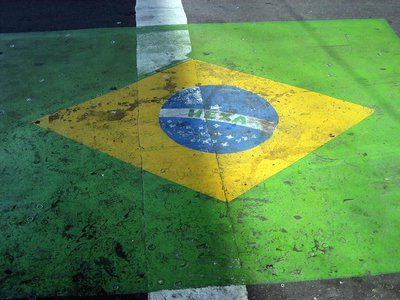
A Copa das surpresas (“the [World] Cup of surprises”) was a phrase I remember hearing several times during the first weeks of the 2014 World Cup. Holland had crushed the 2010 World Cup champion, Spain, 5-1. Germany beat Cristiano Ronaldo’s Portugal, 4-0. Costa Rica went undefeated in its first three games to become the leader of one of the most difficult groups of the cup. Top-ranked teams like Spain, Italy, Portugal and England didn’t even make it to the round of 16. The biggest surprise of all, however, would come later, in the semifinal between host nation Brazil and Germany. Like Brazil’s loss to Uruguay in the final match of the 1950 World Cup in Brazil, this 2014 semifinal will never be forgotten — nor forgiven — by the Brazilian people.
In 1950, Brazil appeared to be invincible by the time it reached the final match of its first World Cup on home soil. In its two previous matches, Brazil had beaten Sweden, 7-1, and Spain, 6-1. In its newly built Maracanã Stadium, with an estimated crowd of nearly 200,000 spectators, Brazil was leading 1-0 until Uruguay scored in the 66th minute. Uruguay scored a game-winning, crowd-silencing and ego-blowing second goal in the 79th minute.
The dramatic upset became known as the Maracanaço in Brazil and as the Maracanazo in Uruguay and almost everywhere else (-aćo and –azo are augmentative suffixes in Portuguese and Spanish, respectively, which may also denote a big blow). Brazilian anthropologist Roberto DaMatta has argued that the Maracanazo “is, perhaps, the greatest tragedy in the contemporary history of Brazil.” The national tragedy of the Maracanazo, however, has now been supplemented — if not supplanted — by the Mineirazo: Brazil’s humiliating 7-1 loss to Germany in the 2014 World Cup semifinal in the Mineirão stadium of Belo Horizonte.
When the 2014 World Cup began, Germany and Brazil were ranked as the second- and third-best teams in the world by FIFA. Despite having lost its captain and central defender (Thiago Silva) to accumulated yellow cards as well as its star offensive player (Neymar) to a back injury, Brazil still expected to compete with, if not beat, Germany in the semifinal.
A German goal in the 11th minute disrupted but did not destroy Brazil’s confidence. Then, stunningly, Germany scored four goals between the 22nd and the 29th minute. Brazilian dreams of avenging the tragedy of its first World Cup on home soil quickly (within six minutes) transformed into a nightmare. In a sport that rarely sees four goals in an entire match (especially in a World Cup semifinal between two top soccer-playing nations), the occurrence was absolutely unbelievable.
The match ended 7-1, becoming Brazil’s worst defeat in World Cup history. Curiously, Brazil had more possession of the ball (52 to 48 percent) and more shots on goal (13 to 12). Nonetheless, the 7-1 defeat was described by everyone I spoke to and throughout the media as a massacre, a humiliation, a disgrace. The main newspaper in Manaus wrote the following morning that the score, “surely, will make every Brazilian now look at the 1950 team with tremendous pride.” That might be some consolation, if it were true, but I am doubtful that it is.
A Note From the Publisher

Dear Readers,
The last two years have been some of the hardest in Eugene Weekly’s 43 years. There were moments when keeping the paper alive felt uncertain. And yet, here we are — still publishing, still investigating, still showing up every week.
That’s because of you!
Not just because of financial support (though that matters enormously), but because of the emails, notes, conversations, encouragement and ideas you shared along the way. You reminded us why this paper exists and who it’s for.
Listening to readers has always been at the heart of Eugene Weekly. This year, that meant launching our popular weekly Activist Alert column, after many of you told us there was no single, reliable place to find information about rallies, meetings and ways to get involved. You asked. We responded.
We’ve also continued to deepen the coverage that sets Eugene Weekly apart, including our in-depth reporting on local real estate development through Bricks & Mortar — digging into what’s being built, who’s behind it and how those decisions shape our community.
And, of course, we’ve continued to bring you the stories and features many of you depend on: investigations and local government reporting, arts and culture coverage, sudoku and crossword puzzles, Savage Love, and our extensive community events calendar. We feature award-winning stories by University of Oregon student reporters getting real world journalism experience. All free. In print and online.
None of this happens by accident. It happens because readers step up and say: this matters.
As we head into a new year, please consider supporting Eugene Weekly if you’re able. Every dollar helps keep us digging, questioning, celebrating — and yes, occasionally annoying exactly the right people. We consider that a public service.
Thank you for standing with us!

Publisher
Eugene Weekly
P.S. If you’d like to talk about supporting EW, I’d love to hear from you!
jody@eugeneweekly.com
(541) 484-0519