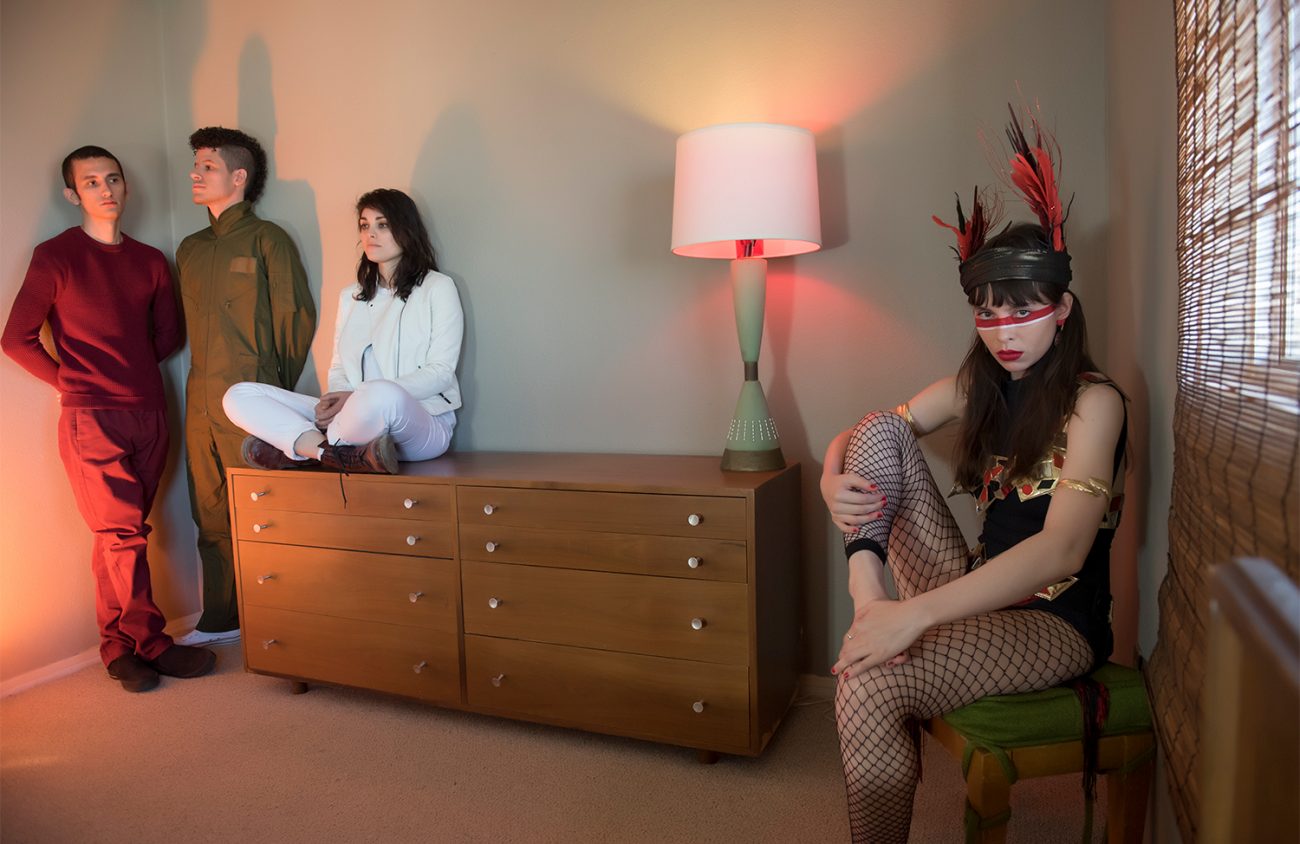
When Teresa Suárez Cosío was a young girl she dreamed of owning a guitar. “It was PTSD from wanting a guitar really bad,” the singer, guitarist and primary creative force behind Le Butcherettes tells me over the phone.
Cosío is probably better known by her stage name Teri Gender Bender. “I would have the dream over and over again,” she says. In the dream, she had a guitar, but every time she strummed, “I wouldn’t be able to get that strum. The guitar strings would melt. I wouldn’t get that satisfaction,” she says.
In real life she would take rubber bands and strum them instead, but she soon grew sick of that. “You want the real thing,” she says.
Cosío saved up her lunch money, and with a little help from her dad, she got her guitar.
This all led Cosío to where she is today, fronting Le Butcherettes. Formed in Guadalajara, Mexico, but now based in L.A., Le Butcherettes come through Eugene supporting their latest release, bi/Mental, with themes addressing duality and contraction in all forms — from gender identity to Cosío’s multi-national heritage.
Duality is even reflected in the forward slash in the album’s title, as well as the name of every song. Take, for example, the slow and murky “struggle/STRUGGLE,” in which Cosío repeats “Struggle, struggle to the end” before her voice collapses into a weary but defiant ululation.
Another theme on the record is the trauma Cosío endured being raised by her bipolar mother, a condition Cosío struggles with herself.
Performing live, Cosío is almost feral, her voice alternating between a torchy, cabaret alto and ferocious rock ‘n’ roll hysteria — redolent of Grace Slick but also Karen O or Siouxsie Sioux. It’s a highly theatrical, glam rock-influenced brand of punk rock inspired by Cosío’s family and love for Latino culture.
Cosío was born in Denver to a Mexican mother and Spanish father. Her family moved back to Mexico when she was 13. Music was in her life early on. “My dad and my mom were big music fans,” she says. Her dad loved the Beatles and her mom was into Middle Eastern music.
Not long after getting a guitar Cosío was writing songs. She was making up songs before she even had an instrument, but with less success.
“I was so frustrated,” she says. “I needed that instrument to get a better grasp on songwriting. When I got the guitar, it was so much easier to get ideas across.”
Costuming and props are also a big part of what Le Butcherettes are about, making internal struggle something tangible in the outside world. In the past, Cosío has worn bloody aprons to symbolize the enslavement and murder of Mexican women.
Even the name “Gender Bender” was adopted as a feminist statement. Cosío is known for wearing a Chichimeca headdress, a nod to her Mexican grandmother.
On this tour, Le Butcherettes are all about color. They are wearing white to represent purity or the inner child, but also military green and dark maroon. The maroon represents “the old blood that has dried up from the past,” she says. But ultimately, it’s a message about hope.
“You have to remember to move forward,” Cosío says.
Le Butcherettes open for Devil Makes Three, Social Distortion and Flogging Molly 5:30 pm Sunday, Sept. 22, at Cuthbert Amphitheatre; $49.50 advance, $55 door, all-ages.
A Note From the Publisher

Dear Readers,
The last two years have been some of the hardest in Eugene Weekly’s 43 years. There were moments when keeping the paper alive felt uncertain. And yet, here we are — still publishing, still investigating, still showing up every week.
That’s because of you!
Not just because of financial support (though that matters enormously), but because of the emails, notes, conversations, encouragement and ideas you shared along the way. You reminded us why this paper exists and who it’s for.
Listening to readers has always been at the heart of Eugene Weekly. This year, that meant launching our popular weekly Activist Alert column, after many of you told us there was no single, reliable place to find information about rallies, meetings and ways to get involved. You asked. We responded.
We’ve also continued to deepen the coverage that sets Eugene Weekly apart, including our in-depth reporting on local real estate development through Bricks & Mortar — digging into what’s being built, who’s behind it and how those decisions shape our community.
And, of course, we’ve continued to bring you the stories and features many of you depend on: investigations and local government reporting, arts and culture coverage, sudoku and crossword puzzles, Savage Love, and our extensive community events calendar. We feature award-winning stories by University of Oregon student reporters getting real world journalism experience. All free. In print and online.
None of this happens by accident. It happens because readers step up and say: this matters.
As we head into a new year, please consider supporting Eugene Weekly if you’re able. Every dollar helps keep us digging, questioning, celebrating — and yes, occasionally annoying exactly the right people. We consider that a public service.
Thank you for standing with us!
Publisher
Eugene Weekly
P.S. If you’d like to talk about supporting EW, I’d love to hear from you!
jody@eugeneweekly.com
(541) 484-0519