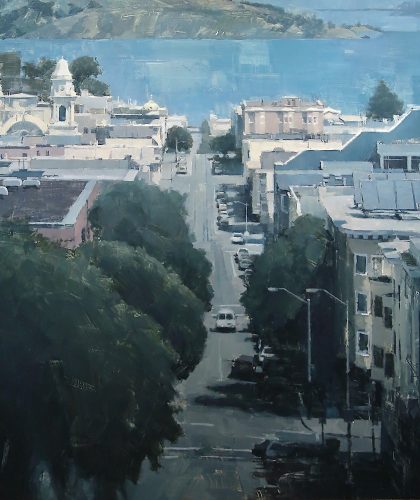
Step into the Karin Clarke Gallery this month, and you might think you had walked through the wrong door. Instead of the gallery’s typically loose, expressive fare — think painters such as the late Rick Bartow or gallery regular Adam Grosowsky — you’re surrounded by tightly representational paintings of ships, seascapes and cityscapes by artist James Kroner.
This foray into realism is sparked in part by the fact that gallery owner Karin Clarke has herself studied painting with Kroner. But the small exhibit, with just 13 paintings, also clearly grows out of the deep, moody and deftly detailed quality of Kroner’s work, a perfect fit for rainy, gloomy Oregon winters.
A San Francisco native now living with his wife in tiny (pop. 600) Union, Washington, Kroner met Clarke in 2017 when she enrolled in a painting workshop he taught in Italy. He studied painting at Academy of Art University in San Francisco, an art school founded in 1929 to teach advertising art and one that apparently still values tight technique of a kind rarely taught at other art schools today.
His approach to painting isn’t photo-realistic; instead it combines careful observation with plenty of mood. Take, for example, a large painting in the show, “The Silent Ship”; in it, a three-masted sailing ship is tied at a pier with San Francisco’s Coit Tower rising in the luminous background. The dark 19th-century ship and the modern electrified city with which it’s contrasted both stand out from a sky of warmish gray clouds and the dull waters of the harbor.
People, in these paintings, are generally no more than accents to the landscape. A small work, “Piazza della Repubblica,” uses warm tones to show a rainy street scene in Florence, Italy, in which pedestrians — all facing away from the viewer — carry umbrellas as they walk toward an arch in the distance. Though we don’t see any of their faces, they seem to be leading us through the arch and into the painting.
Kroner starts his paintings, Clarke says, by using colors planned for the work to mix a solid neutral color that he uses to cover the entire canvas. This practice helps unify the canvas, as the painting’s background is created from the same colors that are used to fill in the image.
Competent realist painting is rare in 2022, and its practice sometimes signifies a reactionary challenge to the conceptual excesses of the current art scene. Kroner’s work doesn’t convey that sense of cultural nostalgia. Instead, it simply invites us to enjoy an image and a mood clearly described.
Besides that, Kroner — who is in his early 40s — is decades younger than many of the artists whose work is regularly shown at Clarke’s gallery. That, by itself, is a good reason to drop by.
James Kroner: New Paintings runs through Feb. 26 at Karin Clarke Gallery, 760 Willamette Street. Hours noon to 5:30 pm Wednesday to Friday, 10 am to 4 pm Saturday. Masks required.
A Note From the Publisher

Dear Readers,
The last two years have been some of the hardest in Eugene Weekly’s 43 years. There were moments when keeping the paper alive felt uncertain. And yet, here we are — still publishing, still investigating, still showing up every week.
That’s because of you!
Not just because of financial support (though that matters enormously), but because of the emails, notes, conversations, encouragement and ideas you shared along the way. You reminded us why this paper exists and who it’s for.
Listening to readers has always been at the heart of Eugene Weekly. This year, that meant launching our popular weekly Activist Alert column, after many of you told us there was no single, reliable place to find information about rallies, meetings and ways to get involved. You asked. We responded.
We’ve also continued to deepen the coverage that sets Eugene Weekly apart, including our in-depth reporting on local real estate development through Bricks & Mortar — digging into what’s being built, who’s behind it and how those decisions shape our community.
And, of course, we’ve continued to bring you the stories and features many of you depend on: investigations and local government reporting, arts and culture coverage, sudoku and crossword puzzles, Savage Love, and our extensive community events calendar. We feature award-winning stories by University of Oregon student reporters getting real world journalism experience. All free. In print and online.
None of this happens by accident. It happens because readers step up and say: this matters.
As we head into a new year, please consider supporting Eugene Weekly if you’re able. Every dollar helps keep us digging, questioning, celebrating — and yes, occasionally annoying exactly the right people. We consider that a public service.
Thank you for standing with us!
Publisher
Eugene Weekly
P.S. If you’d like to talk about supporting EW, I’d love to hear from you!
jody@eugeneweekly.com
(541) 484-0519