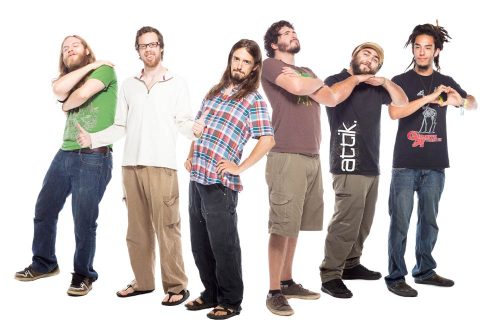
The guys behind Sol Seed are the nicest kids you know. No really. While I was waiting outside their front door, under a string of fluttering prayer flags, guitarist Kenny Lewis appears from the trees in the front yard and, without saying a word, gives me a hug. After the embrace, Lewis smiles and says, “So you are …?” (I would find out later that the band is known for its “Sol Seed Hug Train.”)
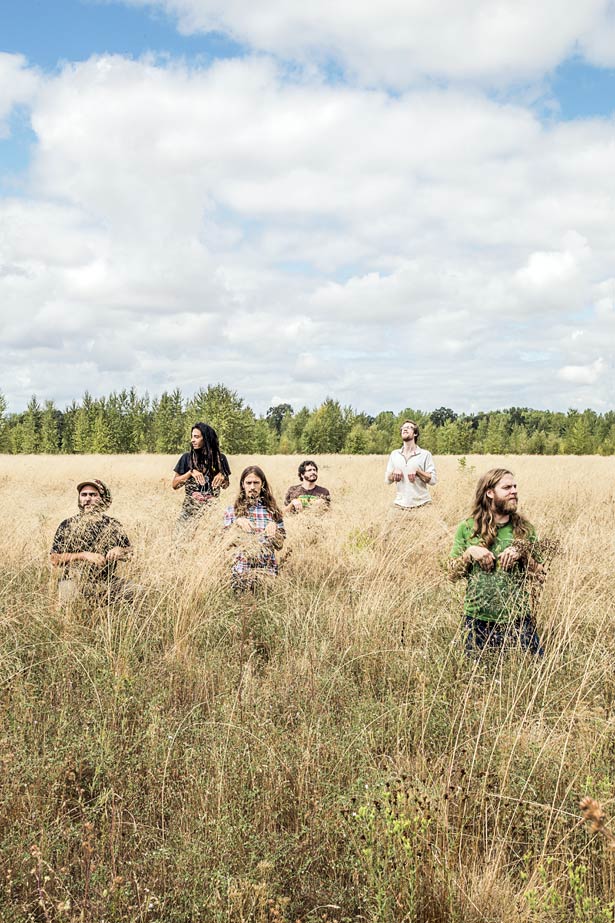
And it’s not only hugs. All six band members — Michael Lennon (vocals, guitar), Michael “Magic” Sorensen (vocals, drums), Benny Pezzano (vocals, bass), Kenny Lewis (vocals, guitar), Sky Guasco (vocals, percussion, didgeridoo) and Graeme Pletscher (saxophone) — are bursting with peace, love and good vibes. When one speaks, the others listen intently. They pat each other on the back and dole out support like it’s the new definition of cool.
Their warmth is important to note because it makes their music — reggae fusion with a message — that much more sincere. Mix in talent, a solid work ethic and a knack for improvisation on stage and it’s no surprise that Sol Seed nabbed EW’s Next Big Thing 2013 crown with their entry “Mr. Mistah,” a jaunty and soulful tune. Even before winning that title, however, Sol Seed was well on the way to becoming a household name in the Pacific Northwest, having toured relentlessly over the past three years. In 2012 alone, they played 100 shows in 40 cities.
On Friday, Sept. 13, they leave for the band’s biggest tour yet, a five-week journey through Oregon, California and Arizona. They are in the process of recording their first full-length studio album, Family Tree, and next spring, they will tackle the East Coast — they have the time now that they quit their day jobs. Before all that, though, the members of Sol Seed sat down with EW to discuss their roots, the message behind the music and what it takes to be a successful band in the 21st century.
To pinpoint exactly where and when the Sol Seed was planted is a little difficult; to hear them tell it, there was a lot of serendipity involved. They settle on Jackson Creek Pizza in Medford, Ore. The majority of the band, save for Guasco and Pletscher, hail from Southern Oregon.
Jackson Creek Pizza was home to the only all-ages (and now defunct) open mic in the area, and post-high school it was a music hub for Pezzano, Sorensen, Lennon and other leading Oregon reggae artists like Alycon Massive and Indubious.
Frankie Hernandez, or as they now call him, “Papa Bear,” a funk-reggae musician originally from Austin, Texas, played host and would become a mentor to the band, even taking them on tour.
“They always solicited feedback. Whatever I had to tell them, they were receptive to,” Hernandez says. “Every week they got better and better.”
Soon the trio was jamming together, and Lewis, who had moved up to McMinnville during high school and come under the tutelage of Kalapuya flutist Jan Michael Looking Wolf, was driving down for the open mic. Then Looking Wolf offered Lewis a birthday present: He could record one song in a professional studio.
“I was like, if I’m going to have the opportunity to record a song, I want a band,” Lewis says. “So they all came up from Southern Oregon to McMinnville.” The recording session went well and a band was born.
Shortly after, in 2010, the foursome moved to Eugene to reach a larger market, and they met San Francisco native and didgeridoo player Guasco through mutual friends. At the last minute, they invited Guasco to join them for a gig at WOW Hall. “I did one rap, a little bit of didge and they were like, ‘Dope,’” Guasco says.
It wasn’t long before sax man Plestcher, a Montana native, joined the band too. Lennon took music theory classes with Plestcher at LCC and discovered that he lived across the street. “He came over one day and melted all our faces,” Lennon says of Plestcher’s sax playing.
Before forming Sol Seed, none of the members were particularly into reggae. Each comes from a wide array of musical backgrounds: blues, rock, folk, hip hop. So why reggae?
“It just kind of germinated out of what we were doing,” Lennon says.
“It’s a very even plate for everything to fit on,” Sorensen says. “You can stack any different style of music onto reggae.”
“Reggae is an awesome genre because we mold into ska, we mold into dub, we mold into super roots, hip hop,” Guasco notes. They also point out that reggae’s buoyant sound — it’s rhythm hitting on the two and the four beats instead of the one and three that is so common in popular music — is perfect for dancing. Or using their new favorite term, it’s perfect for baltering (balter meaning to dance or tread clumsily).
“Reggae is very happy generally and we try to write thought-provoking, motivational lyrics that encourage people,” Sorensen adds. In other words, it’s the perfect genre of music to spread Sol Seed’s message of unconditional love and perspectivism, a theory developed by Friedrich Nietsche that argues that there is no absolute truth or “correct” perspective, and illustrated in songs like “Mr. Mistah”: “You know that everything changes, nobody is right forever in this life / What you are perceiving as strangeness might just be somebody else’s path to the light.” Hence you’ll find the band playing a lot of peace events like the recent United Nations’ International Day of Peace show at Cozmic.
The guys of Sol Seed note their sincerity as a key to their success, and it shines through in their lyrics and their work ethic. If you’ve been to a Sol Seed show, you know that whether there’s five or 500 people in the audience, they are going to give it everything they have. This kind of commitment stems from learning to take the band seriously, a point that was hit home by reggae legend Norma Fraser, who recently came to the band’s home for an educational jam session.
 |
| Photo by Rob and Tracy Sydor / robsydor.com |
Fraser told them, “If you demand respect, you get respect.” That resonated for the band, especially Guasco, who also plays the role of band manager. “That’s true and you can do that in a non-aggressive way — taking yourself seriously,” he says. “I know what we’re worth.”
In August, Sol Seed got really serious: They quit their jobs.
“I’m quitting my job to kick off my career,” says Sorensen, who was a cook at Capella Market. With the kind of recording and touring the band wants to do, it was no longer feasible to hold on to their day jobs. They are starting a Kickstarter to complete their upcoming Family Tree album. The first single, “Waterspout,” is an incredibly catchy, reggae version of “Itsy Bitsy Spider.” With their Next Big Thing recording time, they will also be in the studio putting together a family-friendly acoustic album. All of this will happen between long stints on tour.
“I think what you have to do nowadays is that grassroots following; you have to hit the road, you have to be busy,” Pezzano notes. “You have to play everywhere, everywhere, everywhere.” Guasco says that going on the road, staying late after shows to sign CDs, meeting people face to face and hanging out with younger fans is what it takes to be a successful band in the internet age.
Hernandez, the open mic host who originally taught them the rules of the road, believes their success really lies in their commitment to one another and their shared vision. “They have each other’s backs as bros and not just as musicians,” he says. “I think the music that they perform is an outgrowth of their relationship to each other. When you’re around them, you can’t help but feel included in their sense of family.”
It’s true. At the end of the interview, the Sol Seed Hug Train came chugging along and everyone was on board.
Troubadours of the Willamette Valley
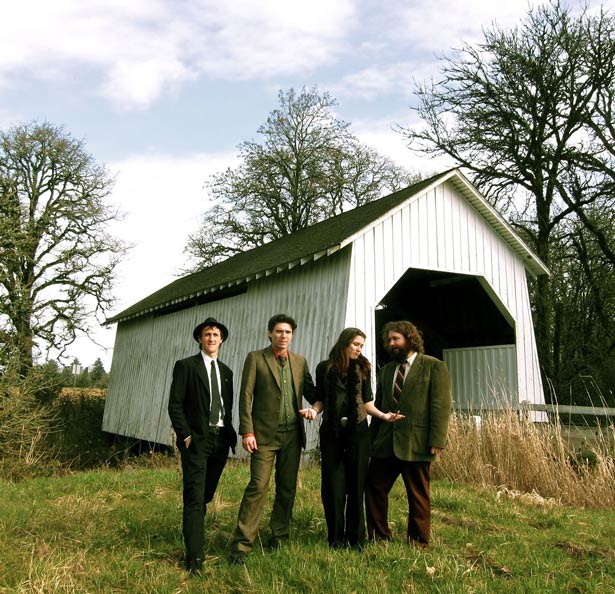
You haven’t heard the last of The Crescendo Show — the alt-folk quartet from Corvallis that competed for first place in EW’s Next Big Thing contest. If you haven’t already listened to their NBT entry “Swig Lee Otis,” you’re missing one of the sweetest tunes to come out of the Willamette Valley in recent memory. The dreamy, earthy lead vocals of Kailyn Kubiak and Nathan Porter drizzle like caramel over rich, round instrumentation, punctuated by tender banjo picking (yes, tender banjo picking). The song stirs something in the soul.
Kubiak also strums guitar, and Porter alternates between piano, accordion and guitar. Matt Kellam on bass and Ricky Carlson on guitar, drums and banjo skillfully fill out the band’s sound.
In a nutshell, these troubadours are hard to forget. And with their growing oeuvre, you won’t have to. They already have two albums under their belt — The Crescendo Show and Sure As The Ocean Shore — and come January, the band will be recording a third at Jackpot! Recording Studio in Portland. Catch them before that at Corvallis’ Septembeerfest (9/14), Florence’s Café Mundo (9/27) and back in Corvallis for the Fall Festival (9/28). For more information, visit the crescendoshow.com.