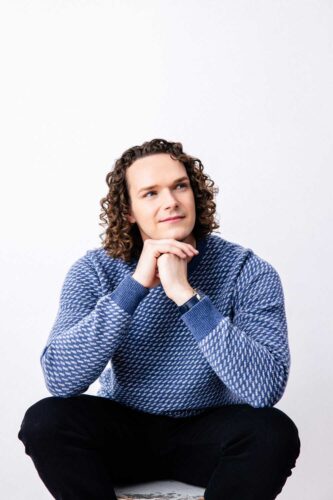
There’s a moment inside Craig Hella Johnson’s brilliant and gripping oratorio Considering Matthew Shepard that damn near brought me to tears — because I would, I think, eventually ask the same question in the same space and circumstance. It’s a question that haunts the score.
“Am I like you?”
It’s midway through the 100-minute piece, performed June 28 at the Hult Center as part of the Oregon Bach Festival. Matthew Shepard, on Oct. 6, 1998, had been savagely beaten with the butt of a pistol outside Laramie, Wyoming, while strapped to a fence. Five days later, he died in a hospital bed in Fort Collins, Colorado. He was 21 — a young gay man full of life, a young gay man who had done some traveling and knew there was a world beyond Wyoming. He may not have been a saint. He still may have had maturing to do, but his future was bright.
At his funeral at St. Mark’s Episcopal Church in Casper, Wyoming — where Shepard had served as an acolyte while a boy — Fred Phelps, a pastor of the Kansas-based and ultra right-wing Westboro Baptist Church, led his congregants and other activists with placards and chants: “God Hates Fags” and “Matt in Hell.” Media attention was nationwide, even worldwide.
By this time in the oratorio, Russell Henderson and Aaron McKinney had been convicted by a Laramie, Wyoming, jury of first-degree murder, and each was given two consecutive life sentences. Both remain in prison.
Then there’s The Fence, at least that segment where Shepard was found 18 hours after being beaten. It becomes a shrine where mourners lay flowers and lay hands. It is no longer inanimate. In the oratorio, it has life. It has words. It has its own story, and The Fence is a cornerstone character of Considering Matthew Shepard.
Finally, as the initial shock and horror — not to mention raw anger — subsides, the question arises: “Am I like you?”
It is the question posed in the song “I Am Like You,” and in the OBF production of Considering Matthew Shepard, conducted by Johnson, it was sung by a quartet of two men and two women (Danielle Buonaiuto, Zerrin Agabigum Martin, Wilson Nichols and Luc Kleiner), representing gays and lesbians. It is sung a capella. It is sung softly, almost in a frightened whisper, to the two killers.
“When I think of you (and honestly I don’t like to think about you)
but sometimes I do,
I am so horrified, and just so angry and confused (and scared)
that you could do things to another boy — they were so cruel and
so undeserved, so dark and hard and full of (I don’t know)
“I don’t even like to say this out loud,
it isn’t even all that true —
but I wondered for a moment,
am I like you? (in any way)
“I am like you
(this troubles me)
I am like you
(just needed to say this)”
As a Christian, and no one’s idea of a saint, this question — “Am I like you?” — has shadowed me from time to time. Shepard was murdered almost 27 years ago, but with bitter rhetoric and threats of violence rising daily toward “others,” the unabated escalation of that rhetoric from both sides of the divide (particularly the right) shows how little has changed.
Even Eugene Weekly has seen this up-close after its recent cover photo of a trans woman holding an AR-15 style rifle. Fear and loathing over contentment and love.
So I will say this for myself: I am not like you, the spreader of fear and loathing. The emphasis, as drilled into me these past many years and noted in biblical verse, Galatians 3:28, is that “There is no longer Jew or Greek; there is no longer slave or free; there is no longer male and female, for all of you are one in Christ Jesus.”
This, for me, eliminates the distinctions that have been created in our present day.
I was struck by a gay couple with matching (and colorful) button-down collared shirts who sat in front of me during the performance. Roughly two-thirds of the way into the performance, the man on the left took off his glasses and began to cry. His partner put his left arm around him and whispered in his ear. I cannot imagine the angst this couple may feel just showing up every day as gay men, not to mention the endurance and bravery to simply show up every day as gay men.
Brian Giebler, a tenor, portrayed Matthew Shepard with loving delicacy. He has had this role before, and the care and kindness he showed toward the character has left a long-lasting and positive impression with me.
Other notable performances included Harrison Hintzsche and Kim Leeds singing solo ventures on behalf of The Fence, Alyse Jamieson singing “Keep It Away From Me” and Gregório Taniguchi singing “The Innocence” as well as Savannah Porter, Carley DeFranco and Leann Conley-Holcom singing “Deer Song.”
Absorbing the oratorio Considering Matthew Shepard is difficult but should be required of all of us — if only to remind us of our basic humanity. It’s my hope that Johnson, who is an artistic partner with OBF, will bring this back to the festival in the years to come.
The Oregon Bach Festival continues through July 13. More information about talks and concerts as well as ticket prices are at OregonBachFestival.org.