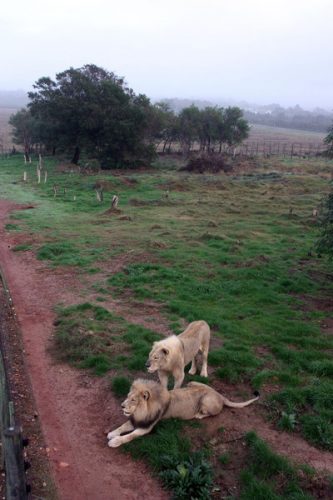
We awake to the colossal, bone-shaking roar of 35 lions bellowing in concert. Tucked into our bed, zipped up in a tent, we find each other’s gaze in the dim moonlight — raised eyebrows melt into wide-eyed glee. The nearest beast, a 22-year old lioness named Simba, lies 15 feet from our heads. She, however, saves her snarls for the sun and currently enjoys a deep, guttural snore. We laugh. We have been engaged for eight hours.
I thought we came here like other tourists, to see the lions — I didn’t know we would be leaving betrothed, as well as being new parents.
A sanctuary for captive-born predators, the nonprofit Drakenstein Lion Park cares for 35 lions and two tigers that have been rescued from lives of abuse in the circus, as pets or other unnatural circumstances. They cannot be rehabilitated into the wild. Some signs of their past lives are obvious: Brutus, formerly a French circus lion, was beaten so badly his face twists permanently to the right from a broken jaw, damage so severe surgery itself would be fatal. Many of the lions will never trust humans again. But all the lions, even Brutus, seem at home on the site’s 50 grassy acres.
Twelve hours earlier, on June 21, 2013, my partner Tony and I drove northwest from Cape Town through mountainous wine country, past the university and artist town of Stellenbosch, arriving at Drakenstein Lion Park before sunset. The sanctuary is named for the Groot Drakenstein Mountains (groot meaning “large,” drakenstein meaning “dragon stone”), which provide a stunning backdrop; craggy pillars shoot straight up from the rolling landscape like rockets. We came to South Africa nine days earlier to visit my grandfather, who lives in Cape Town’s suburbs. Tony chose to stay overnight at the lion park on the longest night of the year, the Cape’s winter solstice.
Kelsey Fegan, a park employee, explains that Drakenstein may be the only park in South Africa that does not breed, conduct research on or allow canned hunting of its lions. The cats are there for one reason: to live out their lives in peace. She tells me this between chucking dead chickens over the barbed wire fences. It’s 4 pm, feeding time, and all the park employees and visitors follow a wagon filled with freshly killed poultry. The lions pounce on the chickens like housecats on mice.
Feathers flutter as winter winds roll down the path back to the main lodge. It’s time for daytime visitors to leave. At 5 pm, people staying the night are locked into the park for security reasons. We bid adieu to our fellow visitors, who look at us cockeyed. They are Capetonians, and it’s the dead of winter; we are the only two staying the night. (Growing up in Minnesota, and living in Oregon, makes South Africa’s winters feel like an early spring day.)
Giddy to have the park to ourselves, we grab mugs of coffee and head off to see if the cats have devoured their dinners. Most are now napping and snoring. Taking their lead, I head back to our tent for a nap. Tony checks in on Fegan and Karel Visser, another park employee, who are preparing a traditional South African braai or barbeque in the lapa, an open-air kitchen. While snoring myself, Tony plots with Fegan and Visser — unbeknownst to me, he wants to propose at dinner.
Before a dinner of grilled chicken and boerewors (a popular South African sausage), Tony pops the question. I say yes. We say yes.
Then a lion lets out the loudest, most triumphant roar I’ve ever heard. OK, that’s not true, but it feels true.
We retire to our tent. We sleep with smiles on our faces and awake to the roars, 100 times louder than any MGM lion could muster. At sunrise, we visit the cats and decide to adopt Ena (a monetary adoption, she stays in South Africa), another French circus lion who was kept in a wooden box beneath a horse trailer for most of her life before she came to Drakenstein in 2010.
“We’ll be back,” we tell Ena. This is where we started our family.
For more information about Drakenstein Lion Park, visit www.lionrescue.org.za.