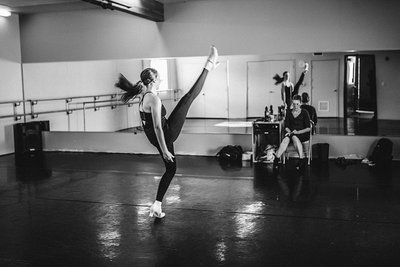
Tap has long held both the glamour of Fred Astaire and the grit of early vaudeville. Even so, its popularity has been inconsistent in the history of dance.
Tap has enjoyed peaks on Broadway in the 1920s, the funk tap show Bring in ‘da Noise, Bring in ‘da Funk in the ’90s and even made appearances on So You Think You Can Dance as of late.
As a whole, however, the scuffs and stamps of tap don’t seem to compete with the pirouettes of ballet or the chest pops of hip hop — especially in Eugene.
Vanessa Martin grew up tapping at Musical Feet, Eugene’s premier tap school, which closed in 2013 after 35 years. Martin took over the space, where she runs Xcape Dance Academy. When she went out into the world of dance, she discovered that tap was difficult to find, and she says there isn’t much of a tap scene in Eugene anymore.
“There’s a small group of people in Eugene that I’ve connected with that I grew up tapping with,” Martin says, “but it’s just so small.” Although Martin teaches several tap classes, they’re usually so small in attendance that it allows her to require all of her young dancers to take tap and gain its immense benefits.
“Tappers have amazing musicality,” she says. “They just excel when it comes to hip hop and contemporary dance because they don’t need to be taught musicality. They know how to listen; they know how to use their bodies to emphasize rhythm, and that is the biggest benefit.”
Jean Nelson, one of Eugene’s tap gurus, has been teaching dance at the University of Oregon for 20 years, but due to a lack of interest, UO will not be offering tap classes this year.
She was also one of the founding members of the Northwest Tap Consort (now defunct) and currently teaches and choreographs at The Shedd.
“There’s sort of isolated pockets here and there, but it doesn’t go anywhere from there, at least not now,” Nelson says of local tap. “The ballet has sponsors and donors, but it’s ballet. People will support ballet in this town but not a lot of other forms of dance.”
Traditionally ballet is for and by the elite, but tap is a dance of the Industrial age, combining styles of various ethnic groups — mostly Irish and African traditions — living in slums in the Five Points District in New York City. In 1935, tapper Bill Robinson was the first African American to appear in an interracial dance scene with Shirley Temple, as well as the first to headline a mixed-race Broadway show.
While other forms of dance, historically speaking, have discriminated based on height, weight, age and race, tap remains one of the most accessible forms of dance.
“Modern dancers, ballet dancers — their body parts break down,” Nelson says. “All the old hoofers, the Nicholas brothers and Sammy Davis, they were all into their 80s, sometimes 90s, and still tapping. It’s something you can do your whole life.”
See dance listings for local tap dance classes.