If time is just a sequence of moments — a metered arrangement of flashes and blips set upon a far-flung scale — are there really such things as minutes and hours? Does history groove to a cosmic cabasa? Are rules of rhythm inherent within us or forged across ages of concrete occurrence?
And if time itself is a beast worth taming, to whom will it answer?
Enter the DJ, whose bass-heavy pulse keeps time in check with the repetitive use of tense and release — a metronome split, then split again, right to the cusp of cosmic dialysis. In this techno-age of smartphones and tweets, DJs reach out and systemize time.
But time existed before dubstep, before laptops and the quantized 4/4 time signature. There came a time when meter was completely unhinged, with each rest offering a cavern in which to spelunk. The great jazz musicians of the ’20s and ’30s used improvisation to reach higher steps, and it might be said they set time free.
Herein lies the ultimate quandary: With the DJ’s time on a domino line and the jazz player’s concept of limitless space, the beast is either caged or set loose to roam — so who will provide an extendable leash?
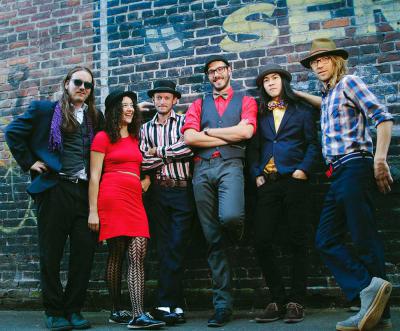
Down at the Old Whiteaker Firehouse, High Step Society may have a solution. The group calls it live electro-swing, and it marks the beginning of time’s reinvention. At once groovy and raucously tight, High Step Society’s tunes growl to a Cotton Club vibe that plunges the depths of the EDM trench. Picture, if you will, traditional scotch on mechanical rocks, or hand-written scrawls on a word-processing page. It’s breakbeat meets swing, big band meets house, The Count meets The Duke meets Martin Garrix — an exemplary fucking of time within space.
“Mixing live music with electronica is something that’s happening in a big way right now,” says Ethan Rainwater, High Step Society’s bassist. “Most of the time there’s still a backing track, something they’re playing to that’s prescribed. That’s something we’ve been able to phase out — we’re playing free.”
The group takes fusion to new realms, harnessing click-tracks while keeping the fluidity of jazz intact. Saxophonist Alex Misar says the sound as it now exists was not an overnight revelation.
“It’s ambitious,” Misar says, “and it’s taken a long time to find that sound. Certainly we’re still working on it. We’ve only just found our initial stride. We’re in a position now where if we can find a little more time to sit down [together], we can really start to rock.”
For a six-piece band, finding time to write and rehearse is challenging enough without also creating a proprietary style. Beyond Misar and Rainwater, High Step Society consists of Rebecca Conner (guitar, vocals), Parkpoom Aempoo (clarinet, trumpet), Nara Reicher (DJ, production) and Phil Allen (drums). Like electrons orbiting a musical nucleus, each member has its own path to keep, so it’s with rigorous planning that the group continues to master its art.
Reicher, who DJs regularly around town, says mixing his style with live jazz is something he never envisioned. He’s had to adopt fresh interests, but he embraces change as an essential facet of contemporary music.
“Electronic music is evolving at a very quick rate,” he says. “Three, four years ago there wasn’t trap music — there was something that sounded like trap. Each year there’s an entirely new style of music. Our interests change with it.”
The rest of the band tend to agree.
“As the collective music consciousness continues to evolve, our sound in 10 years might not be electro-swing,” Misar says. “It could be something radically different that I couldn’t even begin to tell you about. Things change so much that you have to be adaptive to current sounds — that’s how Miles Davis stayed popular.”
Popularity aside, the focus here is experimental duality — time and space — widening lenses of light and sound. There’s a lot to look forward to in this young band’s future, maybe even international tours. But at the end of the road, there’s always a beeline back to the States.
“I’m excited about touring Europe eventually,” Rainwater says. “But I’m also very excited about the prospect of bringing this music back home. Jazz was invented in this country — it’s the original American art form, and that’s a part of our culture.”
He adds: “It’s sad to me that jazz has been forgotten about in a lot of ways. It’s the music of your grandparents. No young people are listening to jazz, so I see this as a way for jazz to have a revival.”
High Step Society plays with Sepiatonic 10 pm Friday, Oct. 9, at Luckey’s; $5 dressed to the nines, $7 wearing rags. Come in your finest swing attire. For more information visit the High Step Society Facebook page.