 |
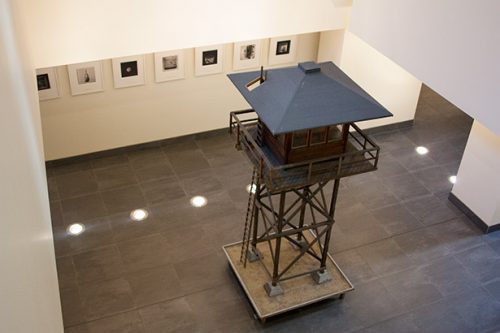
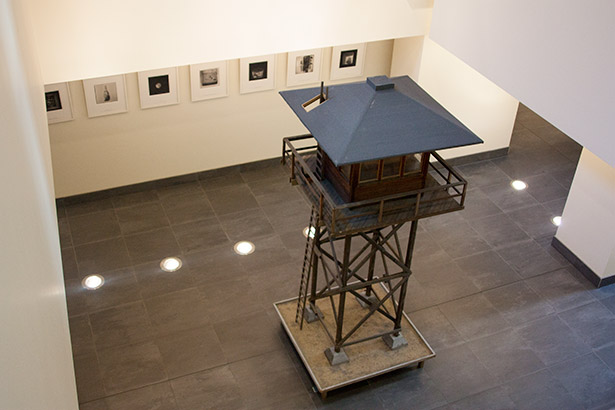
| Former prisoner Jimi Yamaichi’s guard tower replica on view at Wayne L. Morse Courthouse. |
Not many art exhibits require taking off your shoes and walking through a metal detector. Then again, not many art exhibits are hosted in federal courthouses.
In the context of this show, however, there’s something apropos about the process of entering: It heightens the senses before diving into this haunting presentation.
Such is the case of the Art of Survival: Enduring the Turmoil of Tule Lake, the traveling exhibit showcasing the plight and the fight of people of Japanese descent who were imprisoned on the West Coast during and after World War II. Located in the high desert of Northern California, just south of the Oregon border, Tule Lake was the largest internment camp of its kind, at its height housing 18,000 prisoners, a majority of whom were U.S. citizens.
Art of Survival is the first exhibit hosted by the Wayne L. Morse U.S. Courthouse, and it features photography of the art made by prisoners — captured by renowned California-based Japanese photographer Hiroshi Watanabe from 2009 to 2013, as well as a scaled-down guard’s tower made by a former prisoner and text banners detailing the history of this camp and its ephemera.
The exhibits spans the first three floors of the courthouse, as well as outside, where a line of recently planted Japanese cherry trees stand in front of the courthouse steps.
Chief District Judge of Oregon Ann Aiken came across the show at the Favell Museum last spring. “I saw this exhibit in Klamath Falls, which blew me away,” Aiken says. “My goal was just to get it in here.” This is the first of many art exhibits Aiken hopes to see here. To complement the exhibit, Aiken had 500-plus colorful origami cranes built and hung on the second floor.
On the bottom floor of the courthouse, four glowing photographic panels of prisoner graffiti from the camp’s walls hang, lit from behind. In a shaky scrawl, one panel says, “Show me the way to go home.” Another states: “Down with the United States.”
Aiken points to the numbers 9-0-6-6, each number shining through a different panel.
“That’s the executive order,” she says, referring to order 9066 issued by President Franklin D. Roosevelt on Feb. 19, 1943, that authorized the military relocation of peoples of Japanese descent, including U.S. citizens, to internment camps. In the U.S., more than 120,000 people of Japanese ancestry were removed from their homes and put into one of 10 War Relocation Authority camps. Tule Lake is considered the most notorious.
“It becomes the story of all the camps in many ways,” exhibit designer Madeleine Blake tells me over the phone from California. Prisoners at all camps were required to fill out the Loyalty Questionnaire. Two questions were of particular interest to the government:
“They basically asked if you would be willing to serve in the armed forces and would you give up your loyalty to any other national authority, in other words, the emperor of Japan,” Blake says. “If you answered no to either of those questions, in all the 10 camps, you were called a ‘No-No.’ All of the No-Nos in all of the camps were relocated to Tule Lake.”
One of the No-Nos, Jimi Yamaichi — the last prisoner to leave Tule Lake — created a replica of a guard tower, 25 years after he was released. There were 28 guard towers, Blake says. “It was never dark; the lights were always on.”
That replica now stands on the bottom floor of the courthouse, flanked by white walls featuring the photography of Watanabe. Yamaichi introduced Watanabe to his collection of art and artifacts from Tule Lake when they met for a project about San Jose’s Japantown. Blake says Watanabe became so interested that he traveled up to what remains of the Tule Lake site to dig through its dump where more artifacts were rumored to remain.
What he found there, and photographed, is a stunning example of the human condition and the will to endure.
“Everything that was made in Tule Lake was made from found objects — even the tools to make stuff,” Blake says. “They were given nothing. The art from Tule Lake is art that was made from seemingly nothing.”
The power of seemingly nothing is stark. The framed black-and-white images show artifacts such as teapots, canteens, coffee and baby powder tins and art made from pipe cleaners, carved wood and shells. Some women at the camp discovered the shells in the sands surrounding Tule Lake.
Watanabe’s elegant photography lies somewhere between dreams and nightmares: a doll made from pipe cleaners with a painted shell face seems to emerge from a fog; a beat-up metal pail — one was given to each imprisoned family — floats against a black background.
“In my mind, I think we need to know how far we can go in times of fear,” Blake says. “In times of fear we make decisions that can really compromise human rights.”
Art of Survival: Enduring the Turmoil of Tule Lake is on view at the Wayne L. Morris U.S. Courthouse through Thanksgiving. There will be a reception for the exhibit, and also honoring those in the community who helped create the Eugene Japanese-American Art Memorial at the Hult Center, at 3:30 pm Friday, Nov. 13, at the courthouse, 405 E. 8th Ave. FREE.