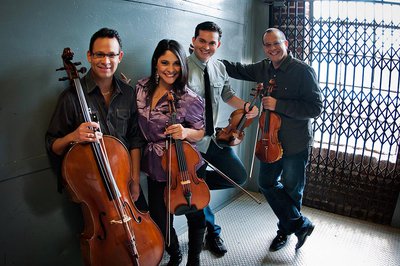
Most touring chamber-music ensembles stick closely to the tried (or is that tired?) and true 19th- and early 20th-century Central European repertoire. Not the Dalí Quartet. Starting out in Venezuela’s famous El Sistema music training program, which also produced L.A. Philharmonic music director Gustavo “The Dude” Dudamel, the members of Dalí Quartet went on to study at major American conservatories.
Now based in Philadelphia, the quartet never forgot its roots, specializing in 20th-century music from Central and South American composers that’s too rarely heard in the typical chamber music recital. For their Nov. 22 afternoon performance at the University of Oregon’s ChamberMusic@Beall series, the foursome will play some greats: music by contemporary Venezuelan composer Efraín Amaya; the great 20th-century Argentine composer Astor Piazzolla’s Four for Tango; the early 20th-century French-Argentine tango superstar Carlos Gardel, other Venezuelan and Cuban music; and (for variety’s sake) a couple of classics by dead European white males — German composer Johannes Brahms’s third quartet and Spanish composer Joaquín Turina’s The Bullfighter’s Prayer.
If you’re closer to Corvallis that same Sunday afternoon, you can hear another fine chamber ensemble, the Amelia Trio, play contemporary Russian composer Lera Auerbach’s evocative second piano trio, Triptych (which, like the titular painting, calls its movements “panels”), Dvorak’s famous “Dumky” trio and Debussy’s wondrous G major piano trio at the Episcopal Church of the Good Samaritan (333 NW 35th St.).
The Dalí Quartet show is but one of the month’s UO treats. At 7 pm Thursday, Nov. 19, at Beall, soprano Amalia Osuga (a student of the great singer and UO faculty member Milagro Vargas) and pianist Ednaldo Borba perform one of the 20th-century’s finest vocal compositions: French composer and mystic Olivier Messiaen’s 1936-8 Songs of Earth and Sky (Chants de Terre et de Ciel). Written during a happy time in the still-under-30 composer’s life, it’s a swirling, sometimes sultry and altogether dazzling half-hour song cycle that hasn’t been performed in Eugene in at least two decades.
At 7 pm Saturday, Nov. 21, at Thelma Schnitzer Hall, Future Music Oregon — the UO’s electronic music program — brings Polish composer and now Stanford prof Jaroslaw Kapuscinski to perform his intermedia creations, which lately have augmented his music with interactive video accompaniments. I hope he shows his witty 1992 Mondrian Variations.
The same night at 7:30 pm in Beall, the University Symphony plays an orchestral version of Stravinsky’s devilish A Soldier’s Tale and music by Delius and Ibert.
At 7:30 pm Monday, Nov. 30, UO faculty pianist Alexandre Dossin continues his series of Brahms’s complete chamber music with the gorgeous Clarinet Trio, second Clarinet Sonata (both starring Eugene Symphony star Michael Anderson) and first Cello Sonata, with Steven Pologe.
For a different kind of chamber music, check out The Shedd at 7:30 pm Thursday, Nov. 19, when splendid saxophonist Joe Manis joins chanteuse Siri Vik for the latest in their series of covers of classic jazz albums, this one less well-known than its predecessors: the great singer Abbey Lincoln’s That’s Him!, which includes music by Kurt Weill, Harold Arlen, Billie Holiday and more. Excellent Portland pianist Greg Goebel, bassist Tyler Abbott and drummer Todd Strait will back the duo.
And next Friday, Nov. 27, from 7:30 to 10 pm, Bay Area-based singer Ramana Vieira brings her quartet (cello, bass, 12-string guitar and drums) to The Jazz Station to perform the magnificently melancholy Portuguese balladry of fado, along with more upbeat numbers from her latest album. Vieira’s show completes a world musical tour featuring stops in France, Latin America, Russia, Portugal, Poland, Spain and New York.