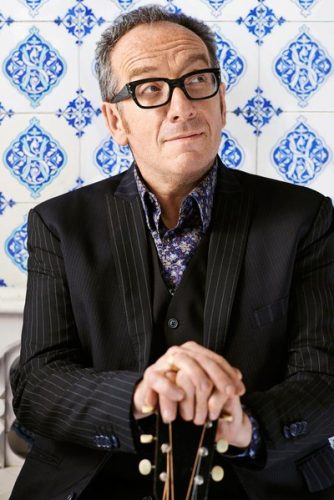
He descended on the Carter era of gas lines and bloody carpets and post-love funk like some infernal geek bastard child of Buddy Holly and Johnny Lydon, spitting out lyrical venom over gorgeous hooks and bellicose riffs that plumbed the deepest, darkest wells of pop music — billboard fuzz attacking itself with newborn impunity — all of it churned out with a churlish amphetamine sneer that belied his antediluvian genius for melodic universalism within the three-minute cliché of radio-radio rock.
The artist known as Elvis Costello seems to reside on a separate plane, one that exists slightly off-kilter and ajar from that occupied by the general run of musicians. The man is somehow outside of time and yet utterly embedded in it. He is a purveyor of nostalgic futures and an archivist of orthodox pop melodies. And as a voracious raider of genres, Costello has an uncanny knack for finding just the right progression (see, for instance, “Beyond Belief”) and coupling it with lyrics of naked poetic aggression (see, for instance, “I Want You”).
And if such things are possible, he is at once underrated and overestimated, an unclassifiable nerd-savant whose grit ratifies his gleam. Underrated because, by most aesthetic standards, Costello should hold a place of cultural esteem rivaling that of, say, David Bowie or Johnny Cash. Overestimated because folks like me have been hollering “genius” for so long it’s grown tiresome and rote, as though Costello were something other than human.
Costello, of course, is all-too-human, as prone to vulnerability and fuck-ups as any of us; his long and stellar career is marked by some gargantuan muffs (witness the 1979 Ray Charles incident, for instance). And yet that fallibility and vulnerability, expressed at times in an unhinged snarl, is what compels the perpetual brilliance of his music, which exhibits the cruel reckonings of Bob Dylan, the compositional innovation of Brian Wilson, the Tin Pan traditionalism of Burt Bacharach and the pop savvy of Paul McCartney.
Born Declan Patrick MacManus, Elvis Costello burst onto the scene in 1977 with My Aim Is True, one of the most stunning debuts of the latter half of the 20th century. Since then, his music has remained vital and relevant and challenging as he’s moved through a series of incarnations (country, folk, jazz, pop, stomp, string quartet, etc.), all the while maintaining that certain undeniable Costello-ness: lyrics that are by turns angsty and romantic but always sharp and poetic; a talent for laying down tasty pop confection; a furious political engagement; and adherence to the value of what can only be called “authenticity,” a willingness to be real and risky.
To encompass the full breadth and depth of Costello’s career would require a book at least (something he himself just published, to critical acclaim); there are just too many too many great albums, too many great songs (go back and listen to “Alison” for one example among many perfect songs he’s written). So, fuck it, for my money, Costello’s finest achievement, and in a way his most unlikely, is King of America (1986), a folksy, countrified cycle of songs that is so immaculately conceived it almost hurts. But the moment I make such a claim, inner objections arise: What about Imperial Bedroom? What about This Year’s Model? What about Brutal Youth?
Whatever. As much as I admire Costello, I can’t keep up with him. Even believing devoutly in his legendary qualities and his artistic brilliance, much of his body of work remains a mystery to me, as yet undiscovered (so there’s that overrated/underestimated factor). I suppose there’s always time. For now, I’m just thrilled to know that, very soon, I’ll get to stand in the same building Elvis occupies for a brief moment in Eugene (his only Oregon stop) as he plays a solo show. That’s something I thought I’d never get the chance to do. And that makes me happy.
Elvis Costello’s ‘Detour’ Tour with opener Larkin Poe plays 8 pm Saturday, April 16, at McDonald Theatre; SOLD OUT.