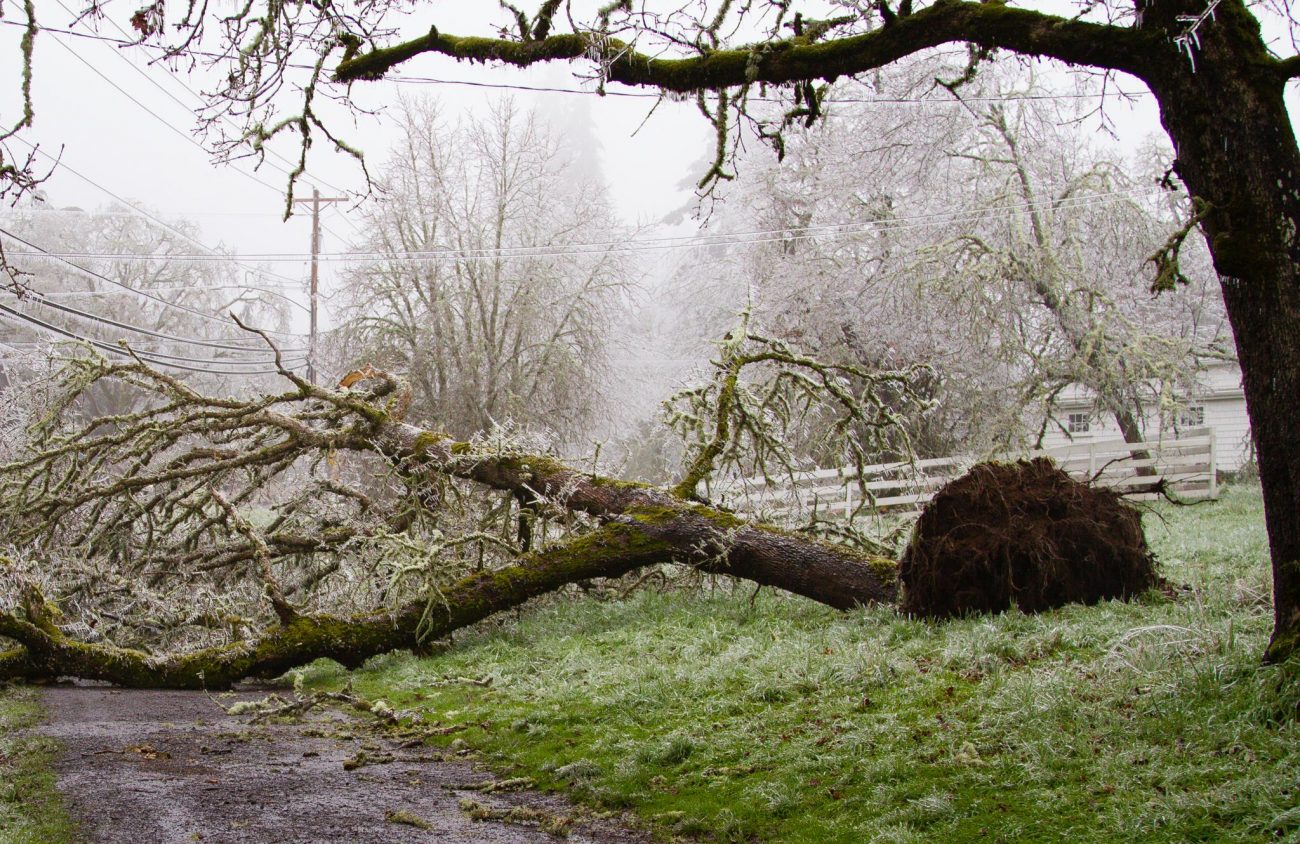
An immense old oak tree crushed Kaye Parsons’ garage roof during December’s record-breaking ice storm in Eugene that knocked out power to thousands.
Parsons can show you the enormous tilted stump of the tree, which also smashed through her wood fence on a hilly part of West 29th Avenue in the Friendly Street neighborhood. Piles of chopped branches from hundreds of fallen trees are stacked in many front yards of this venerable Eugene neighborhood.
“It’s an old neighborhood so the properties are bigger and the trees are bigger,” Parsons tells EW in a Jan. 2 interview at her house. Her older neighborhood also features mostly overhead power lines, like many other such neighborhoods in Eugene.
Areas like this saw the most damage and power outages during December’s ice storm because there are so many overhead power lines and so many aging trees planted.
The city of Eugene changed city code several decades ago to require all new subdivisions to use underground power lines, but powerful ice storms like the one last month continue to cause monstrous damage because of Eugene’s many trees and the existing overhead power lines already in place.
So, why not just put more power lines underground?
It’s complicated, says Eugene Water and Electric Board (EWEB) spokesperson Joe Harwood. Each year, EWEB crews install $200,000 to $400,000 of new underground power lines throughout Eugene, at a cost of about $150 a foot for a smaller line and $500 a foot for a larger transmission line.
“Several hundred thousand dollars doesn’t go very far when you are talking a minimum of $150 a foot,” Harwood says.
The city already has 552 circuit miles of underground lines running under it, and 3.5 miles of underground transmission lines (most of downtown uses underground lines thanks to urban renewal funding). Conversely, there are 160 miles of overhead transmission lines and 563 miles of overhead lines throughout Eugene.
Parsons’ house, which lost power in the storm, sits on a hillier section of West 29th Avenue. Her living room view is eye-level with a towering handful of pine trees and a big telephone line that runs through the alley.
“In this old neighborhood, it wouldn’t be feasible to bury it,” says Stan Parsons, Kaye’s husband. Changing an overhead line to an underground line requires working with private landowners and digging around old sewer and water lines, to name only a few of the obstacles, Harwood says.
Additionally, city crews must get rights-of-way passed and an even simpler problem — big rocks under the soil — may also block an underground line from completion, Harwood says.
After lines are buried, another problem could arise if homeowners accidently dig into lines before checking with EWEB about possible buried utilities.
“We had one mile of downed overhead lines in the Saratoga and East 53rd area a couple weeks ago,” Harwood says, referring to the December ice storm. “If we moved all that underground, we’d have to go under the backyards of all these people.”
Broken limbs and shattered trunks still line miles of Eugene streets. Crews were able to clear fallen trees from roadways during the storm, but many trees have lain untouched at the roadside since.
Neighborhoods hit hardest by the storm include the South Hills, Southwest Eugene, the Ferry Street Bridge neighborhood and College Hill.
Harwood says the storm left EWEB with about $4.2 million in damages, which it hopes can be partially reimbursed through emergency funds from the Federal Emergency Management Agency.
EWEB will be holding a public information meeting 5 to 7 pm Monday, Jan. 9, at the EWEB building.
“We want to explain what happened and how we approach restoration,” Harwood says.