Most of us collect objects of some kind: a shell, a concert ticket, a dried flower kept in a book as a keepsake.
But what if you went to someone’s house and they had a whole room filled with such objects — and those things weren’t personally tied to their experience? Would you perhaps think that person was wired a little differently?
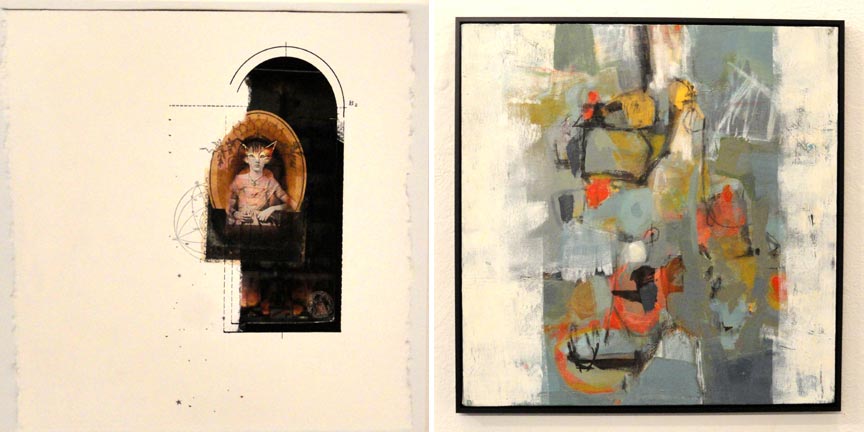
The title of Beverly Soasey’s artwork Wired Differently (Self-Portrait), showing at Maude Kerns Art Center in the exhibit Unspoken, speaks to a popular stereotype about artists: that they are different. Not quite like the rest of us. Who collects scraps of metal, birds’ wings, books, boxes and old photographs of people they don’t know?
Well, Soasey does. She says her studio is filled with such objects. That they are not connected to her personal history doesn’t keep her from finding value in them. They are the source of inspiration for her art.
It isn’t necessarily the objects themselves that hold value. It’s how they are put together. Give two artists the same objects and they will find two different ways to assemble them. Showing with Soasey in Unspoken is Beth Robinson.
Robinson shares Soasey’s passion for objects. She says she “obsessively” collects. Robinson’s artwork Queen of Empty Coffers is also a portrait, and it features an object that is present in Wired Differently (Self-Portrait) as well. It is a box divided into a number of sections, each of which holds an item of some kind. The actual box sits in Soasey’s work, while a picture of it is in Robinson’s.
The box may not be immediately recognizable in Robinson’s work because she photographs and scans her objects, manipulating their appearance to suit the design.
The three artists showing in Beyond Language seem not so interested with objects in themselves. In fact, much of the work in this exhibit moves entirely away from representing recognizable things. Suma Elan, Zoe Cohen and Rebecca Mannheimer all share a painterly approach to making art that leans towards abstraction.
“Mark-making,” Cohen says, “has power to speak to truth ‘where words have failed us.’”
This is a sentiment common to many abstract artists. They make marks — shapes, lines and colors — to get beyond what is superficial. Cohen’s works fluctuate between referencing subject matter and total abstraction. Looking at her paintings Shipyard Wall and Beneath I can see ships or parts of ships. But the Roadmap keeps me guessing.
Mannheimer’s artworks are light and playful. Her mixed-media pieces in particular, such as The Unexpected Begins to Emerge, include simple drawings that are done with a nod to children’s art and an inquisitiveness about the way things work.
Elan’s artworks Prayer and Wordless are completely abstract. The titles reference Cohen’s idea about art — that it can speak to (for lack of a better phrase) something which can’t be arrived at with words. It is an idea that all five artists seem to share.
Beyond Language and Unspoken continue at Maude Kerns Art Center, 1910 E. 15th Ave., through March 24. Hours 10 am to 5:30 pm Monday through Friday and noon to 4 pm Saturday. Suggested donation $3.