What do you want to be when you grow up? It’s a question asked of children, and they know to pick just one thing. Sometimes it works out that way. You decide on a profession or fall into a job, and then stay in it the rest of your life.
Other times you choose one answer, and after nearly 20 years, put it aside and choose another. That is how it happened with Allan Kluber, whose ceramics are on view at Karin Clarke Gallery through July 1.
Kluber moved to Oregon to study ceramics at the University of Oregon. After earning his degree he worked as a studio artist rather than as a professor.
His inability to find employment as an instructor at first seemed unfortunate. Looking back, Kluber realizes that it afforded him time to focus on making art. He produced colorful porcelain ceramics during the 1970s and 1980s, showing in town at the former Opus V gallery, and he received fellowships from the National Endowment for the Arts and the Oregon Arts Commission.
At his opening earlier this month, the artist explained how he made his ceramic pieces by layering colored clays into blocks and then slicing them. The results are strands of varying widths, with colors running across plates and around bowls and vases.
Each artwork is functional, but the designs are abstract, with lines of color randomly and gracefully embedded in the formats.
All the pieces on view at the gallery were made in the 1980s, during the last two years of Kluber’s time in the studio. When he stopped making them he went back to school, earned a degree in counseling and gave up his preoccupation with art for interacting with people and raising a family.
When this exhibit was scheduled, it was to show the artworks that Kluber produced in the days he worked in the studio. At the time he didn’t tell Karin Clarke that he was working on something new, because he didn’t exactly know how it would turn out.
So he worked in secret.
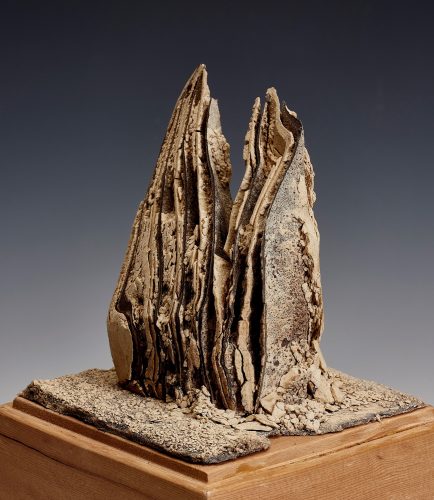
Last summer Kluber took a trip to southern Utah. There he was moved by rock structures, in particular by the vast spans of time it took for nature to create them, eroding and restructuring them differently. He saw those rock formations in terms of clay, and when he returned to Oregon he began creating his own versions. He replaced the forces of nature with his own hand by pouring water over blocks of layered clay to emulate the effect of erosion.
Kluber refers to this series of sculptures as “Geologic Forms.” Displayed at the gallery, the forms are framed in cases and resemble miniature biospheres.
Old Work/New Work includes a collection of pieces made by Kluber in just the past few months as well as a collection produced about 40 years ago, from his first time in Oregon working in the studio. The geology metaphor, so striking in the sculpture, can be seen in the colorful layers of his earlier work as well.
I asked whether he had been thinking about geology back when he made those first pieces. No, he said, it wasn’t until he looked back that he found the idea of stratigraphy in his old work.
Today Kruber works as a mediator — and as an artist once again. He thinks of the sculptures as being in their adolescent stage. Now in his early 70s, he is once more at the beginning.