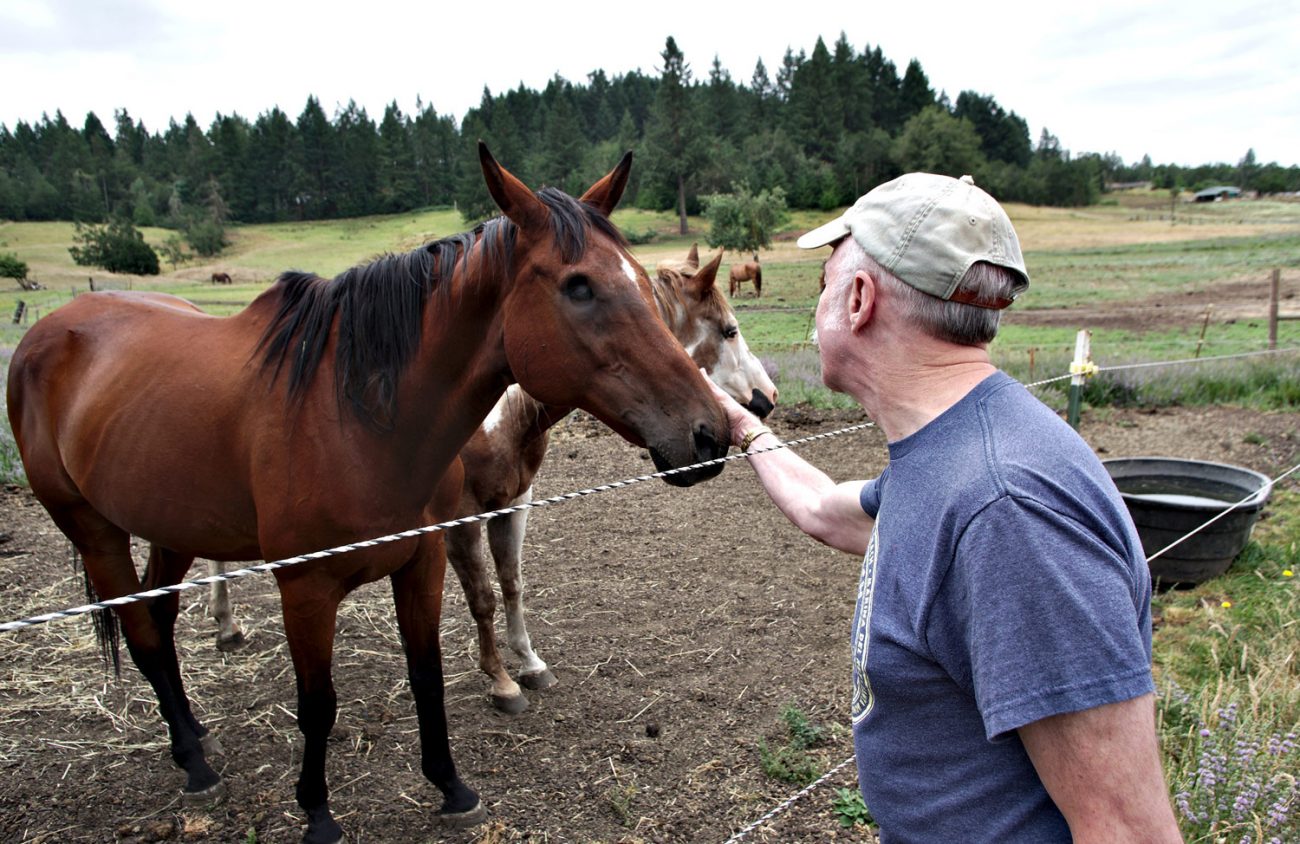
Humans, if we’re very lucky, get to retire in some comfort. Horses — some of humankind’s closest companions for thousands of years — have to be extremely fortunate to be cared for past their productive years.
On 70 rolling acres a little west of Eugene, a former Eugene city councilor and his wife have spent the past five years, with the help of a small army of paid staffers, volunteers and donors, providing what amounts to a retirement home for dozens of lucky horses who might otherwise have been put down.
We’re talking blind horses, horses with cancer, horses who limp, horses whose age is so advanced that it’s become a chore to care for them. Oregon Horse Rescue takes them in and literally puts them out to pasture.
“What it comes down to is, what’s the horse’s quality of life?” explains David Kelly, who founded Oregon Horse Rescue with his wife, Jane, five years ago. “If the horse can continue to roam the pasture and enjoy life for another year or two, they can do that here.”
Kelly, who served on the City Council for eight years, has always been “an animal guy,” he explains during an afternoon visit to OHR’s facility, which consists largely of rolling pastureland, all neatly fenced and cross-fenced, with four well-tended barns.
We strolled down a long gravel road that runs along the spine of OHR’s pastureland. Every 100 feet or so Kelly would stop and talk to another horse. In a barn we checked in on Honeybun, a blind miniature appaloosa mare who came to the fence to be petted. She lives with Bella, a blind Arabian mare.
He and his wife, Jane Kelly, had talked since they met three decades ago about “doing something” for animals. They picked horses because Jane had ridden competitively and knows the animals, and because there was a strong local need, he says.
“There is a huge problem in this area of horses who are neglected, flat-out abandoned or in some cases abused,” he says.
“People don’t realize it’s a lot more to take care of than a big dog. The horse gets an injury, or the horse is too old to ride. Owners age, and they can no longer live on rural property. Or owners die. There is a huge need for folks who can and will care responsibly for horses that others won’t.”
The word “rescue” suggests an intervention site that provides temporary housing on the way to adoption. But most — as many of two-thirds — of the horses at OHR won’t be going to other homes. “They are elderly or blind or have a chronic medical condition that needs treatment,” David Kelly says.
The Kellys set up Oregon Horse Rescue as a nonprofit corporation. It rents the land from them — the Kellys bought the property themselves and live there.
Taking care of all those horses requires money. OHR expenses for a year added up to $273,000, according to the corporation’s 2015 tax filing. Last year, Kelly said, expenses included about $65,000 for feed and more than $70,000 in veterinarian bills.
Fundraising being the challenge that it is, Kelly says he and his wife have contributed nearly $1 million of their own money to the organization in the past five years.
The rewards, though, are simple. “A horse that comes to us skin and bones and afraid of his own shadow, several months down the line seems to have a smile on his face, strolling around the pasture,” Kelly says. “Life is good!”
A Note From the Publisher

Dear Readers,
The last two years have been some of the hardest in Eugene Weekly’s 43 years. There were moments when keeping the paper alive felt uncertain. And yet, here we are — still publishing, still investigating, still showing up every week.
That’s because of you!
Not just because of financial support (though that matters enormously), but because of the emails, notes, conversations, encouragement and ideas you shared along the way. You reminded us why this paper exists and who it’s for.
Listening to readers has always been at the heart of Eugene Weekly. This year, that meant launching our popular weekly Activist Alert column, after many of you told us there was no single, reliable place to find information about rallies, meetings and ways to get involved. You asked. We responded.
We’ve also continued to deepen the coverage that sets Eugene Weekly apart, including our in-depth reporting on local real estate development through Bricks & Mortar — digging into what’s being built, who’s behind it and how those decisions shape our community.
And, of course, we’ve continued to bring you the stories and features many of you depend on: investigations and local government reporting, arts and culture coverage, sudoku and crossword puzzles, Savage Love, and our extensive community events calendar. We feature award-winning stories by University of Oregon student reporters getting real world journalism experience. All free. In print and online.
None of this happens by accident. It happens because readers step up and say: this matters.
As we head into a new year, please consider supporting Eugene Weekly if you’re able. Every dollar helps keep us digging, questioning, celebrating — and yes, occasionally annoying exactly the right people. We consider that a public service.
Thank you for standing with us!

Publisher
Eugene Weekly
P.S. If you’d like to talk about supporting EW, I’d love to hear from you!
jody@eugeneweekly.com
(541) 484-0519