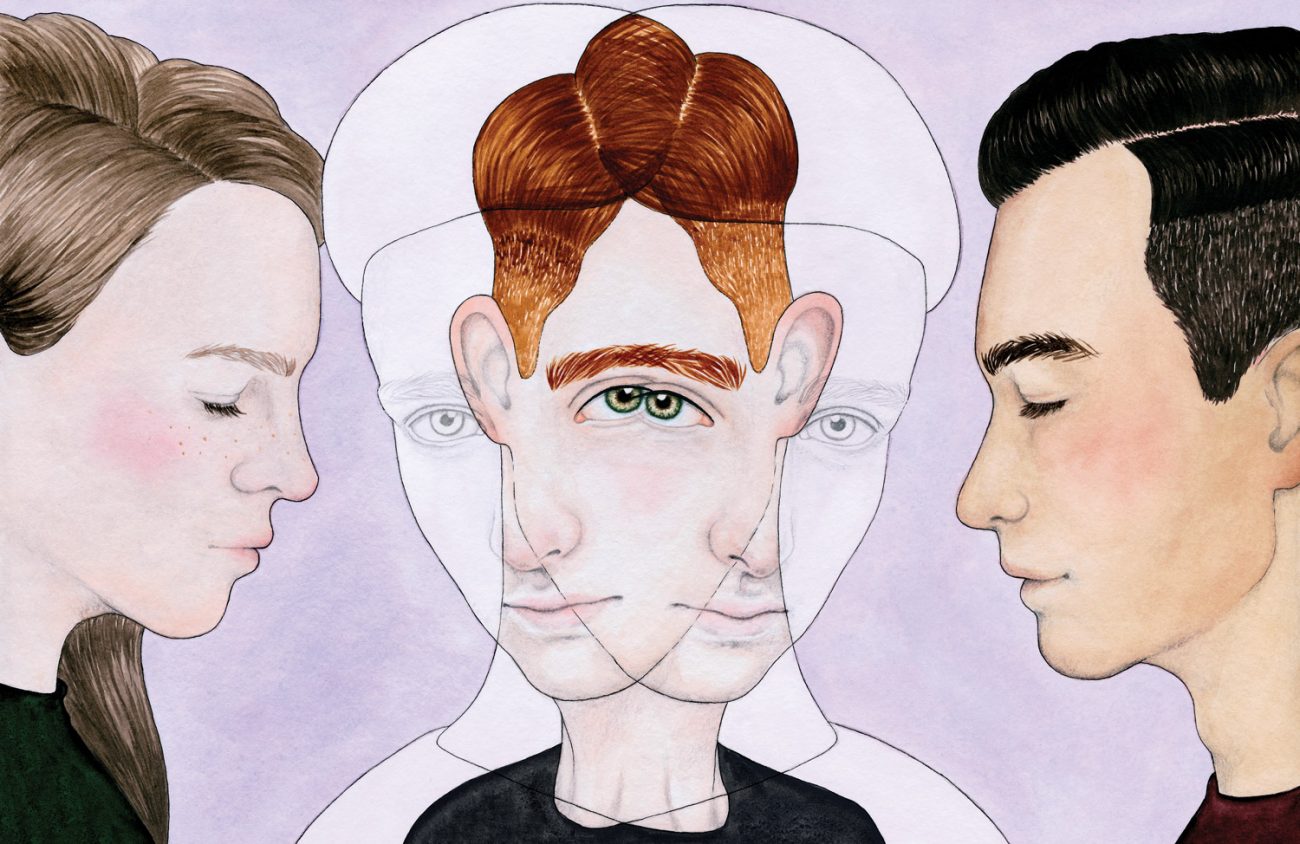
So what’s it like to be bisexual? Henry Osborne, 22, says it can be confusing. “It’s weird to be attracted to both, and people don’t believe you a lot of the time,” he says. “People will give you kind of a look if you say you’re bi. Especially people in queer circles — they don’t really believe you.”
Bisexual people, despite having a stable sexual orientation of their own, are often assumed to be “going through a phase” instead of being permanently bi. Some may assume they’re only halfway out of the closet, while others will say they “went through a phase in college” if they end up with a member of the opposite sex.
Bi people are therefore more likely to be treated with suspicion in LGBT communities, and face increased isolation because of it. As a bisexual myself, I’ve experienced some of these issues — I’m still not sure my parents believe me about my identity since I came out in college.
Osborne says that others misunderstand his sexuality, expecting that he can “turn it on and off.” He says that when he came out to his parents as bi, they didn’t understand. “I was like ‘Mom, I’m not gay, I’m bi,’ and she was like, ‘Oh, but you’re gay right now.’”
“When I was in a relationship, everyone thought I was just gay,” Osborne adds. “I didn’t correct them because I’d get looks and whispers, so I just let them believe I was gay.”
According to a 2011 report by the San Francisco Human Rights Commission, Bisexual Invisibility, “Other people’s assumptions often render bisexuals invisible. Two women holding hands are read as ‘lesbian,’ two men as ‘gay,’ and a man and a woman as ‘straight.’ In reality, any of these people might be bi — perhaps all of them.”
Bisexuals are rendered invisible — their identity subsumed by their relationship. Osborne says he often heard derogatory comments about bisexuals when he was part of a queer community during his last relationship. “They told me bi people don’t exist,” he says.
Bisexual women can face similar issues. Tatiana Enriquez is a 33-year-old student from Guayaquil, Ecuador currently enrolled at Lane Community College. She says she was outed as a lesbian when she still lived in Ecuador, despite actually being bi. “It was awful,” she says.
Homosexuality is really taboo in Ecuador, she adds. “Being a tomboy doesn’t mean you are a lesbian, it’s just part of me.”
Though Enriquez prefers serious relationships, she says many people assume she’s promiscuous because of her identity. “Sometimes people think that because I’m bisexual I like all the girls and all the men. It’s not like that.” Most here in the U.S. assume she’s straight until told otherwise. “I am a person who loves people, regardless of gender,” she adds.
Hannah Steinkopf-Frank is a recent University of Oregon graduate who identifies as bisexual or queer. “I think it’s in the nature of being bisexual that you have a tendency to be left out,” she says.
“When you’re with a man you can feel like a fake member of LGBTQ. You feel like you’re an intruder because you’re fulfilling a part of your identity that fits in with hetero-normativity,” she says.
I can relate to that. Though I’m bisexual, I agonize over checking the LGBTQ box on census forms, scholarships and job applications — since bi people can usually pass for straight, the bi identity can feel like taking resources from other, needier people. When I came out to my family, reactions varied from “What? I don’t understand” to “You’re doing this for attention” to “Your boyfriend can never trust you not to cheat.”
My parents probably still think I just went through a phase in college. I’m in a happy relationship with a man right now, so clearly my “gay phase” has come to an end. I can assure you that I remain bisexual despite my loyalty to my male partner. I certainly feel like an outsider in LGBTQ communities — too straight to fit in, not queer enough to be considered.
Straight partners can be quite jealous, too -— or can fetishize the idea of two women making out in front of them. I can’t tell you how many times I’ve searched Tinder for potential dates with women and found couples seeking a third for a ménage à trois. From an actual Tinder bio: “Cute boy in the first picture and I trying 2 find one more [tongue sticking out emoji].”
Osborne says being bi can feel like you’re not quite queer enough. “I worry about taking the conversation away from people who are more in danger and more in need of support than I am,” he says. “But at the same time it does bug me that the queer community in general can be really exclusive towards bi people even now, and dismiss them as either closeted men or promiscuous women who are just going through a phase and trying it out.”
So what does this mean for bi people? They tend to have mental health issues and feel isolated, as it turns out.
According to the Bisexual Invisibility report, “Previous studies may have overemphasized the risk of mental health problems for homosexuals by grouping them together with bisexuals.” The report says that 45.4 percent of bisexual women report suicidality, compared to 29.5 percent of lesbians. There’s a similar disparity between bisexual and gay men.
Being invisible means bisexuals don’t have clear role models in the media. Bisexuals don’t have precedents for their sexuality, and neither queer communities nor the straight population understands them. Even Oregon’s bisexual governor, Kate Brown, occasionally faces ignorant questions because she is married to a man.
But with high-profile people like Brown out about their bi status, as well as celebrities such as Drew Barrymore and Carrie Brownstein, bisexuals are finally becoming more visible.