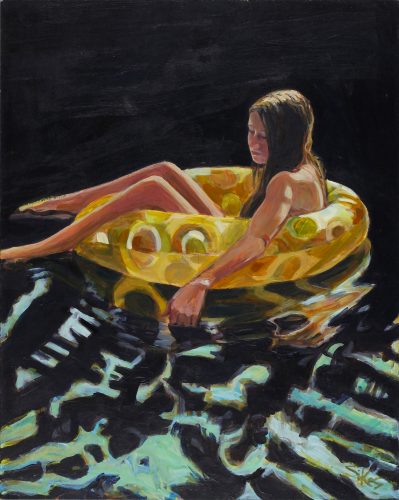
An entire room at the Maude Kerns Art Center is dedicated to Melissa Sikes’ series of artworks titled The Back Dock. Other paintings from the series are sprinkled throughout the rest of the art center, too, in a group show that’s up through Aug. 25. All of Sikes’ paintings are of the same outdoor place: the back dock by a lake where her family has been spending summers for years.
According to the artist, the front dock is for boats, and the back dock is for lounging and swimming. The back dock is where she spends most afternoons in summer.
The show is titled after a place in nature, but it’s the figure that takes center stage. The water and trees, painted in values of greens, are often so dark they read as black. The landscape provides a background for the figures, and the dock acts as a platform.
The paintings are done in acrylic on wood panels because, the artist says, wood references the natural landscape of the scene. The grain of the wood provides an additional design element as well, particularly where the paint is applied thinly and the lines of grain are visible. Horizontal in some works and vertical in others, the grain lines add an underlying movement to the serene scenes of summer.
Pointer Finger depicts a figure from the back, a young woman in a swimsuit lit brilliantly from above throwing a dark shadow in the foreground. In Dock’s Edge II a young woman peers over the dock at the water, either at the lake or at her own reflection. Swim Dock Readers is a series of four paintings that feature young women on lounge chairs reading in the sun.
The question of where inspiration comes from is often asked of artists. The answer differs depending on the particular artist. The renowned conceptual and installation artist Yayoi Kusama, for example, was sitting at the kitchen table as a child when the dots on a tablecloth seemed to come off and float in the air. That experience has inspired her career as an artist, and she creates rooms full of dots using lights and mirrors to simulate the experience of seeing infinity.
The inspiration for Sikes’ work comes neither from hallucinations nor the grand desire to depict infinity. It comes from the feeling the artist gets spending a summer afternoon by the water, hanging out with family or friends. The poses are not unlike the ones models take during a figure drawing class. They recline, read a book, sit and stare. They take the kind of positions a person can keep for a long period of time without having their hands or legs fall asleep. They don’t really pose, Sikes’ husband said at the opening of the exhibit about his daughters’ participation in their mother’s work. It’s this that the artist captures well: people not posing, people not doing anything except for hanging out.
It’s not an easy task describing that feeling of lingering by the water for an entire day — all those days by the lake, or if you’re from L.A., like I am, then all those afternoons by the pool.
How do you describe the way it feels to sit on the edge of a dock or on a diving board in the moments before taking that first dive? How do you represent just hanging out? One picture at a time. That’s why these paintings have a cumulative effect, adding up nicely to what it felt like — summer afternoons spent by the water.