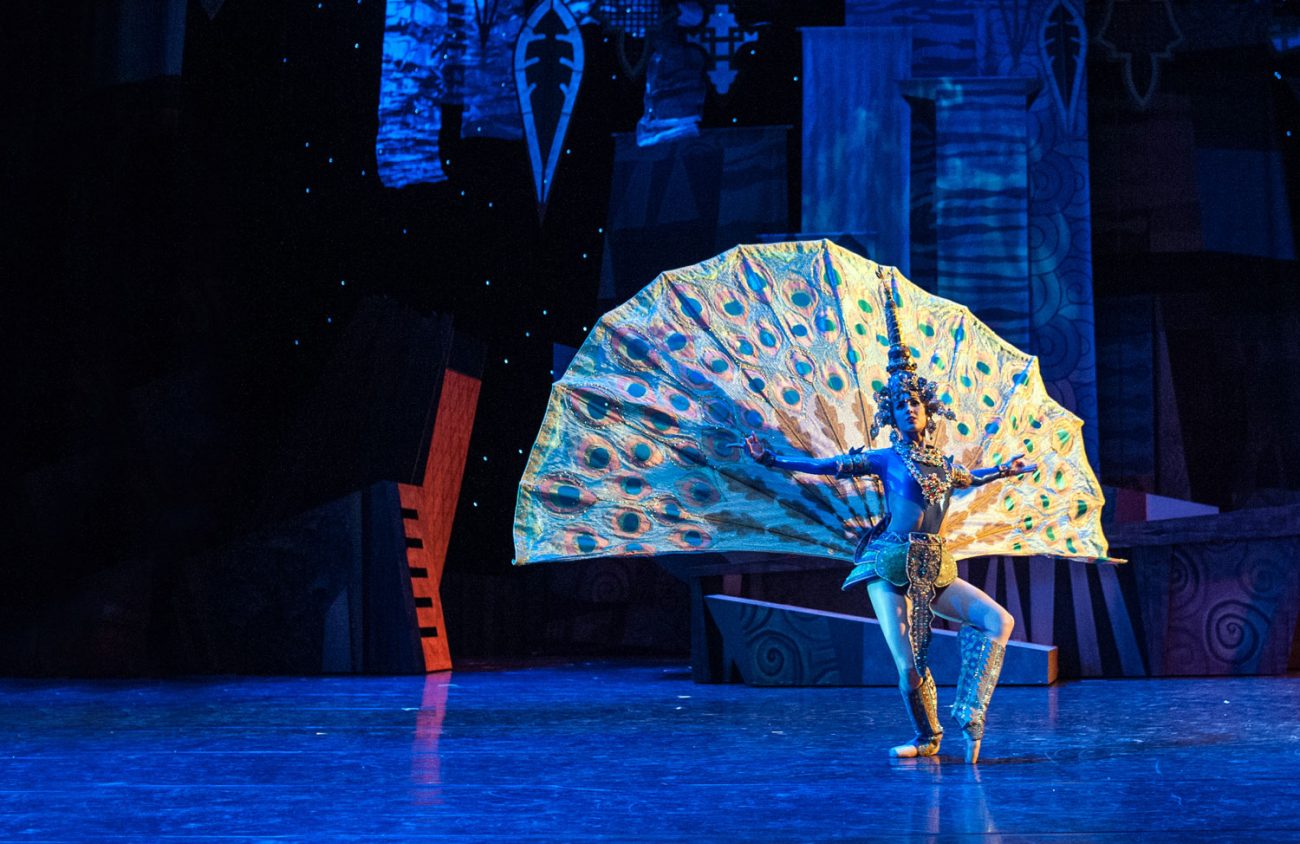
If you’re like me, your experience with ballet is limited to The Nutcracker. As such, I associate ballet with incredible athletics, surreal costumes and incomprehensible plotlines.
Halfway through The Nutcracker, I usually get bored. That was not the case with Eugene Ballet’s production of Mowgli, which may have converted me from apathy toward ballet to wonder.
Mowgli is the familiar story of The Jungle Book, transformed by ballet. Title cards explain plot points before scenes, allowing me to focus on how the choreography told the story rather than squinting to decipher. The music was vaguely Indian, as were the costumes, designed by Jonna Hayden.
The dancers moved like the animals they portrayed: Koki Yamaguchi in particular, who danced the Monkey King, was incredible to watch. He jumps in the air, flittering his feet and kicking his heels like an energetic rhesus macaque.
An example of choreography telling the story: After the monkey troop steals Mowgli, Baloo (Mark Tucker) and Bagheera (Danielle Tolmie) seek the help of the great snake Kaa to help rescue him. Before Kaa’s arrival, the monkeys move in circles, leaping and jumping in joy around their captured foe.
Once Kaa arrives, they sway back and forth, facing him, and eventually succumb and walk into his gaping maw (symbolized now by the set), some monkeys dragging the others to their doom.
Baloo the bear makes wide, sweeping movements, his great mask and bulky costume giving him the breadth and height of a bear. Bagheera the panther is lithe and elegant, at times stretching luxuriously on the stage in her Catwoman-like costume.
Hirofumi Kitazume, who danced Mowgli, is a comedian on the stage. As he secretly studies the nearby humans, he mocks their movements. When he fights Shere Khan, he dramatically kicks at the tiger, then turns to the audience with a coy smirk.
Mowgli’s choreography — all by Toni Pimble — is brilliant as well. When he finally returns to the humans, the music and his movements show that he is terrified by their speech. His wild movements clash with the smooth transitions of the villagers. But as the music becomes more soothing, he grows more restrained, his body language mirroring that of his human mother. By the end, it was clear he “spoke” the same body language and had joined the community.
I’ll add that if you’re sensitive to cultural appropriation, this ballet has the same sorts of pitfalls as Rudyard Kipling’s The Jungle Book, written in 1894, but that shouldn’t come as a surprise. If you can get past that, it’s a hell of a fun show.
Mowgli is the perfect starter ballet for youth and the uncultured — like me — alike. Regardless of your understanding of the technicalities of ballet, this one will entertain you in its costuming and diversity of movement.