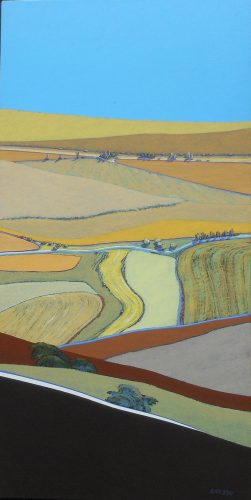
An appealing mix of reality and imagination in each of Jon Jay Cruson’s paintings reminds me of a bit from the first days of the TV show Saturday Night Live. Father Guido Sarducci, a character on SNL, suggested that a planet just like ours existed on the other side of the sun. We couldn’t see it, of course — because the sun is in the way — but this other planet was just like ours in every way except that people who lived there ate their corn on the cob north-south (up-down) instead of east-west (across). Though this was the only difference, Father Sarducci didn’t want to go to this other planet because he said he was a creature of habit and eating corn north-south would just be too messy.
Cruson has a series of paintings on exhibit at White Lotus Gallery that are clean and linear — not at all messy. Still, they have something in common with Father Sarducci’s alternate planet. They look just like Earth but are, in fact, different. Each of his paintings looks like a representation of somewhere you could get to on this planet, if only you were given a location. But Cruson doesn’t title his landscapes by place. He names them with titles such as: “A Quiet Road” or “Valley Below No. 2.”
To prepare for his paintings, Cruson does quick sketches of landscapes and then saves them to use later as reference material, when he picks and chooses from a handful of sketches to create just one painting. There is a reality to Cruson’s landscapes but it’s not a simple one. You may recognize a piece of a painting but you’ll find nowhere on Earth, at least not this one, where a place entirely exists the way it’s seen in, say, “A Quiet Road” or “Valley Below No. 2.”
Organizing spaces differently on his canvas gives Cruson a “sense of freedom” and allows him to play.
“I love playing with perspective,” he says.
He plays with perspective in art and also in life. Before he started this series of landscapes he painted streams, studying light and water and how waves break. He’d been studying and painting streams for a long time, he says, when one day in an open space he looked out, instead of down, and was taken by the vista. This shift in perspective led him towards an entirely different subject matter.
What’s interesting about the way this artist plays with perspective in his landscapes is the subtlety. His paintings read so well as actual places that we don’t readily register when a rule is broken. Lines of roads don’t taper off when they should to indicate distance, values or shadows aren’t always consistent, and we barely notice at all. We see the overall picture and the rich warm colors of the Cascades.
Cruson plays with colors too, not feeling restricted by the seasons or colors attached to any particular subject. He is not an abstract Color Field artist though. He paints actual fields, the kind you find in open agricultural spaces; the kind you see near Sacramento, California, where he was raised, or the kind just outside Eugene, where he lives now.
Cruson graduated with an MFA from the University of Oregon in 1968. By the time Father Sarducci was cracking his corn on the cob joke on SNL, Cruson was showing in his first art exhibits. Talking to him, I get the sense that his art career has been as much fun as it’s been work. He speaks a lot about “play.” He plays with the elements of design, with perspective and color, and he plays around with what he’s seen and where he’s been.
In the end, he leaves off the location on the titles of his paintings because the places don’t exist entirely as pictured, but there’s another reason too. He doesn’t want to close off anyone’s feeling of recognition. When someone thinks they recognize a place in one of his pictures, he doesn’t want to take that away from them. He likes to leave his open spaces, well, open.
Interpretation of the Landscape: Paintings by Jon Jay Cruson is up through Nov. 28 at White Lotus Gallery, 767 Willamette Street.