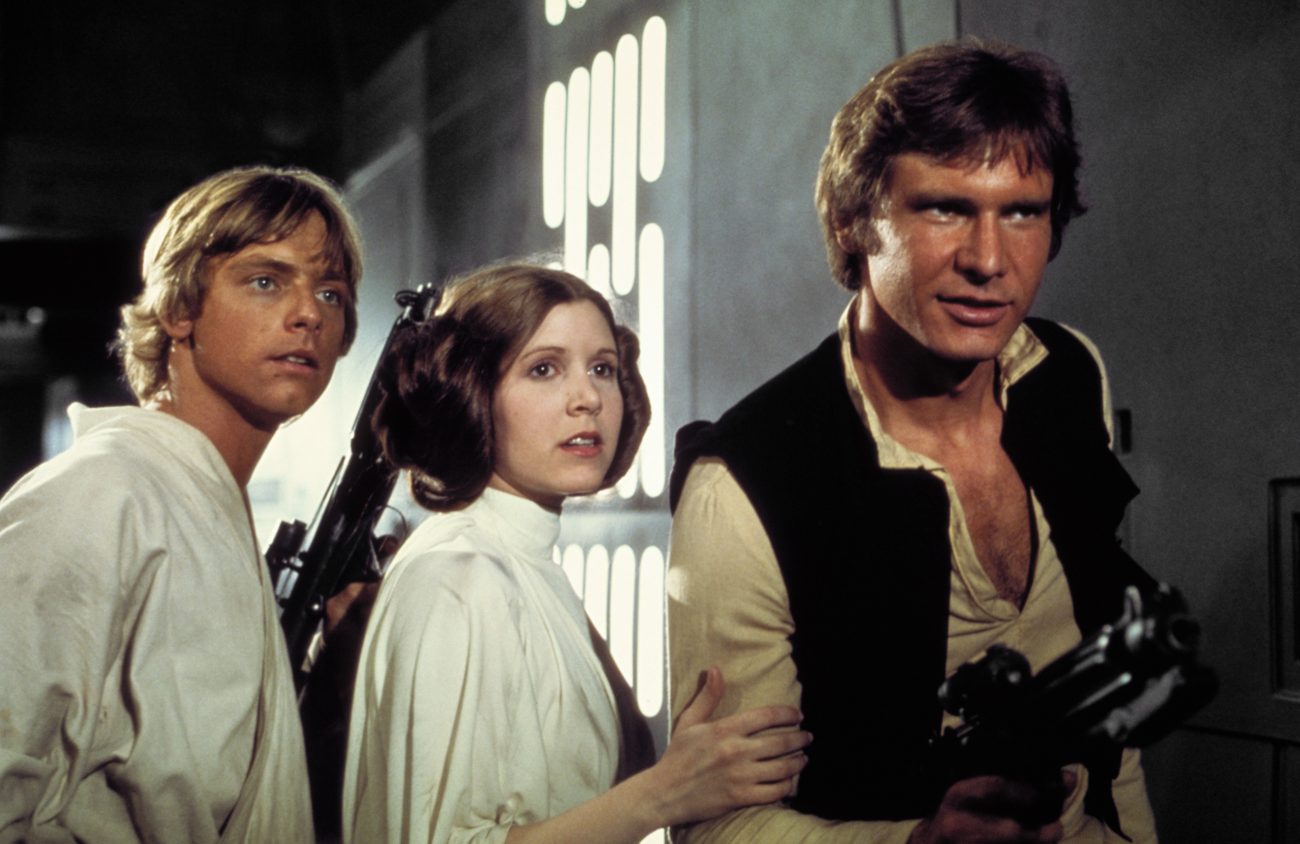
Mark Hamill (Luke Skywalker) told Variety in 2018 that John Williams’ score elevated Star Wars: A New Hope to the status of Lawrence of Arabia. And it’s true. His score is more than just a movie score. In fact, watching Star Wars: A New Hope without Williams’ music is just plain weird.
To celebrate the score, Eugene Symphony will perform Williams’ masterpiece live, accompanying Star Wars: A New Hope as it shows on the big screen at the Hult Center for the Performing Arts on Dec. 1. Tickets are now on sale.
Although Williams composed a huge score for a movie that would go on to change lives, it would result in living at the mercy of the director — something that could be minimized for dialogue, for example. Francesco Lecce-Chong, music director and conductor of Eugene Symphony, hopes to give the audience a taste of how Williams truly intended to have the score sound when paired with the movie.
For Lecce-Chong, Williams is more than just a film composer. He’s a composer. That’s an earned distinction because the Star Wars score stands out from anything else written for the silver screen. Williams, he says, approached the score with the tradition of borrowing from past composers — such as Gustav Holst, Sergei Prokofiev, Igor Stravinsky and Richard Wagner. While standing on the shoulders of these composers, he blended the score with tropes from cinema history. The result was something that basically surpassed the story of George Lucas.
“No one’s come close to this so far,” Lecce-Chong says, “as far as the intensity of the writing, modernistic touches, the incredible textures and the drama of the music itself.”
The Star Wars saga isn’t considered sci-fi to many because the series neglects the science in its imagination. Instead, the saga has earned its “space opera” moniker — given that each character has their own theme. And Lecce-Chong incidentally described the saga that way. He says what’s great about the Original Trilogy is that Lucas left room for Williams’ score in a Wagnerian way.
“[It] gives space to the music. The best example is Throne Room,” he says about the final scene in Star Wars: A New Hope. “For five minutes, [Williams] is given the chance to write epic music underneath. It makes the scene work and makes it better than any stupid talking would’ve done.”
Hating on the Prequel Trilogy is probably one of America’s more recent pastimes considering poorly directed and written dialogue, erasing the mystique of the Force (midi-chlorians, really?) and killing off a total badass villain (Darth Maul) so early on. However, Lecce-Chong says another downside to Episodes I through III is that Williams wasn’t able to shine as he did in the Original Trilogy. But that seems to change with Disney’s Sequel Trilogy, especially when Rey (Daisy Ridley) finally found Luke Skywalker. The final scene of Force Awakenshas no dialogue. Only Williams’ score — just like the Throne Room scene in Star Wars: A New Hope.
“I was like, ‘Oh my god, they’re gonna do it.’ There’s no talking; nothing going on except the camera panning around the island as she walks. So for five minutes, all there is is music. That’s what I’m excited about with these new movies,” he says. “It seems like they realized what’s so great: Letting John Williams go to town on these scores.”
When Williams goes to town on his score, it requires a conductor to rely on the Force to summon the energy it takes to conduct.
“I’m exhausted … I feel like I’m doing the Rite of Spring in a couple of these numbers,” he says, adding that his back often hurts as well.
Of course, just listening the “The Battle of Yavin” segment of the score, it’s easy to imagine the struggle that Lecce-Chong and the orchestra go through. This part of the score supports the kick-ass Death Star battle where Luke joins the Rebels to try and beat the clock before Grand Moff Tarkin and the Empire eliminate the Rebel Alliance once-and-for-all.
“There’ll be scenes where it cuts away to headquarters where people are sitting around and the music will grind to a halt for a few seconds,” he says. “It’s very hard to do as an orchestra and a conductor.”
Considering Lecce-Chong’s admiration for Williams’ work, it comes as no surprise when he says two of the greatest experiences he’s had in life were working for Williams. He got to work with the legendary composer as an assistant for a few weeks with the Los Angeles Philharmonic at the Hollywood Bowl and worked with him when Williams conducted the Milwaukie Symphony.
During one of these gigs, he got to talk to Williams. Lecce-Chong used it as a chance to ask about releasing the full score for Star Wars: A New Hope.
“I was like, ‘Please, please, please tell me Star Wars is going to be released for orchestra. This is the greatest film score of all time,’” he remembers.
Williams assured him that full score would be released. It would just take more time. That was a few years ago. And, just like any good Jedi Knight, Lecce-Chong’s patience paid off. He’s going to conduct the score with the Pittsburgh Symphony and then lead the Eugene Symphony this December.
“You could almost play this score without the movie at all, as a symphony. And it would be very compelling,” he says. “It’s that beautiful and fascinating.”
Eugene Symphony’s tickets went on sale to the general public on Tuesday, July 17, with prices ranging from $45 to $85. Eugene Symphony’s Star Wars: A New Hope is Saturday, Dec. 1.
A Note From the Publisher

Dear Readers,
The last two years have been some of the hardest in Eugene Weekly’s 43 years. There were moments when keeping the paper alive felt uncertain. And yet, here we are — still publishing, still investigating, still showing up every week.
That’s because of you!
Not just because of financial support (though that matters enormously), but because of the emails, notes, conversations, encouragement and ideas you shared along the way. You reminded us why this paper exists and who it’s for.
Listening to readers has always been at the heart of Eugene Weekly. This year, that meant launching our popular weekly Activist Alert column, after many of you told us there was no single, reliable place to find information about rallies, meetings and ways to get involved. You asked. We responded.
We’ve also continued to deepen the coverage that sets Eugene Weekly apart, including our in-depth reporting on local real estate development through Bricks & Mortar — digging into what’s being built, who’s behind it and how those decisions shape our community.
And, of course, we’ve continued to bring you the stories and features many of you depend on: investigations and local government reporting, arts and culture coverage, sudoku and crossword puzzles, Savage Love, and our extensive community events calendar. We feature award-winning stories by University of Oregon student reporters getting real world journalism experience. All free. In print and online.
None of this happens by accident. It happens because readers step up and say: this matters.
As we head into a new year, please consider supporting Eugene Weekly if you’re able. Every dollar helps keep us digging, questioning, celebrating — and yes, occasionally annoying exactly the right people. We consider that a public service.
Thank you for standing with us!
Publisher
Eugene Weekly
P.S. If you’d like to talk about supporting EW, I’d love to hear from you!
jody@eugeneweekly.com
(541) 484-0519