We’re in what’s called the digital or information age, though I sometimes think of it as the “you can do that on the computer” age. As an increasingly digital-dependent society we are constantly being directed to “do that on the computer,” whatever that may be: banking, shopping, “hooking up,” playing games, etc.
I can see the appeal, more so now than ever, of turning to an art form, craft, or pastime that is grounded in doing things that can’t be done on the computer — one that uses natural fibers as its medium and is based in making things by hand.
Eugene Textile Center fosters the fiber arts from weaving, spinning and dyeing to felting, its website says. These are techniques that the Oregon Fiber Artists note have been practiced for “eons.”
The Oregon Fiber Artists, who meet at the center, are now showing work at the center’s gallery.
The center is foremost a business that sells fiber art supplies. It also holds an impressive schedule of classes by local artists in weaving, spinning, design and dyeing and felting. If you didn’t know felting was a thing, don’t feel bad. Neither did I. It just means you’re not part of the fiber arts community — yet.
If you are interested, not only can you learn how to make things out of felt, the center offers a class that teaches how to make felt from scratch.
The appeal of fiber arts is rooted in how long these practices have been around. An appreciation of the medium’s natural origins can also be clearly seen in the choice of nature as subject matter exhibited in the Oregon Fiber Artists group show.
Anne Daughtry’s artwork Fascial Chi is made of tulle (a fabric), silk stars, crystal beads, Angelina fibers and wool roving. A depiction of a spinning galaxy takes center stage. Barely perceptible at the top of the work is the outline of a pair of hands reaching for, but not being able to touch, the central object.
Fascial Chi could also stand as a symbol for the entire show, where the media is comprised of fibers and where many of the objects displayed — jewelry, a blanket and purse — ask to be touched, worn or held. Textile art is a lot about touch. Even when it is hung on the wall, as in a gallery where everyone knows not to touch, we still recognize the handwork that went into the weave, the stitch and the dye.
Katy Gollahon’s Magma Rising was made with commercial fabric and ribbon, and it’s hand-beaded. It is another work that seeks to present a powerful force in nature. Gollahon’s artwork, put together with strips of fabric, reads almost like a puzzle. It is a disjointed image that gives the impression of motion. Her design results in a more abstract approach than Daughtry, but reads more dynamically.
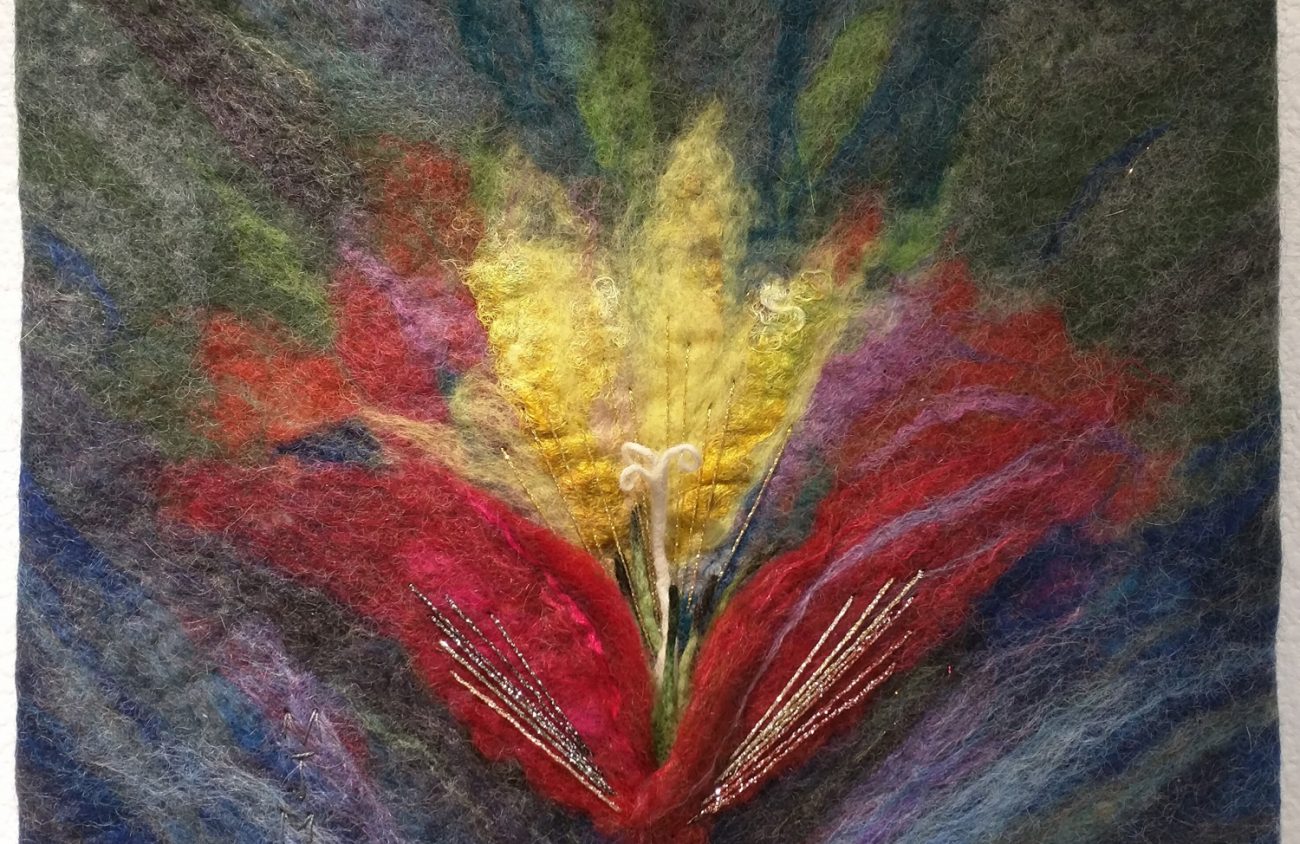
Mary Jane Moffat’s Growth was created with wool, silk, and other fibers. It is a relatively small work and is deceptively simple. A single, close up view of a flower is presented. For this reason it may remind you of countless similar images painted by Georgia O’Keeffe. Moffat has laid the background in flat, broad strokes that resemble those of a paintbrush, then built up a three-dimensional effect at the center of the image. It is a striking transition from flat to sculptural that emphasis the pistils at the center of the flower.
I visited the Eugene Textile Center for the first time last week, so I didn’t know there was a door that leads directly to the gallery room. I went in through the store looking for the gallery. I recommend that way in. Going through the store is like entering a show through the artist’s studio. Instead of tubes of paint you see spools of colorful yarn, and in place of easels, perhaps a warping board and a loom.
Current work by Oregon Fiber Artists runs through Aug. 2 at the Eugene Textile Center, 1510 Jacobs Drive.