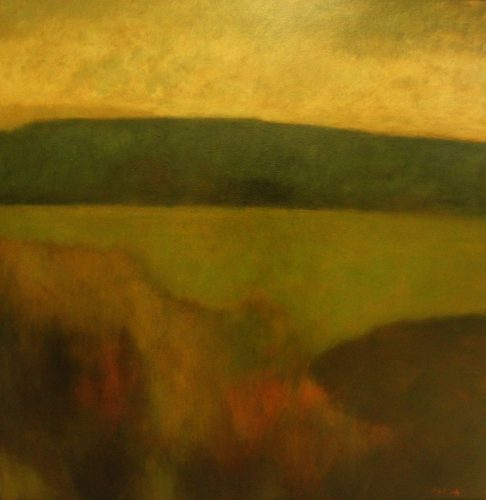
The late Mark Clarke was such a gentle, unassuming man that it was easy, when he was alive, to forget what a masterful artist he was. Clarke didn’t boast. He didn’t market himself. He sometimes failed to show up at his own openings. He just painted, day in, day out, for well more than half a century.
As a result, nearly every time I stand in front of his paintings I am shocked at how very good they are, as I was again last week on visiting a new show of his work at his daughter’s downtown gallery.
Clarke, who died suddenly in 2016, was a quiet genius with a brush and paint. If you have any doubt at all about this, walk into the Karin Clarke Gallery and look at the three large paintings hanging on the wall to your left. Together, they summarize his deep understanding of the misty, foggy, vague Northwestern landscape.
On the left is “Stream to the Sea.” Painted in 2011, it’s a symphony composed of simple dark tones and textures. In the center is “Sienna Sky Over Blue Hill,” a four-foot-square canvas that reduces the landscape to no more than a handful of gently colored forms.
On the right, the third painting, untitled, breaks into ebullient color, at least by Clarke’s sober standards. The wall card says it’s a landscape viewed from Highway 99, which would probably mean it was painted up the road a piece from Junction City, where he was born and grew up.
But that’s the thing with Clarke’s work. The untitled painting appears to be a perfectly accurate description of a place that may or may not actually exist. He spent so many hours over so many years studying the soft Willamette Valley landscape that it became part of his muscle memory. Late in life he could glimpse a landscape while driving by, perhaps slowing down to study it for a moment, and then return to the tiny basement studio where he worked at his Eugene home and reproduce it perfectly.
Clarke always joked that his paintings were “myopic.” They don’t contain much in the way of fine detail, substituting instead a patient process of layering, sanding, scraping and glazing acrylic paint until he got the effect he was after. But it is the spot-on emotional accuracy of these “myopic” paintings that makes them local masterpieces.
Across the room from those big three canvases is a smaller one, titled “Receding Fog,” just a cool, pale sea of bright color.
Clarke painted it in 2015, the year before he died. As the title suggests, it’s a painting of fog — just fog, and nothing more. No hint of landscape or seascape lies concealed in this fog, no ghostly figures about to emerge from the mist. And yet it’s absolutely captivating, a simple study of tone and color in the weather we Northwesterners all know so intimately.
Clarke and his wife, painter Margaret Coe, were honored after his death by a retrospective at the Jordan Schnitzer Museum of Art last year. He was, and is, a Northwest treasure. This new exhibit of his work downtown offers one more chance to admire his myopic genius at close range.
Classics, an exhibition of Mark Clarke’s work, continues at the Karin Clarke Gallery, 760 Willamette Street, through Sept. 29. A reception will be held during the First Friday ArtWalk, which begins at 5:30 pm Friday, Sept. 7.