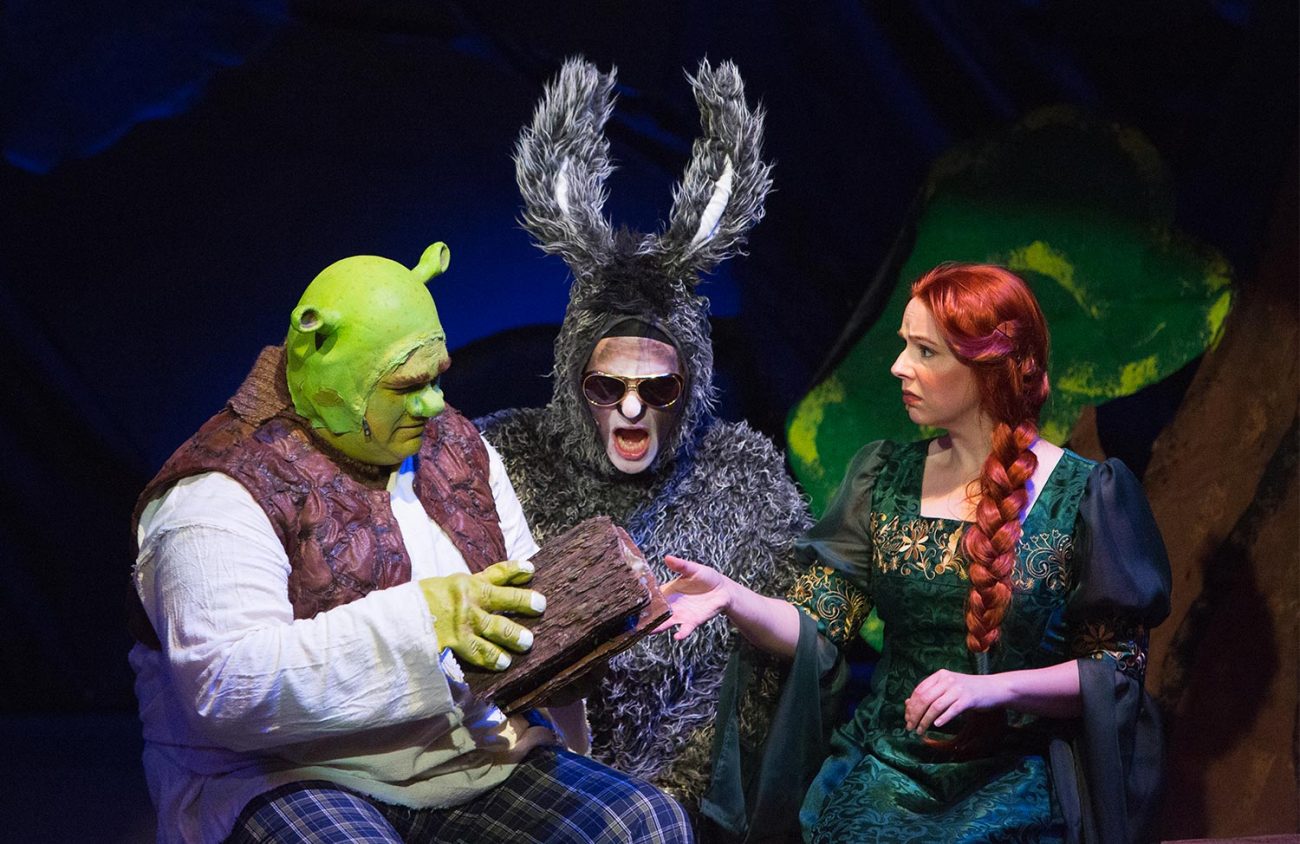
Somehow it’s 2018 and we’re still talking about Shrek. But it’s for good reason this time. Cottage Theatre’s production of Shrek The Musical, directed by Keith Kessler, has found a way to surpass the over-played movie — and is probably one of the greatest productions the theater has ever put on. Most of that is because the musical has layers; it’s politically relevant, filled with comedy and music, and masterfully delivered.
For those who have lived in a swamp detached from society, Shrek started off as an animated movie (and became a never-ending series of cash-grabbing movies) from 2001 that spoofed fairy tales in a way that must have had some inspiration from The Adventures of Rocky and Bullwinkle and Friends shorts titled “Fractured Fairy Tales.”
Shrek (Mark VanBeever) must protect his swamp from fairy tale creatures that have been relocated by decree from Lord Farquaad (Joshua Sayre) to the swamp due to their “freak” nature (sound familiar?). This takes Shrek, accompanied by Donkey (Matt Arscott), on a quest to free Princess Fiona (Melissa Miller), who’s guarded by a dragon, so Farquaad can marry and become king.
The success of Shrek The Musical is partly due to its script and songbook, but that only gets you so far. What really brought the Cottage Theatre audience down to Shrek’s swamp was the talent of the actors, who actually had an uphill battle overcoming the talent of the original movie.
By the first few scenes, the comedy icons of Mike Myers, John Lithgow and Eddie Murphy fell by the wayside as the Cottage Theatre talent easily surpassed them — even though there’s an awkwardly long flatulent joke between Shrek and Fiona that certainly pushes the boundaries of fart jokes that was set in place by Blazing Saddles.
Miller as Princess Fiona has some great comic moments in her portrayal of the fairy tale cliché of woman in distress in a castle guarded by a dragon, most notably in “Morning Person.” The musical number is a reference to the movie scene where Fiona and a bird get in a something of a bout of high pitch singing. (The bird loses.) The lampooning takes the Disney Princess’ quality of being “one with nature” trope to work. During the number, Fiona meets the Pied Piper, who’s trying to get rid of some rats. This of course leads to some impressive tap dancing from the Three Blind Mice.
Despite Farquaad’s short stature, the character emerged as one of the standouts of the production. Sayre plays the part on his knees but that didn’t mean he slouched on Janet Rust’s choreography. When Shrek and Donkey arrive at Duloc, Sayre praises his policy of kicking out the freak fairy tale creatures and how it cleaned up the kingdom in the number “What’s Up, Duloc?” Sayre moves with nimbleness on his knees for the choreography and, with the help of his costuming, it doesn’t take much suspension of disbelief to imagine him as the short, egomaniacal character.
Shrek The Musical is what America needs right now because it honestly reflects what this country has become in the same manner Jonathan Swift did with Gulliver’s Travels. Although the Lilliputianesque Farquaad was originally intended to lampoon former Disney CEO Michael Eisner, the role has since grown to reflect leadership of a U.S. president who, to reference Shrek, is overcompensating for his small hands in the same way Farquaad was for his short stature.
Shrek is no hero, either — although he does express his wish to become one later in the musical. He doesn’t stick up for the “relocated” fairy tale creatures. Instead, he focuses on his plight: getting his swamp property back. With that sort of NIMBYism, he’d fit right in at Eugene.
Shrek The Musical runs through Sunday, Oct. 28, at Cottage Theatre in Cottage Grove. Tickets range from $15 to $25.