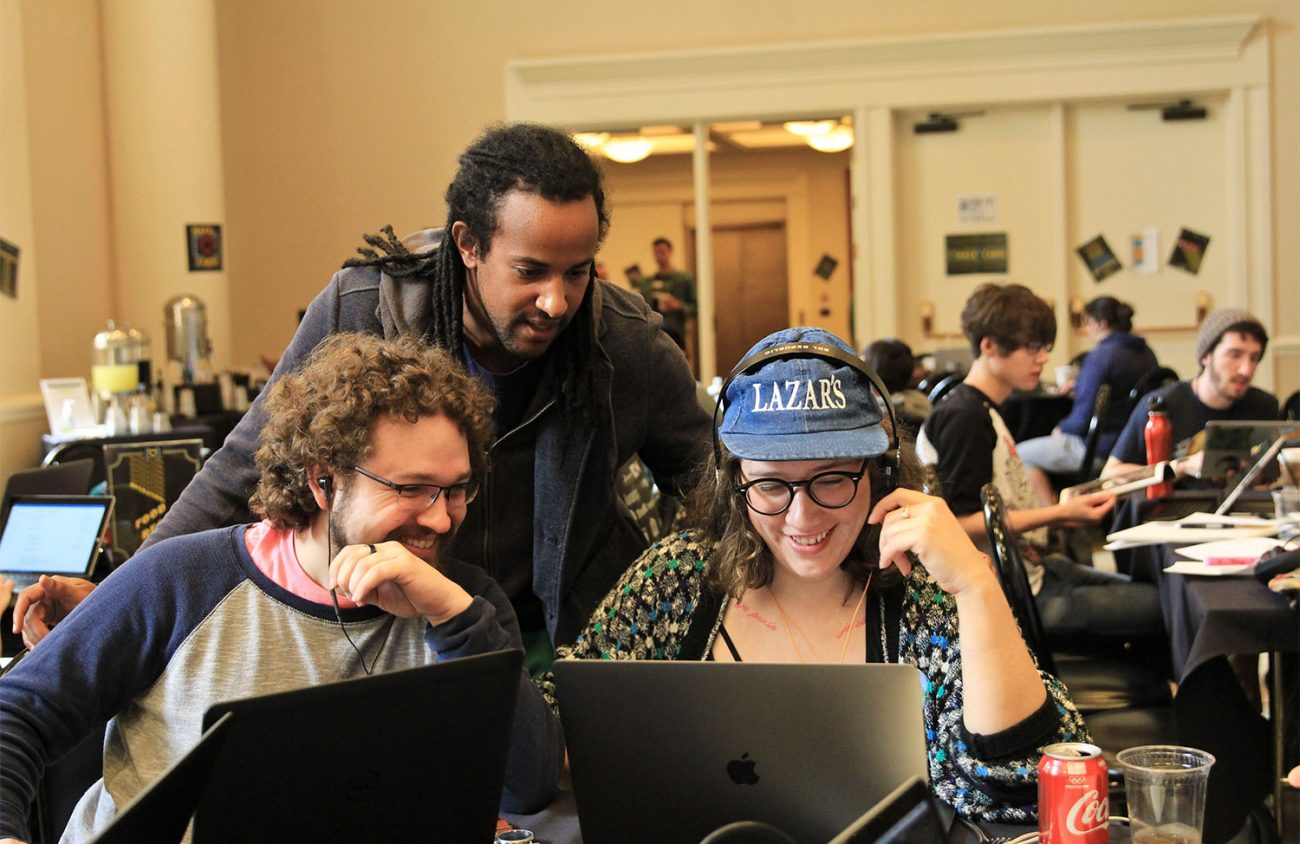
The term “hacker” may conjure up characters from The Matrix, but the competitors in Eugene’s fourth annual Hack for a Cause may have different goals in mind.
Hack for a Cause is a three-day overnight hackathon where teams of web programmers, graphic designers and other creative minds join forces to devise high tech solutions for local issues.
Hackathons — a portmanteau of the words “hack” and “marathon” — are multiday events where computer programmers collaborate on large-scale software projects. Generally, the goal is to design either a functioning product or an early prototype of one.
University of Oregon professor Seth Lewis says that, although the term is usually linked with clandestine thievery, pro-social hacking can crowdsource ideas for a potential solution — meaning that large, hard-to-tackle problems can be solved piecemeal.
“It’s a lot of the same motivations behind people editing Wikipedia,” says Lewis, who studies technology and society in the University of Oregon School of Journalism and Communication. “Essentially, people who want to give their time and expertise even freely, voluntarily. It’s something that they believe is a social cause that matters.”
“We believe technology can be part of the solution, maybe not the entirety of the solution, but technology has a role to play there,” says Matt Sayre, head of Technology Association of Oregon (TAO) in the Southern Willamette Valley, the Eugene branch of the nonprofit that hosts Hack for a Cause.
In previous years, Hack for a Cause challenges have tackled local issues such as downtown livability, counting guests at the Egan Warming Center, internet access and waste prevention.
Hack for a Cause is open to students, professionals and volunteer mentors. Food and entertainment will be provided, according to its Eventbrite page.
At some multiday hackathons, competitors power through by bringing sleeping bags and recharging with pizza and energy drinks. Other cities, such as San Francisco, Houston and New York, also host hackathons, which can be geared toward teenagers, women or college students.
“It nurtures a culture of problem solving, right?” Sayre says. “We have this growing tech sector, and to the extent that you can cultivate social entrepreneurship as part of that, technology becomes a way to affect the greater good.”
TAO seeks to connect technological entrepreneurs and promote their work to build the Pacific Northwest’s status as an innovation hub.
This year, local nonprofits and organizations submitted more than 30 challenges for consideration, and TAO announced the 10 it would be working with, including the HIV Alliance, Carry It Forward and the Oregon Family Support Network.
The word “hacking” means “creation through breaking,” according to UO history professor Vera Keller, who studies the history of science and technology.
“Hacking implies a critical consideration of current technologies and the decision to reject them or break them in some way,” Keller says.
But computers haven’t always been seen as a positive good for society.
Computers used to be seen as a part of corporate culture in the ’60s, Keller says, and computing was seen as a way to identify and control people. As an example, she cites IBM, an information technology company that assisted Nazis with its punch-card computer technology in the early 20th century.
For technology to be socially responsible, she says, it needs to acknowledge how people are using it and are being affected by it.
“It’s not about technology giving back,” Keller says. “It’s if they don’t do that, then what they’re actually doing is parasitically profiting off of people.”
Lewis’ son, a high school sophomore who works as a blockchain engineer at the data privacy company BrightHive, says that pro-social hackers may also just enjoy solving problems.
“A lot of hackers, they’re motivated to do things like hackathons — and I know that I am, too — just because they like to solve problems,” Jackson Lewis says. “The same reason why people play sudoku.”
Although the paradigm of thinking that there’s a technical solution to every societal problem could be problematic, Seth Lewis says that there’s another, perhaps unexpected benefit to hackathons: The friends competitors make along the way.
“Often, these hackathons, where they succeed is bringing together people to build community,” he says. “The community-building, ultimately, is the best outcome.”
Hack for a Cause runs Friday through Sunday, April 26-28, at Nulia, 180 W. 8th Avenue, Suite 200. Tickets are required and range from $5 to $100; financial assistance is available. Register online at Eventbrite by searching: “Hack for a Cause 2019.”