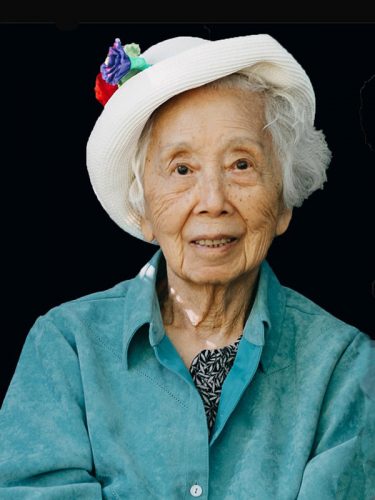
An exhibit of Kiahsuang Shen Lo’s brush painting now up at the University of Oregon’s Mills International Center was initially intended to celebrate the artist’s 100th birthday. But Kiahsuang passed away two months before turning 100. Now the exhibit serves as a memorial to her life and her dedication to the art of Chinese brush painting.
Kiahsuang moved to Eugene to be near her daughter Ginnie Lo, who was a computer science professor at the UO. The two women lived in adjoining houses. Kiahsuang’s dining room table became her studio. She sat at the table in front of a large picture window, working in the tradition of Chinese brush painting masters.
Kiahsuang said in her artist statement that most famous Chinese artists give their studio a special name. So she named her dining table “Yi Qin Tang,” which means “Remembering My Parents’ Studio.”
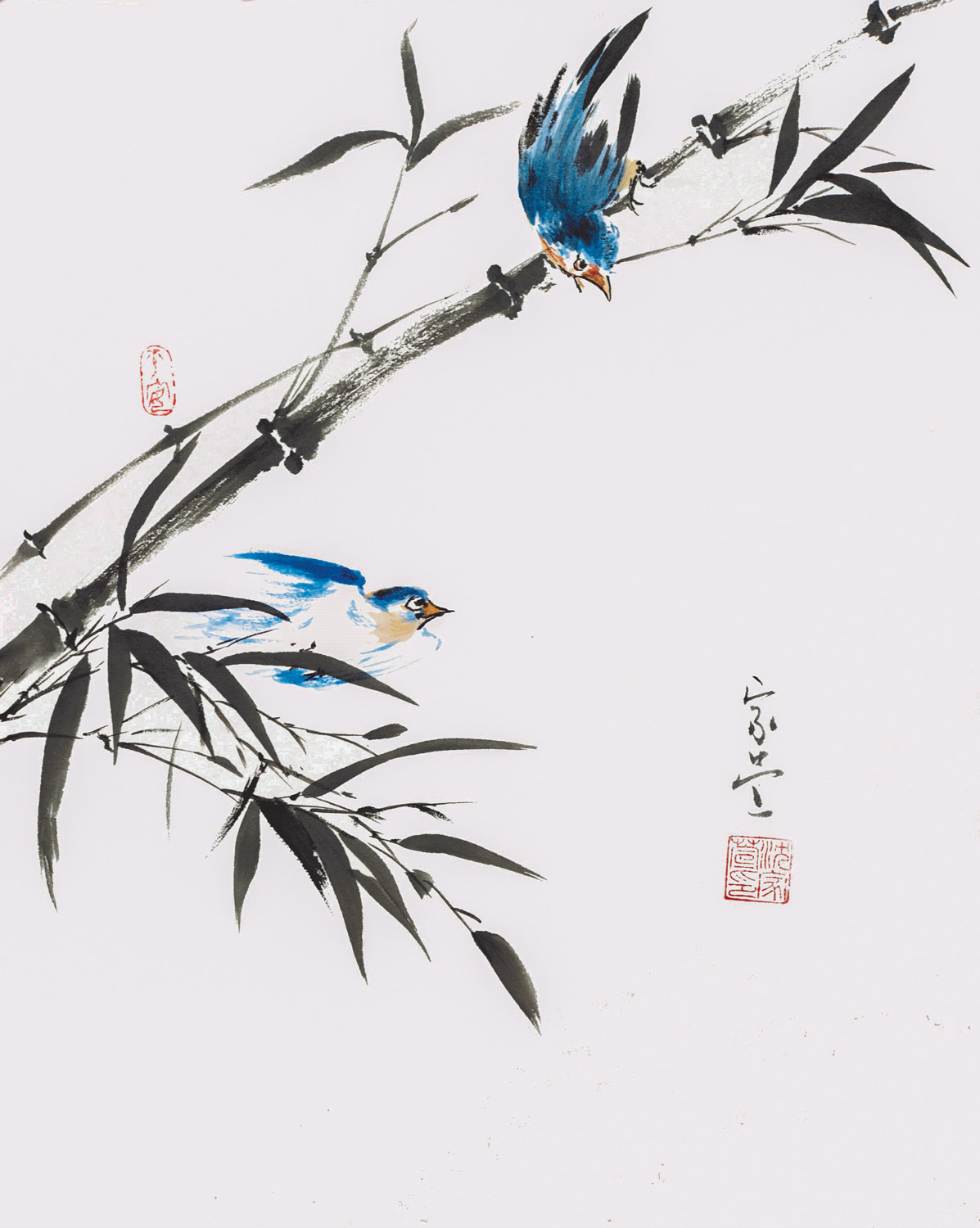
Beginning to work as an artist late in life — she was 75 when she seriously took up a brush — Kiahsuang recalled calligraphy lessons her father gave her when she was growing up in China. Chinese brush painting employs a technique similar to calligraphy. It incorporates the same instruments and wash, the use of line and value variation, and the delicate response to medium and subject.
It is common for Chinese children to learn calligraphy, Ginnie says. Kiahsuang taught her and her sister Beth as children. Beth Lo went on to become an artist and is a professor of art at the University of Montana.
The Lo sisters have published two children’s picture books centered on their family’s traditions: Mahjong All Day Long and Auntie Yang’s Great Soybean Picnic. The books were written by Ginnie and illustrated by Beth. A ceramicist, Beth drew her illustrations on ceramic plates, which are also on display at the Mills International Center.
Beth’s illustrations reflect a child’s view of growing up with a Chinese American heritage. In contrast, the subjects in her mother’s paintings are taken largely from nature: flowers, trees, animals and landscapes — and poetry. The following is taken from “Spring Dawn” by Meng Haoran, a poem done in calligraphy by Kiahsuang:
I slumbered this spring morning and missed the dawn.
From everywhere I heard the cry of birds.
Last night the sound of wind and rain came.
Who knows how many flower petals have fallen.
Sitting with Ginnie at her mother’s dining room table I noticed a small stack of folded paintings. “I just found these,” she explained. A month earlier she’d been cleaning her mother’s basement and found an unfamiliar box. When she opened it she found hundreds of paintings.
“I’m going to give them away,” she said.
It seems fitting that she will give her mother’s art away to family at the memorial, for Kiahsuang first got her artwork out of the house by giving it away as gifts. She made a calendar with her images in it to give as Christmas presents.
On another Christmas she printed her artwork on note cards. And then with note cards in hand she sold her art in printed format at Eugene’s Saturday Market and Asian Celebration.
She liked the social aspect of it, Ginnie says, smiling at the memory of her elderly Chinese-American mother hanging out with Eugene’s hippie art crowd.
The memorial exhibition of Kiahsuang Shen Lo’s artworks, Remembering, is on display through April 26 at Mills International Center at the University of Oregon. The gallery will be closed April 21 for a private memorial.