What does it mean to be a successful art gallery? For Ditch Projects the measure is not counted in financial rewards. The contemporary art gallery in Springfield doesn’t really try for sales. It doesn’t even place the traditional red dot next to a sold painting.
The red dot is “weird,” says Mike Bray. He is co-artistic and executive director, along with Marissa Lee Benedict.
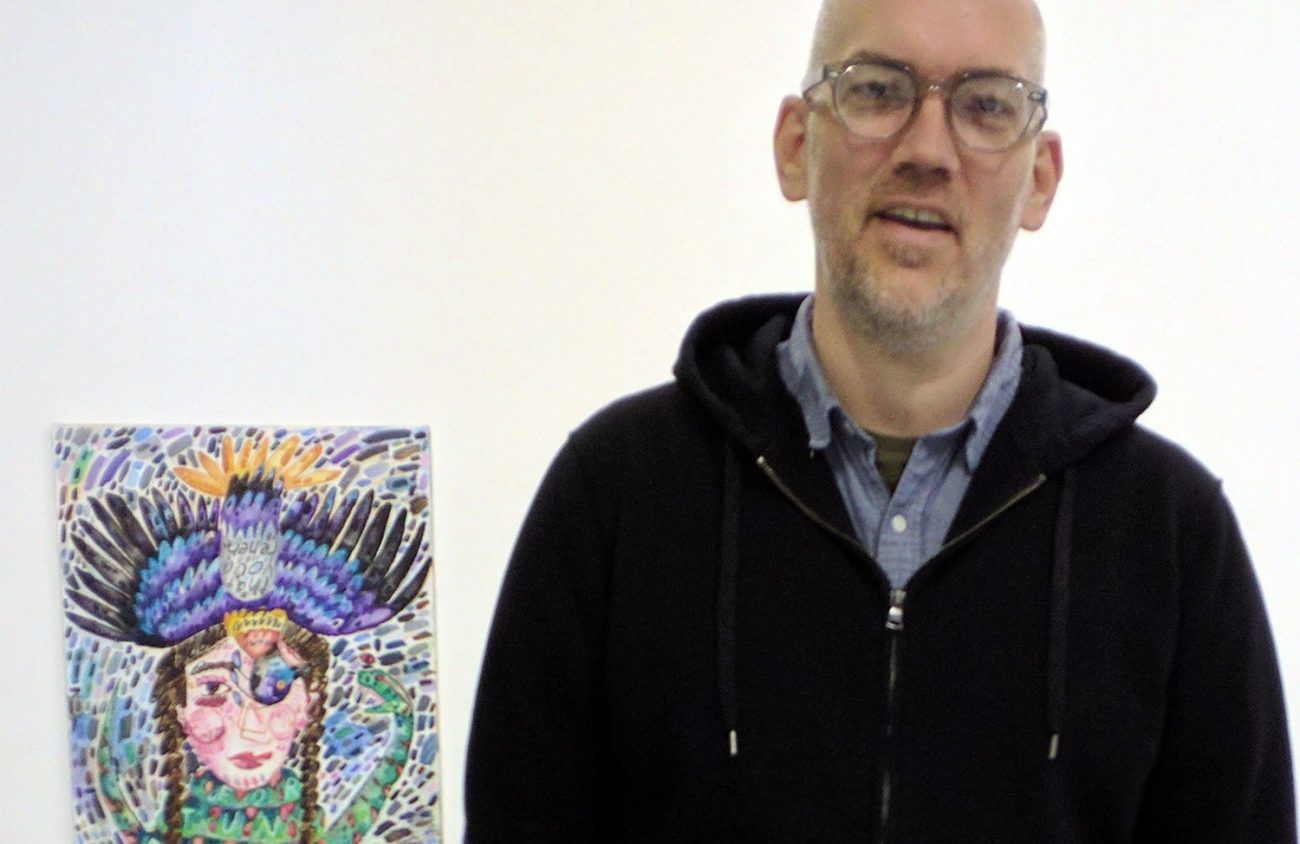
When I met Bray at the gallery he explained that the red dot attracts viewers’ attention to the commerciality of an image or object rather than to its content.
Members don’t push sales in the gallery. Sometimes someone wants to buy. What happens then is the gallery contacts the artist and the sale is made between that individual and the buyer. The gallery does not take a percentage.
Bray is himself represented by Fourteen30 Contemporary, a more conventional commercial gallery in Portland, and teaches cinema studies at the University of Oregon. He and five other masters of fine arts students from the UO started Ditch Projects 10 years ago.
Though all original members were UO students, the gallery is not formally affiliated with the university. The artists and students began the member-run space as a way to keep in touch with the contemporary art world they’d been engaged with in graduate school.
For Bray’s part, he wanted to stay in town, and there was no other gallery that showed the kind of contemporary art he’d been connected to at the university: works that focus on — as stated on the gallery’s web page — “providing critical contemporary art experiences.”
The decision not to identify individual artists for a members show started early. The gallery had an unexpected empty slot on the calendar they needed to fill, so members pitched in for a show. It was a spontaneous decision to leave their names off the pieces. They liked the idea of showing as a group, as Ditch Projects.
That “left ego out it,” Bray says.
Art Forum magazine covered a Ditch Project group show in Portland as a “Critics’ Pick,” attracting national attention. Bray says the gallery is better known in L.A. or New York than it is in Eugene and Springfield.
Ditch Projects has not exactly been on the public’s radar in Lane County. It is located only a short way from Main Street in Springfield, but if I didn’t know about the gallery beforehand I wouldn’t have known to go to it. The gallery is hidden within an industrial complex. Until recently the gallery was open only a handful of hours one day a week.
Things are changing, though. The member-run gallery has recently become a nonprofit, and it has extended hours to being open Friday through Sunday. Bray says one of the gallery’s goals as a nonprofit is to reach out more to the local community.
Ditch Projects has two exhibit rooms. The one in back is slightly smaller and usually used by members, who can show once a year. The one in front is reserved for guest artists.
Since its first show, the gallery has been successful attracting artists with standing in the art community. I asked Bray why he thought this was and he didn’t hesitate to answer.
It’s a “risk-free” space.
In terms of success, being off the radar has paid off for Ditch Projects. Artists are free to experiment because Springfield doesn’t attract a lot of attention from the art world.
For an artist like Los Angeles-based Calvin Marcus, who is part of this year’s Whitney Biennial in New York, exhibiting art at Ditch Projects is akin to what Jerry Seinfeld does when he tries his act at the Comedy Cellar (though that’s still in New York) before taking it to Carnegie Hall.
For their 10-year benefit art auction on June 7 the gallery’s focus will be, for a change, on sales.
“Art experiences” will be up for grabs, such as learning to make jewelry from an expert jeweler or getting a tour of art studios complete with cocktails led by Fourteen30 Contemporary.
The evening of June 7 will also include music by DJ Jason Urick, food and beer by Falling Sky, and more than 35 artworks will be up for auction.
The gallery was named “Ditch” after an actual nearby ditch that has since been repaired (though the name references the former Deitch Projects contemporary gallery in New York).
In place of the ditch is now a creek. Will Ditch Projects change their name to Creek Projects? No. They have a reputation now, one that has been built in part by members’ experimental approach, willingness to reach out to contemporary artists outside of Eugene/Springfield and, last but not least, by their relatively remote location.
Ditch Projects is at 303 S. 5th Avenue, No. 165, Springfield. Ditch Projects Inaugural Benefit Auction is 7-10 pm Friday, June 7. Tickets are $53 at ditchprojects.com and include entry to the event, food, and drinks. Regular hours of the gallery are noon to 4 pm Friday through Sunday and by appointment.