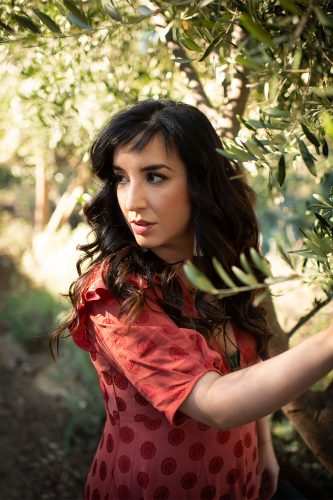
Jazz vocalist, author and educator Gina Saputo grew up in an old farmhouse near Springfield.
“In this house, the kitchen is higher, elevated,” Saputo tells me over the phone from Los Angeles, where she now lives. “We had a natural built-in stage. We used to put on little shows for my parents and their friends. I grew up on stage.”
With music in her family, Saputo sang with Oregon Children’s Choir and was involved in a whole host of music-related opportunities for children in the Eugene area. But it was when she was about 11 that her dad played for her an old Carmen McRae record, and the world of jazz opened up.
“I did my first jazz gig when I was 14,” Saputo says.
Classically trained, she had been taught to sing what was on the page. It was the freedom of expression intrinsic to jazz music that appealed to her. “The ability to improvise. You can make it your own. To me that was freedom,” she says.
After graduating from Springfield High School, Saputo studied jazz at the University of Southern California in Los Angeles, where she now gigs as a jazz vocalist, writes textbooks on vocal technique and teaches at the Musicians Institute.
After a few recording projects that either fizzled or never rose above the level of a hobbyist’s endeavor, Saputo, along with pianist and friend Matt Politano, has released Duetto, a self-produced and self-released collection of jazz standards.
On the record, Saputo’s dextrous alto handles not only familiar tunes like “Ain’t Misbehavin’” and “Lullaby for Birdland” but also less-known songs like the Sinatra deep cut “I Could Have Told You.”
“I wanted it to have songs that I love,” Saputo says. “Some familiar, some that people may not have heard for a long time.”
Jazz vocal recordings can have a lot going on, being highly arranged and highly produced. Saputo wanted to contrast that with the simplicity of singing and being in the moment. She wanted the album to be about the songs and “not about anything fancy,” she says.
Something Saputo appreciates about jazz singing is how the voice can be used like a trumpet or horn. Throughout Duetto, Saputo employs notes as stepping stones rather than any kind of ladder. Dancing between them, she occasionally leans one way or the other but never loses her balance.
At times she attacks her tone like a horn, coming from far away and moving past you like a New York taxi or a rainstorm passing overhead in the night. Politano’s piano offers a gentle bed for Saputo, with an understanding that jazz at its best uses the space in between the four walls of the room, remaining organic and never sterile.
In addition to Duetto, Saputo also appears on the new jazz record I Shouldn’t Be Telling You This from Jeff Goldblum and the Mildred Snitzer Orchestra.
In case you weren’t aware, actor Goldblum is a jazz musician — because, of course he is — and whether it’s his screen work or his late-career epoch of being famous for being Goldblum, he’s an excellent listener — which also makes him a great jazz musician, Saputo says.
“He is exactly who he is on screen,” she adds, and she frequently passes along to her students a choice Goldbloomism: “You are as interesting as you are interested.”
I Shouldn’t Be Telling You This by Jeff Goldblum and the Mildred Snitzer Orchestra is out on Decca. Duetto by Gina Saputo is out now on all major music streaming services, with physical copies coming in late November.