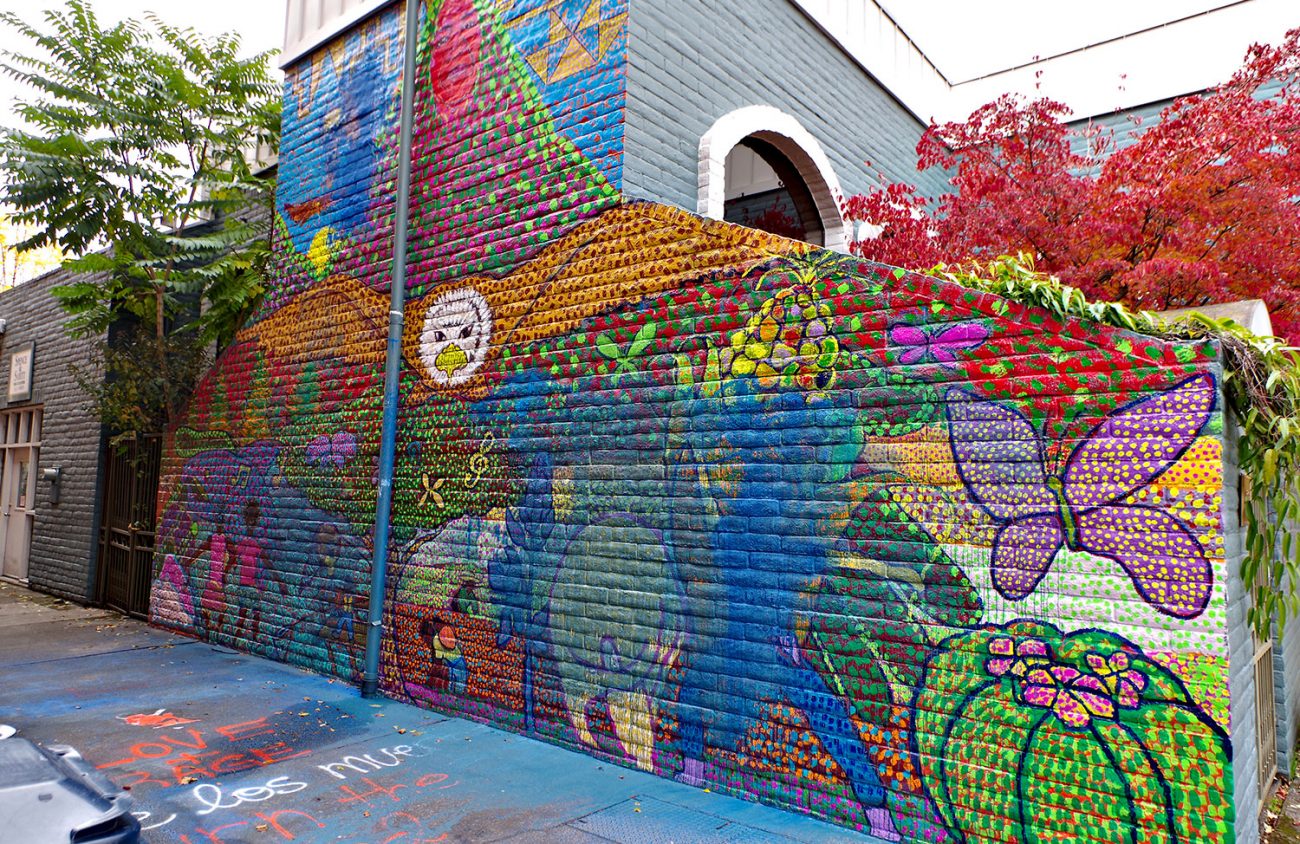
The mural — “Fibers of History” — glowed for less than a month with rainbow colors and motifs of children, monarchs and music notes. Its elegance was in its simplicity, connecting the dots of the Latinx and Indigenous cultures.
Yes, it had an image of Charlie Landeros on the top left corner, and for that, it seems, the mural is now smeared with blue paint, the result of at least two vindictive swipes of vandalism that were, presumably, to represent police.
On the alley that is West Park Street itself is painted the plaintive cry from the recent All Saints’ Day, celebrated annually in Mexico with the holiday called Día de los Muertos as well as the words, “Mourn the Dead.”
It is a clash of cultures that are still feeling the immediate pain of Jan. 11, 2019. That’s when Landeros, of Mexican and Filpino ancestry and who was just 30 years old, was shot and killed by a Eugene Police Department officer at Cascade Middle School. There was a scuffle, Landeros fired two rounds, and an EPD officer followed with the fatal shot.
It all took less than a minute, and the pain is not going away soon.
“The focus of the mural was never meant to be on Charles Landeros,” Colette Ramirez, community program senior manager for Cultural Services in Eugene, says in an email to Eugene Weekly, “but rather about celebrating the rich beauty, power and diversity of Indigenous and Lantix cultures, as well as touch on the fear, loss and trauma that has been experienced.”
Yet Landeros’ image on the mural became the angry centerpiece to some who interpreted it as an attack on police. An EPD officer purportedly on the scene that fateful January morning, speaking anonymously to KEZI television, decried what he believed to be harmful images and demanded the mural be taken down.
Chris Skinner, chief of EPD, echoed that thought in a statement that read in part that certain images in the mural “feel very divisive and do not seem to be in alignment with the goal of bringing [the] community together.”
Then on the week of Oct. 26 came the first wave of the blue paint vandalism. Skinner responded with another statement that read, “We are aware there has been heightened emotions surrounding the imagery depicted on the mural; regardless, the defacing of the mural is a crime and only serves to further divide this community at a time when we need to be coming together.”
Still, not not everyone was done weighing in with their criticisms of the mural. In a Eugene City Council meeting in October, councilor Mike Clark likened some of the mural’s images to painting white supremacist or Nazi symbols.
And on the week of Nov. 2 came the second wave of blue paint vandalism to the mural.
“This mural is manifesting anger and hurt that already exist in the community and opening up a pathway for conversation and understanding,” Stacey Ray, interim executive director of Lane Arts Council, says. “The path to understanding is not an easy one.”
No, it’s not, and the vandalism brings to the fore many questions.
Did Skinner see the mural in person before commenting on it? If he had concerns or questions, did he reach out to the artist (Rodolfo Redstone Serna of Portland), Lane Arts or the Cultural Services Division of Eugene for clarification? Was the vandal (perhaps more than one?) emboldened by Skinner’s original statement?
Because words matter.
Melinda McLaughlin, spokesperson for EPD, took a pass on those questions, but Laura Hammond of the city manager’s office noted to EW in October that inter-departmental communication was lacking throughout the process.
Hammond reiterated that point in an email to EW in early November, saying that “while the mural was a surprise to [Skinner] and the department, they fully support the need to provide a platform for multicultural voices.”
So what now for the mural?
“Moving forward, we are staying engaged with the artist, wall owner and Lane Arts Council to assess the damage and determine next steps,” Ramirez says. “Until these conversations happen, we simply will not know the fate of the mural.”
Both Ramirez and Ray note that “Fibers of History” did align itself with each group’s mission statements and core values.
“The intent behind the mural was to create a platform for local multicultural voices from the community to be heard; a chance to express themselves through art,” Ray says.
Ramirez concurs, adding that the mural provided “a platform for a select group of Indigenous and Latinx community members who historically are marginalized and not given the same opportunities for expression as those that identify with the dominant culture.”
Hopefully, opportunities will come in the future, and we’ll be able to celebrate the power and diversity of Indigenous and Latinx cultures in downtown Eugene and elsewhere.