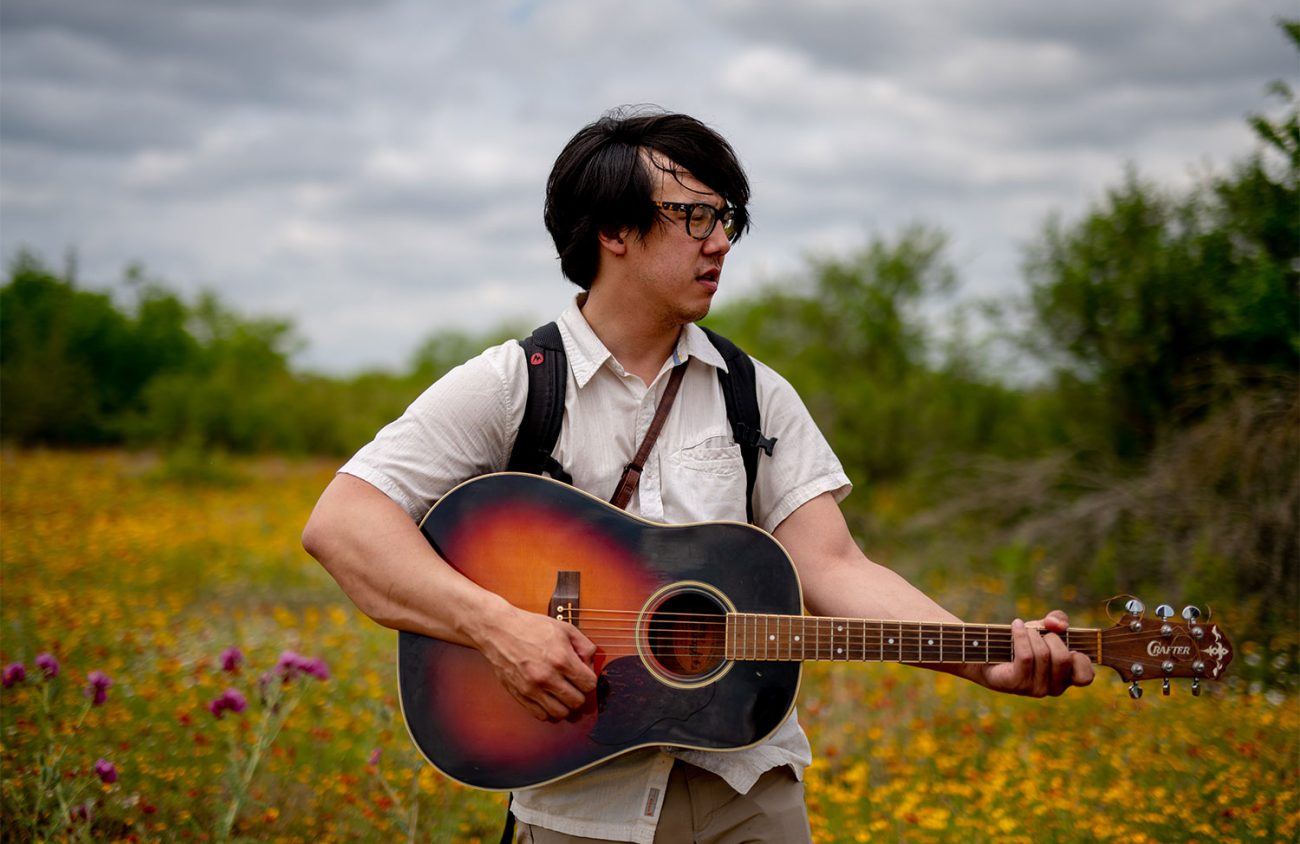
Portland musician Julian Saporiti, who performs as No-No Boy, tells me with a note of sarcasm that spring break 2019 was the worst ever. That’s because while other students were taking time off, Saporiti — who’s in the middle of completing his doctoral degree in American Studies at Brown University — traveled with friends and colleagues to the border of Texas and Mexico, where they would return several times throughout 2020.
The objective was to see for themselves the conditions at ICE detention facilities, many holding women and children from Central and South America seeking asylum in the U.S.
No-No Boy’s latest release, 1975, is the second installment in a two-part album series, doubling as Saporiti’s own ongoing doctoral thesis, and it’s out now on Smithsonian Folkways Recordings. On each album, Saporiti has synthesized his own research in the Asian American experience — including oral histories of World War II Japanese internment camps, fact-based documents and news stories and his own family history. Saporiti’s mother was a Vietnamese refugee to the U.S.
Altogether, it creates a nonfiction, storytelling form of popular music, with the sound leaning toward folk and Americana styles, but also the smartly composed edge and literate feel of rock bands like Eels or even mature-era Elvis Costello records like Brutal Youth from 1994.
Along with storytelling and multimedia visual elements, No-No Boy performs Nov. 20 at the Hult Center, part of the ongoing 10X10 concert series highlighting emerging artists.
Through Saporiti’s academic work, he grew interested in the untold stories of marginalized communities throughout American history. This led him to the Texas-Mexico border back in 2019, a recent hotspot for anti-immigration sentiment as refugees from Central and South America seeking asylum in the U.S.
While there, Saporiti wrote songs — 1975’s baroque-pop “Close Your Eyes and Dream of Flowers” was written outside one of the detention centers, he says — and he also played a concert for lawyers working pro bono for women and children refugees caught up in that system.
“I was so overwhelmed looking at the overlapping histories,” Saporiti continues. Not just the detention centers, but also “Native Americans put into reservations,” he says. “Japanese being put into camps; the history of Jim Crow and slavery where I’m from, the South; all of these state-sponsored racist policies.”
The son of an acclaimed country music promoter, Saporiti was raised in Nashville, more or less on music row, he says — the de facto heart of the country music industry. He played music as a boy, and graduated from Berklee College of Music in Boston, finding some success touring the world with his band, Young Republic. Burned out on the music industry, Saporiti returned to school, earning first a master’s degree in ethnomusicology, and otherwise, he says, working to “un-stunt” his education.
“When you’re a boy in a rock band and you get a record deal when you’re 19, you stay at that emotional intelligence,” Saporiti explains. “You just live and survive. I felt like I was still a teenager when I was in my late 20s. I didn’t get the college education a lot of my peers got.” Coming from the South in the ’80s and ’90s, and returning to school to read works of feminist and queer theory, among other marginalized communities, “was like a salve and potion that opened my eyes,” he says. “It felt like I was drinking from a firehose.”
Even though Saporiti wrote papers and gave talks on his research into the Asian American experience throughout his academic career, he says he found no better way to communicate with an audience than through songwriting.
“I was like, man, it would be cool if I could reach more people with these stories,” Saporiti continues. Writing songs, he says, is “how I’ve always interacted with the world.”
Musicians commonly return to school as a “Plan B.” In a twist on that narrative, though, Saporiti is earning a second chance as a music performer by, paradoxically, going back to study something else.
His latest release, he says, “is my most well-received album!” And on the topic of music-based historical subject matter, he adds, “I think there’s lots of utility for the past. I hope the past is studied in service of the present and the future.”
Accompanied by Emilia Halvorson, No-No Boy performs 7:30 pm Saturday, Nov. 20, at the Hult Center; $10, all-ages.