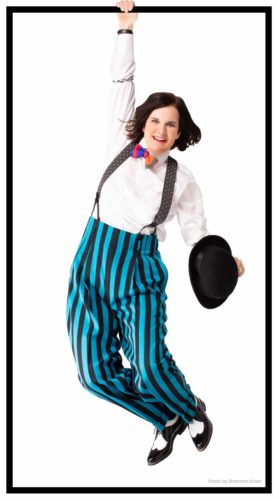
The first time that comedian Paula Poundstone was in Eugene, she saw a sign on the side of the road that left an impression.
“There was a billboard that said, ‘The wages of sin are death,’” she tells Eugene Weekly. “And I said, ‘But after they take taxes out, it’s just a tired feeling, really.’” Eugene, she says, “is a bizarre mixture of artsy and right-wing religious zealots.”
Poundstone is a regular guest on NPR’s Wait Wait… Don’t Tell Me and a comedian whose material often focuses on pop culture and politics. And, in 2018, like many other people with access to a computer and a microphone, she launched a podcast, which she says she started to help young people navigate life. She performs at the Hult Center Friday, April 8.
As an observational comedian, it seems like Poundstone would have an easy time writing material for her stand up through the day’s bizarre events, including U.S. politics.
But she compares the overwhelming current events to growing up as a struggling comedian.
“I had a car named Dave — it was a ’65 Ford Mustang — and it broke down every few feet,” she says. Her roommate told her that her frustration with the car would be good stand-up material one day, but that wasn’t what Poundstone says she wanted to hear. “I don’t need my life to suck. I’ll make shit up if I have to. And I feel like that about the world in general today.”
Poundstone started her stand up career in 1979, doing open mic nights in Boston. While learning the craft of comedy, she says it’s common to hang out with other comedians — but it has a cost. “We’d go out for a glorified meal at a Denny’s when the clubs would close and some of us would go to the restaurant for brunch the next day,” she says. “There comes a time where you worry you all start to sound the same.”
She says she realized she was starting to sound like other comedians while living in San Francisco. She had a roommate who worked as a magician. Being a struggling comic at the time, she remembers being short on cash a lot, and she’d often ask him for money. One time, she says she asked him for $5.
“He strung out the embarrassment because he shows me the $5 and he does something and takes it out of my ear in that magician way,” she says. “And I thought to myself, ‘What is magic anyway?’ It’s, ‘Here’s a quarter, now it’s gone — you’re an idiot.’”
She later went to see fellow observational comedian Jerry Seinfeld at the San Francisco club called the Punchline. That’s where she heard Seinfeld on stage, saying, “What is magic anyway? Here’s a quarter, now it’s gone; you’re a jerk.”
She never used the joke on stage, but she says it was a sign that she was spending too much time going to comedy clubs and with other comedians. “That’s why I became a hermit,” she laughs.
But people — especially comedians — are more similar than they think, she says. “A lot of what’s funny is familiarity,” she adds. “If I was unique, people wouldn’t laugh; they’d just stare at me funny.”
Despite its name, her podcast — Nobody Listens to Paula Poundstone — actually has listeners, she says. Although she doesn’t look at the metrics of the podcast, she says when she brings it up on stage, the crowd reacts like they’ve heard of it.
She says she’s not getting the pot of gold that some podcasters are — like Joe Rogan, whose contract with streaming service Spotify is now reportedly worth $200 million — but she and many others are getting “sloppy seconds” paychecks. “But that’s OK,” she adds. “I enjoy doing it. It’s a different kind of writing than what I’ve done for 40-something years.”
Her podcast episodes vary in subject, from the U.S. Electoral College to climate science to the danger of plastics in the environment. But after hearing an expert talk about the Electoral College — the thing that actually elects U.S. presidents — she says she’s still confused about some of the things the Founding Fathers did.
“I’ve been focused on the Constitutional Convention a lot lately,” she says. “The idea that our Constitution began with the premise that a slave was three-fifths of a human being, it really doesn’t feel like solid ground.”
And the Electoral College will probably stick around since Republicans aren’t too interested in changing something that benefits them, she says. But if the U.S. had some sort of bizarre chemical in the air that had parties switch places, meaning Republicans became Democrats and vice versa, maybe the Republicans would see how unfair it is, she says. Then again, she adds, it’s the Republicans who’ve shown they’ll do anything for power.
Even though the podcast is meant to inform people about mundane topics injected with her humor, like how to change your cell phone plan, she’s learning from the experts she’s had on. Her favorite is a plumber, from whom she learned why she’s always had high plumbing costs.
“I had no idea that you weren’t supposed to flush Kleenex down the toilet. It really changed my life,” she laughs.
Paula Poundstone performs 8 pm Friday, April 8, at the Hult Center. Tickets start at $35.