An art show at the Eugene Downtown Library highlights humanity, biology, COVID-19, female activists and the American flag.
On the second floor of the library, in the magazines and newspaper room, there are four art installations by artist, writer and fifth-generation Oregonian Julie Anderson Bailey. Each work is located strategically above waist level, so it is impossible to miss them when entering a room full of desks and shelves. As you walk into the main entrance, make a left, take a deep breath and let the journey begin.
“Biology Rising” is an installation, over four windows, of nearly 900 light green circles composed of old sewing pattern tissue paper, wire, gel pad and Oregon beeswax. Hanging from thin threads, multiple semi-transparent circles create what looks like enormous floating clouds. The intriguing part is that each circle houses a particular internal design.
Look closer, and you will find patterns inspired by volvox, a genus of freshwater algae. Anderson Bailey committed close to 640 hours to work on the circles as it helped her deal with her grief and look up to something each day after losing her mother in December of last year. “It gives your hands something to do and gives your heart something to do,” she says.
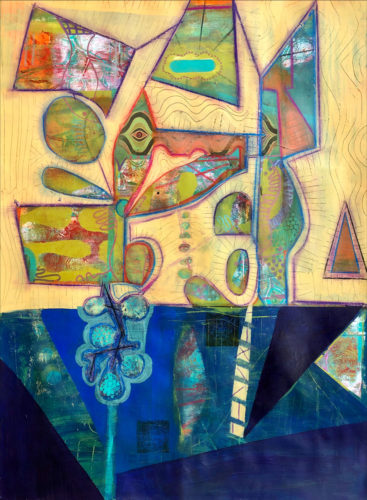
Located on the walls between the windows is “Hues of Life,” a series of nine cradled wood panel displays of circle prints that pay tribute to micrology and humanity. They are, after all, part of the first collection. The difference: They deliver macro views in different tones and shades. A few steps away is “The Art of COVID,” which includes five black-framed mixed-media paintings made on paper and using acrylic paint. Now, look carefully at the shapes, colors, tones and lines. Cubism, an art style created in part by Pablo Picasso, seems to have been influential in this collection.
Take the opportunity to take an internal trip and decipher the meanings of a project that started along with the pandemic’s beginning and its aftermath. The artist gives us a hint: “This is telling a story of COVID, the world and the pandemic. And this narrative of — we have to work together, and the politics and the division.”
These reflections led Anderson Bailey to inquire about what people thought regarding the American flag, and this was how “The State of Hope” was born. The collection includes seven mixed-media framed and canvas collages located on the wall across the window display. You can find images of American female activists, the American flag and quoted views about it from friends, family members, volunteers and social media users.
Did you find the white and orange butterflies in one of the pieces? Did you recognize any of the faces portrayed in the collection? Have you read all the quotes? This collection has multiple dimensions and approaches; that is the beauty of art.
Your final stop: Locate the two glass display cabinets on the sides of the main entrance. In them, you will find the artist’s biography, detailed descriptions and documentation regarding her exhibition, and tools and references used in her work. But there is more than meets the eye. What is art if not the opportunity to interpret it as you please and perhaps connect with it?
There are several ways to explain the relationship between art and the artist. “It is the way that we process the world, right? It is the way that we figure things out,” Anderson Bailey says. For her, this exhibition has a personal and social meaning. What is displayed on the second floor of the Eugene Library is the work of an artist who has dedicated almost her entire life to multiple artistic expressions, including art, painting, drama and music.
Julie Anderson Bailey’s art exhibition runs through July 24 at the Eugene Public Library, 100 West 10th Avenue. The window installation “Biology Rising” will be on display at the library until the end of August as part of the Mayor’s Art Show. See more about the artist at JulieJulie.co. Free.