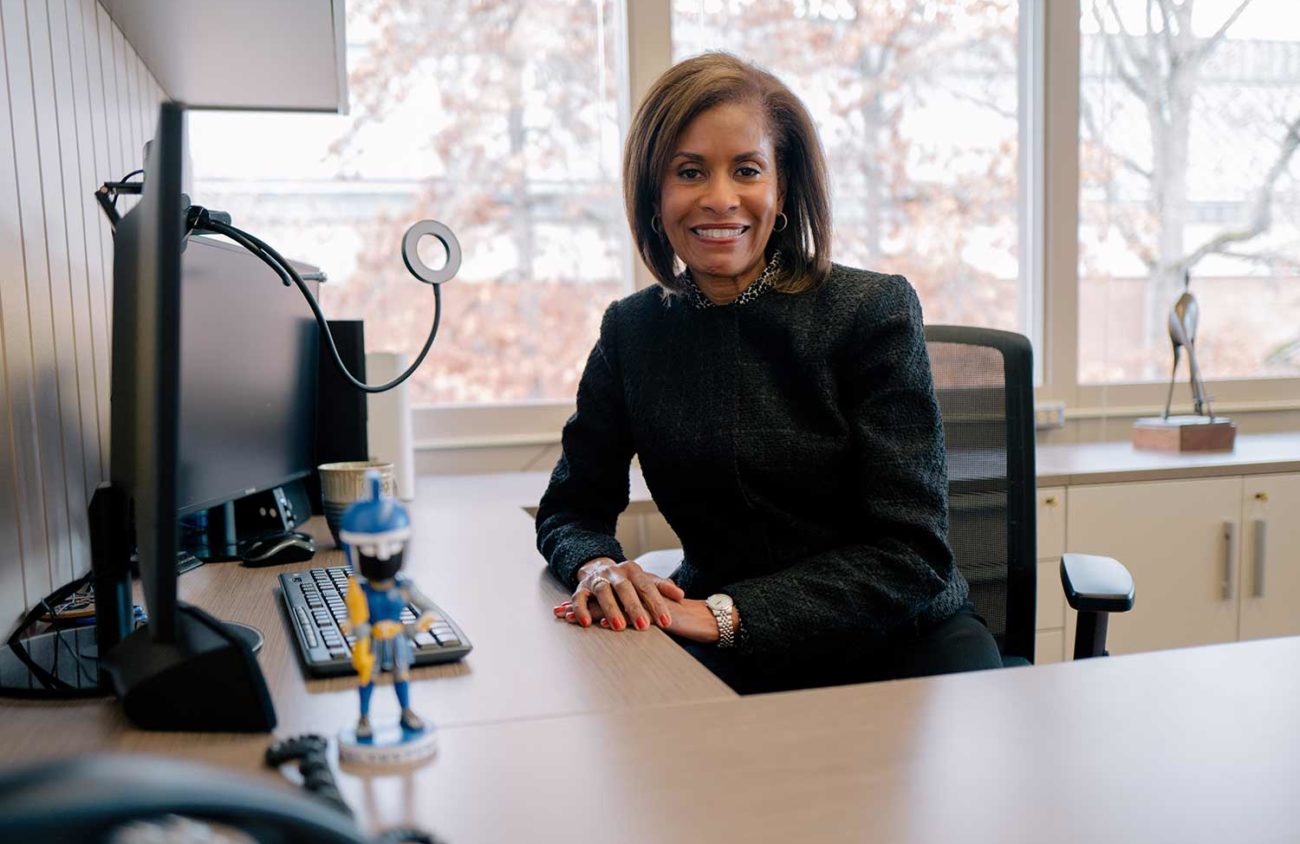
In summer 2022, Lane Community College named Dr. Stephanie Bulger its eighth president.
Born in Chicago, Bulger grew up in a military family where she moved around a lot. She went to high school in Detroit when her family settled. Growing up, Bulger says thanks to all the moves, she doesn’t remember the names of teachers and friends until almost middle school. She is the oldest of four siblings from two different families.
“It was an adventurous time,” Bulger says. She explains that it allowed her to be engaged with new things and places. “So, that’s why I think I’m in Eugene, in some ways.”
Bulger says her presidency at LCC was meant to be because two of the former LCC presidents have connections to the other community colleges where she previously worked. Dr. Dale Parnell was LCC’s founding president in 1965 and was the chancellor of San Diego Community College in 1974. And Dr. Richard Turner, who began his presidency at LCC in 1985, would later serve as an interim president from 1994-95 and executive vice president in 1996 at Wayne County Community College in Detroit, Michigan.
Most community colleges do not use the job title professor, and not all community college instructors have a Ph.D., so many people with doctorates who work at community colleges use the honorific Dr., like Dr. Jill Biden, for example.
Bulger is currently in her eighth month at LCC; she says what drove her here is that LCC has a national reputation in the fields of sustainability and innovation.
Bulger comes from a family of educators. Her mother retired from early childhood education, some of her family members are involved in K-12, and a family member is a retired professor from a liberal arts college. Education is “kind of part of my DNA,” Bulger says.
She earned a BA in English from Brigham Young University, and after obtaining an MA in 19th and 20th Century British and American literature from the University of Utah, she went into corporate sales. But along the way, she “was struck by the community college mission of being responsive to the community,” Bulger says. “And also its mission of transforming lives.”
She then went to the University of Michigan and received her Ph.D.in higher education. In that program, she learned concepts about internet expansion to where it was “going to democratize education for people through the internet.” That attracted her to work for an educational technology company, she says, and those experiences led her to be an educator in the community college sector.
In 2002, Bulger began working for Wayne County Community College District where she remained for 13 years. She started as an associate dean and then, for the last six years there, she served as vice chancellor for Educational Affairs and Distance Learning. Then in 2015, she held the position of vice chancellor for Instructional Services at the San Diego Community College District in San Diego.
At both institutions, Bulger worked with the CEOs, and she described them as mentors. “I consider myself very, very fortunate” because they invested time and resources that were “invaluable to my development,” she says. Her mentors are of color, and she mentions as a professional leader of color, her experiences gave her strength.
“Certainly, I’ve had experiences where I’ve been the only woman of color or a person of color in the room,” Bulger says. “But my preparation was solid” and “my grounding in my family is solid.”
Family history is one of Bulger’s interests. She and her family have traced their lineage back to her great, great, great grandparents, who were enslaved on her father’s side. And one of the grandfathers escaped slavery through the Underground Railroad into Canada. Bulger mentioned Harriet Tubman rescuing slaves by leading them through the railroad, and that is an empowering story for her family.
On her mother’s side, they were able to “nearly get back to the slave owner,” she says. Family tracing is important for them to solidify their family values over their history, Bulger explains.
“Even though this is a very painful history for this country,” Bulger says. “It is important to know that history.”
Along with learning more about her family history, she enjoys travel, hiking, yoga and reading presidential biographies. With not a lot of free time for those activities, Bulger says she gets energized by “meeting all these new people and learning about the institution.”
The next step for her career was a president’s position. Someone called her and said, “Why don’t you look at Lane?” Bulger visited the campus in 2016 or 2017 for a meeting hosted by LCC for The League for Innovation in the Community College. And Bulger had experience as a lead board member through the San Diego Community College District for the first time.
“We are developing the talent for now and in the future,” Bulger says.
LCC has excellent qualities and faculty, she says. “There are other real gems that not a lot of people know about here,” including undergraduate research that is not typical for community colleges. The college also attracts students from around the world to study in its international programs, and Bulger says it’s an opportunity for people of all backgrounds to get their start.
“Our vision really is about positioning Lane Community College to be the workforce hub of Lane County,” Bulger says.
Bulger advises aspiring young leaders to invest in themselves and their professional development. “Don’t give up as you are on your own career journey,” she says. ν