On Sunday, June 25 the Oregon Legislature passed the House Bill 2004, which proposes ranked-choice voting in upcoming federal and statewide elections. The ballot measure will be voted on in November 2024 and if implemented will require all state-wide elections to use the ranked-choice voting method.
Ranked choice voting allows voters to rank candidates in order of preference instead of choosing one candidate. In ranked-choice voting, a candidate will not be chosen until they have gotten more than 50 percent of the vote.
Oregon is not the first state to look into ranked-choice voting; Maine has used ranked-choice voting since 2018, and Alaska implemented it in 2022. Benton County and Corvallis are the first places in Oregon to adopt ranked-choice voting in county and city elections.
Ranked Choice Voting in Oregon’s communication director, Caroline Phillips, points to voters’ frustrations with polarizing politicians as a motivating force in getting this bill passed. “Oregon voters, like voters everywhere, are increasingly frustrated by politics and increasing polarization in our politicians,” Phillips says. “Ranked-choice voting is shown to kind of help solve a lot of that by addressing that spoiler candidate, or the vote splitting, and allowing voters to really vote for candidates that are their true favorite.”
Although ranked choice appears to be a favorable measure, with Multnomah County planning to move to ranked-choice voting in the next election, many advocates for an alternative voting method aren’t sold.
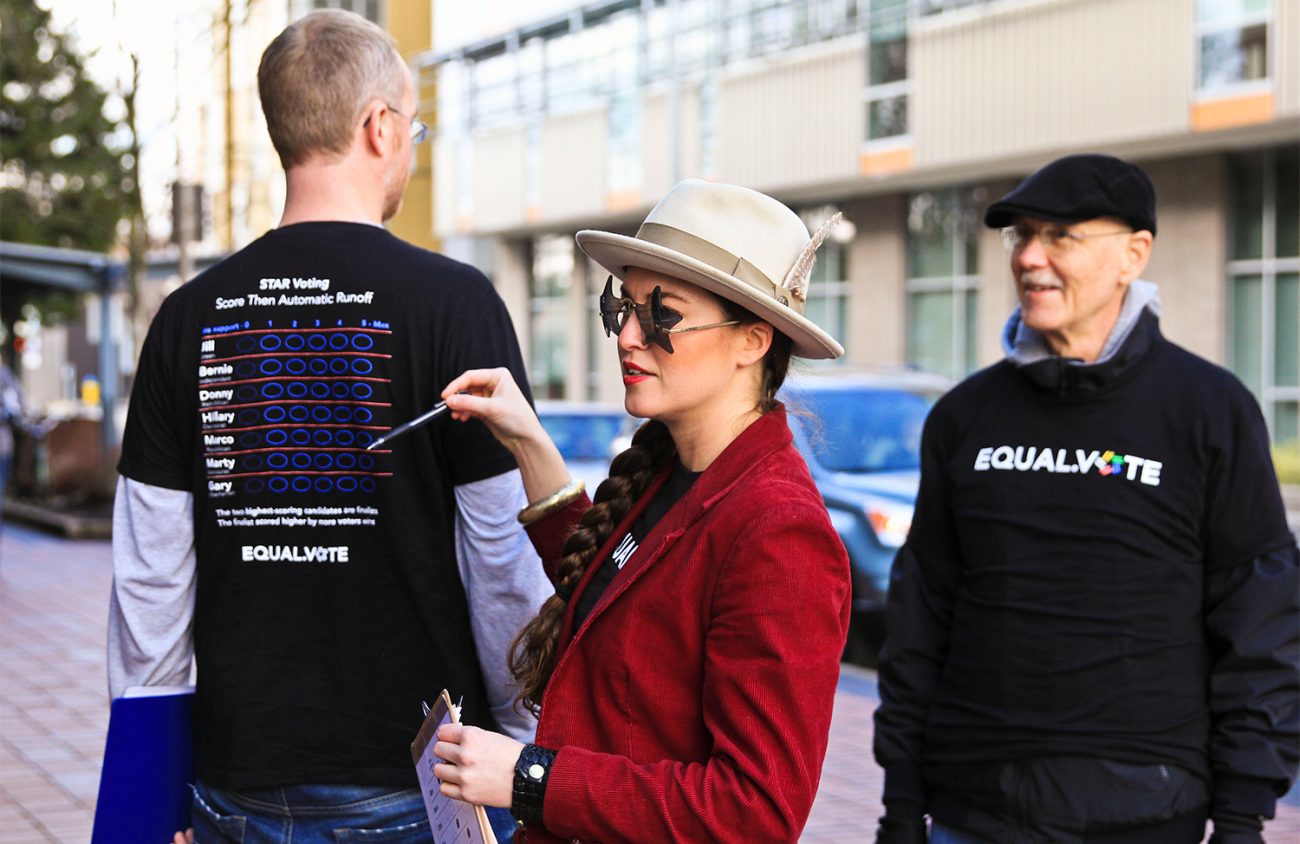
The Equal Vote Coalition’s operations coordinator, Sass, expressed concern over a ranked-choice voting system due to its “centralized voting process.” Ranked-choice voting is done round by round which means one would need to know who was eliminated in the previous round and report that data to the public. Sass says because there is simply too much data to be reported to the public, the Secretary of State would be the only one with full access to voting data across counties in the state.
Sass advocates for a STAR (Score Then Automatic Runoff) voting system. A STAR system allows voters to score candidates from zero to five stars. Ballots are then counted in a two-step process where the two candidates with the most stars go head to head in a secondary, final vote.
STAR advocates campaigned to get on the ballot in Eugene during the 2020 election, but were rejected by Lane County elections due to invalidated signatures. STAR argues that their petition to get on the ballot was illegally blocked by Lane County Elections and is taking their case to court. They are currently in litigation, but if Lane County Elections is proven wrong, STAR will appear on the ballot in the next election.
STAR has yet to be used in any public election, leading critics to believe that there is simply “not enough data.” (Full disclosure, Eugene Weekly once used it in Best of Eugene) Phillips’ main concern with the STAR voting method is the lack of “time to gauge how it would impact our elections and voters — especially those from underrepresented communities.”
STAR will need to collect 10,000 signatures by the end of September in order to get on the May 2024 primary ballot in Eugene. In addition to campaigning for implementing STAR in Eugene, there is a larger effort advocating for STAR across state-wide and federal elections. STAR has until July 2024 to submit enough signatures in order to be on the November 2024 ballot. If STAR gets on the ballot it will be competing against ranked choice voting on the general election ballot.
This story has been updated.