By Larry Kaplowitz
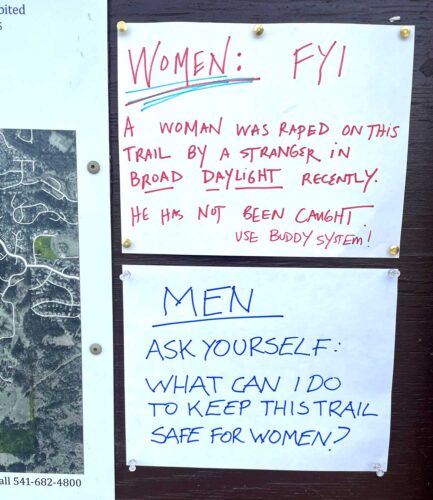
Here’s the situation: Last week a man raped a woman who was hiking alone on the Wild Iris Ridge trail in broad daylight. A concerned citizen posted some signs at the trailhead, warning women and suggesting they bring a buddy. My partner, who has regularly hiked this trail alone in the mornings before going to work, and doesn’t always have access to a buddy, now feels afraid to hike there by herself.
As the concerned citizen who posted the signs suggested, women can take precautions, like always hiking with a buddy. They might also get a dog, or carry pepper spray and a loud whistle, or develop proficiency in self-defense or martial arts. Or they can avoid hiking trails entirely and only walk in populated neighborhoods, or exercise at the Y or a gym.
All the while, I, a man, can continue to blithely (and safely) hike any trail I like, without any special precautions, enjoying a peaceful experience in nature, while women who choose to continue hiking alone will likely feel the need to maintain some level of vigilance throughout their hike, and perhaps consider every man they encounter with suspicion. Does this suck? Yes. Is this just a problem for women? I don’t think so.
I believe, as Kamala Harris said in her DNC speech, that “a harm against any one of us is a harm against all of us.” This is not just an abstract idea.
While my physical safety may not be threatened, this rape hurts me, too. I, as a man, however benign I know myself to be, must now consider that I may be an object of suspicion for every woman I encounter when I’m hiking. A hike on any of the wonderful trails that are such a special part of life in Eugene is now tainted by a cloud of danger.
My partner, who I deeply love and care about, has a new cause of stress and has lost access to a daily part of her routine that has been deeply nourishing and helped her to manage the stress she already feels working fulltime and raising a teenage son. I feel grief, and helplessness, about all of these consequences.
My partner has challenged me: What will I do about this?
In the short term, the best I can think of to do is attempt to broaden the conversation from, “What can women do to keep themselves safe?” to “What can men do to make not only hiking trails, but the whole community, safe for women?”
If we, as men, spend as much time and energy engaging with this second question as women in our community are required to spend engaged with the first question, that could be a good place to start.
So here’s my challenge to men: For the next week, when you’re with other men, set aside your political opinions and speculations, the start of the football season, the freakishly hot weather, and talk about this. I don’t know what the solution is, but I am pretty sure that if we’re not talking about it we’re not very likely to figure it out.
Note: By talking about men and women, I am not meaning to ignore or marginalize non-cis folks, who generally must endure an elevated level of threat wherever they are. Let’s include them, and the particular threats they face, in our considerations.