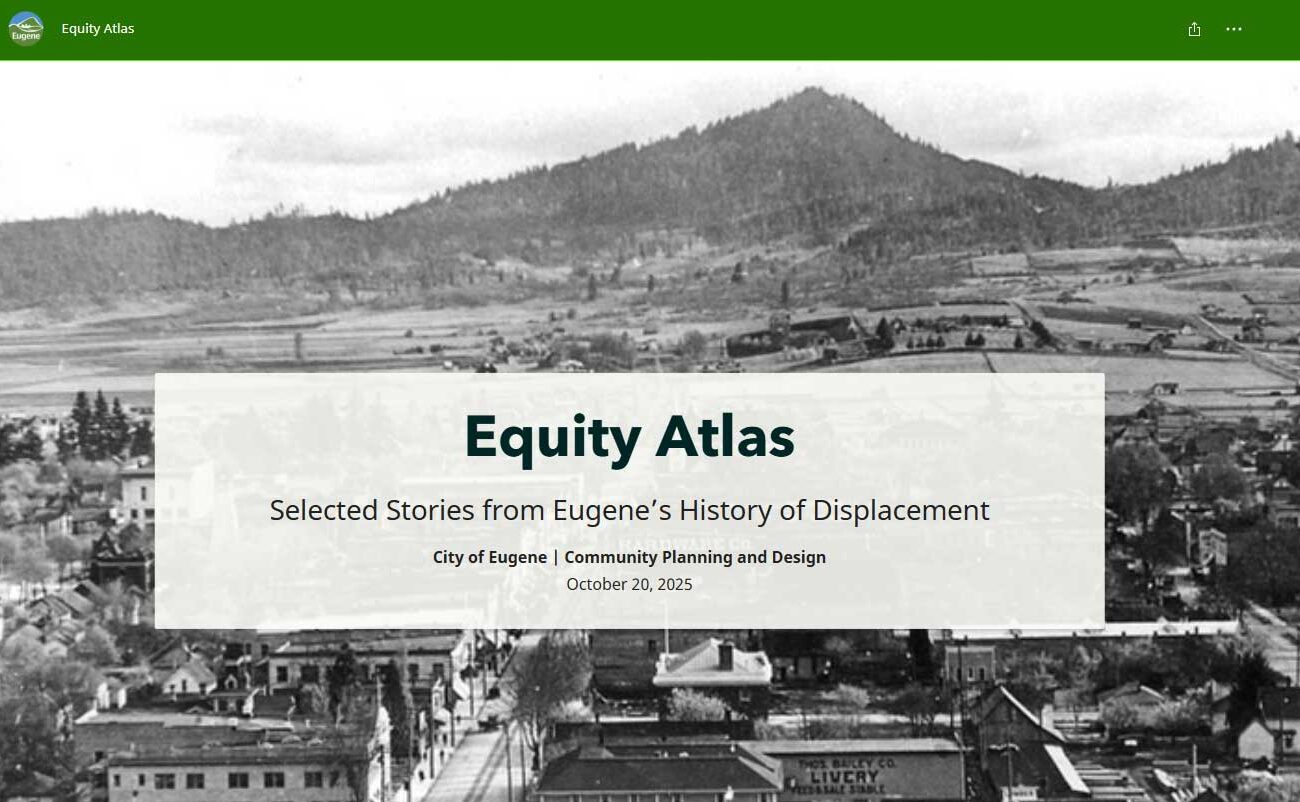
The city of Eugene launched a program in October — required by state law — that sheds light on its history of discrimination in regard to land use, housing and displacement.
In 2023, the Oregon Legislature passed House Bill 2001, which requires cities to “inventory and address past and current discriminatory practices in their housing planning work.” Equity Atlas: Selected Stories from Eugene’s History of Displacement, was built to help support planning projects that recognize the city’s extensive history of housing discrimination.
Talicia Brown, founder of the Black Cultural Initiative and member of the Urban Growth Strategies advisory panel, says it was important for her to collaborate with Equity Atlas because of the city’s housing history.
“I used to live in [the] Eugene-Springfield area, and I moved away because it was not a place where me and my family could feel comfortable,” Brown says. “When we look at the Equity Atlas, we have to look at how the history has resulted in what is happening today in terms of cultural diversity.”
The Eugene Planning Division’s Urban Growth Strategies project formed the Equity Atlas, which has a story map drawing on selected stories of how state and federal legislation, exclusionary zoning and displacement have impacted Eugene’s marginalized communities over time. Historical research and community input also formed the timeline.
According to Stuart Warren, associate planner in Community Planning and Design, the research will be integrated into the planning process through the Envision Eugene Comprehensive Plan — a plan the city says helps guide the city’s land use to align with its values of “community, supporting the health, wellbeing and prosperity of all community members.”
The research will also specifically help shape Eugene’s “contextualized housing need,” a component of Urban Growth Strategies. “This work will really inform how we’re planning for housing and those places that people want to live,“ Warren says. “Also, how we’re planning for future amenities in neighborhoods that may not have access to those types of things.”
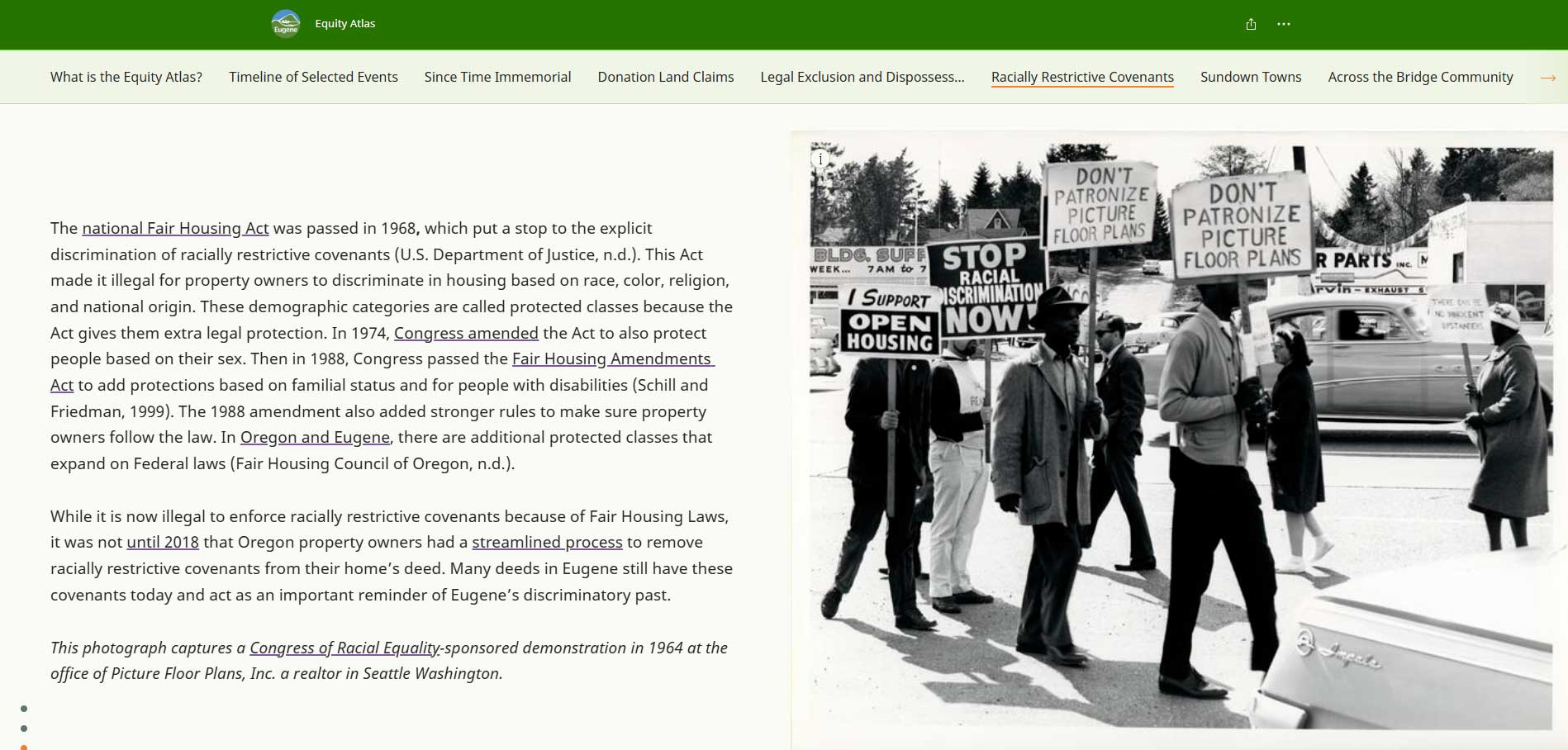
The atlas ranges from policies in the 1800s that broadly favored white men, to Sundown Town laws and racially restricted covenants limiting where people of color could own land and property, to displacements of Black communities in the 1940s and ’60s to the present where land-use planning can become a tool of exclusion — for example planning where apartments are only allowed near busy streets or in less desirable areas, farther from schools, parks and other community assets.
Warren says the city is focused on working with those who have been most impacted by past decisions. “We are working with community leaders who we have relationships with,” he says. “One thing we heard from our community advisory panel is that this work is awesome, they fully support it, and we need to include more storytelling in it because not everyone’s experience throughout this history was the same.”
According to Warren, the community advisory panel, which has given feedback to the Planning Division on the program, was a large demographic ranging from high school students to retirees and different races and economic backgrounds.
“They have a very wide variety of income levels, so we’re kind of capturing that full range when we’re talking with this group, which is really nice,” he says. “They’re folks who are retired architects. There are folks who are in high school that are involved in local organizations, like the City of Eugene Youth Advisory Council [and] the NAACP Youth Advisory Council.”
While Brown of the Black Cultural Initiative says her collaboration with the city on the program has been positive, she also wants to keep in mind that the city “is wanting to pat their own back about putting together the Equity Atlas.”
“When in reality, it’s actually mandated by the state,” she adds, “so the city is actually doing nothing in terms of actually advancing the wrongs or making amends for the wrongs that they have done.”
City Councilor Greg Evans agrees that the mandate from the state “was a motivating factor.”
Warren says that the Planning Division has not worked with the City Council as a whole or with other commissions, except for the Planning Commission. “This is never intended to be something that’s adopted, so we haven’t worked it into our decision-making framework yet, with the exception of our Planning Commission,” he says. “Our Planning Commission is a group of folks who we work very closely with, and we found that this history was just really interesting, so we wanted to make sure that our Planning Commission knew this history as well,” Warren says.
Evans, the only person of color on the council, says he believes the city took longer than needed to create a program like Equity Atlas. “It’s been overdue for years,” Evans says. “It’s not like people around here didn’t know the history, didn’t know what was going on, didn’t know what was happening — they knew it.”
While Evans says he’s hopeful the program will make a difference, he’s uncertain. “I’m not always sure that will be a primary motivating factor in any kind of decision making,” Evans says. “Things are a lot different now than what they used to be. And again, as we move forward in this conversation, there’s still a lot of open and latent racism in this community.”
Find Eugene’s Equity Atlas at Eugene-or.gov/5491/Equity-Atlas.