In 2025, Kristil Krug of Colorado was murdered following two months of online stalking.
The stalker, who posed as an ex of Krug’s, was actually her husband. He violently killed her, and Krug’s cousin, Becky Ivanoff, believes it could have been prevented. Ivanoff, an attorney in Lane County, has brought new legislation to Oregon to protect people affected by domestic violence and stalking.
Krug made several efforts to contact law enforcement, who then filed search warrants to identify her online stalker. The phone carriers and social media companies did not respond to the search warrants for weeks, which meant her stalker — and murderer — went unidentified.
The day of her murder, law enforcement filed an “exigent circumstance request” and, in under 15 minutes, received the information that had previously not been fulfilled.
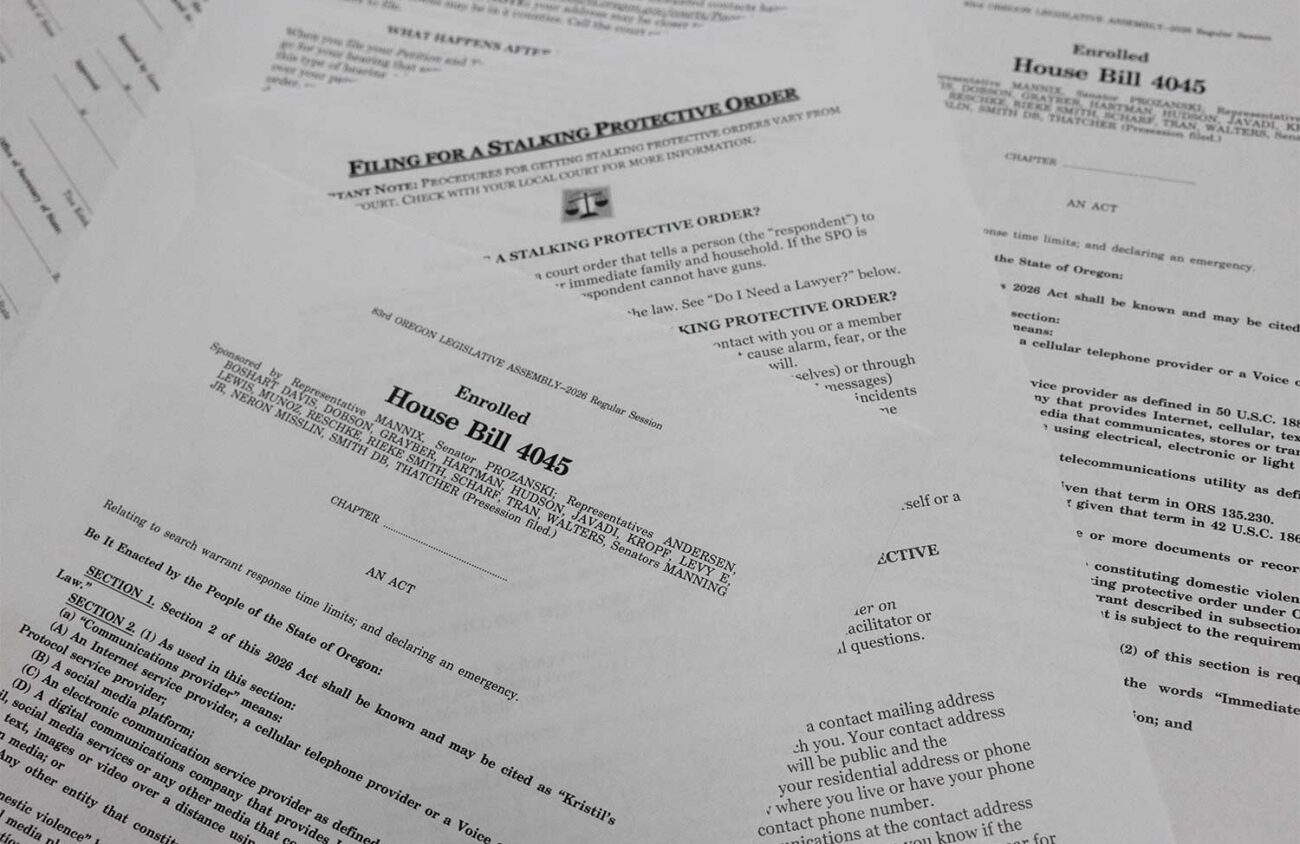
On Feb. 17, both the Oregon House and the Senate Judiciary unanimously passed a law in her honor, Kristil’s Law, House Bill 4045. The law requires communication providers, such as phone companies, to respond to search warrants regarding stalking or domestic violence within five business days, and social media providers to respond to warrants within 72 hours.
“I believe that if it had been in place when she was targeted, that there’s a very good chance she’d still be alive today,” Ivanoff says of Kristil’s Law. After her cousin was murdered, Ivanoff immediately got involved with legislation in Oregon to ensure this does not happen to other families.
Ivanoff says she was pleased the bill received bicameral and bipartisan support from its co-chief sponsors, Republican state Rep. Kevin L. Mannix and Democratic state Sen. Floyd Prozanski, to move the bill forward. Although it’s typically uncommon for legislation to pass during a short session, this bill was considered an emergency measure and went into effect immediately upon Gov. Tina Kotek signing it March 31.
The bill will be enforced as of May 1. It does not include any required sanctions for search warrants that are completed after the deadline. “Right now, I’d say it’d have to be through some type of court sanctions,” Prozanski says.
Before it was passed, companies had no requirement to reply to warrants promptly. Michelle Mhoon, Mannix’s chief of staff and policy director, says this bill should help the companies “not feel completely overwhelmed, and maybe help them organize things like this as they come in.”
Mhoon also explains that the process was previously first-come, first-served regarding replying to the warrants. The companies “don’t want to have liability for choosing what is prioritized over something else.” This bill relieves the telecommunication companies of deciding between which search warrants are most important to fulfill, and pushes forward cases of domestic violence and stalking to be carried out promptly.
Before this bill, there has been no statutory deadline for communication providers or social media companies to respond to search warrants, creating pauses in domestic violence and stalking cases that need immediate attention. A press release from Mannix’s office states, “It can take weeks or even months to produce critical evidence, even if a judge has already determined probable cause.”
Oregon is the first state to enact a bill of this nature. Ivanoff and Mhoon say they hope to see the bill enacted in other states. “The goal all along was to create model legislation that other states would be able to adopt,” Ivanoff says.
She says this bill will “create more safety for survivors of stalking and domestic violence, and more immediate accountability for offenders.”
Ivanoff says she has also received commitment from Colorado House Majority Leader Monica Duran, a Democrat, “who will bring Kristil’s Law forward as one of her primary legislative objectives for the 2027 session.” Duran emailed that she was not available for comment in the middle of the Colorado legislative session, but will “circle back.”
State Sen. William Lindstedt from Colorado, also a Democrat, tells EW, “I will run this bill next year. Unfortunately, there was a major update to many of these statutes this year, and we had to wait until next session.”
“I would like to see something similar to what we did in Oregon, where we had co-chief sponsorship from a member of both chambers. I think that was a nice way to signal, while in Oregon, it was both bicameral and bipartisan support,” Ivanoff says, who adds that the bill is not partisan in nature.
Mhoon says she has heard from several attorneys in Oregon who supported the bill. They told her they had worked on cases and with victims of similar situations, and that Kristil’s Law would have “made a huge difference.”
For Ivanoff, working on this legislation has helped her grieve her cousin. “I would say that being able to advance Kristil’s law is part of my healing,” she says. “For me, it is, I think, easier to manage grief when I know there’s going to be some kind of outcome that positively impacts the community as a result of what’s been a horrific tragedy.”