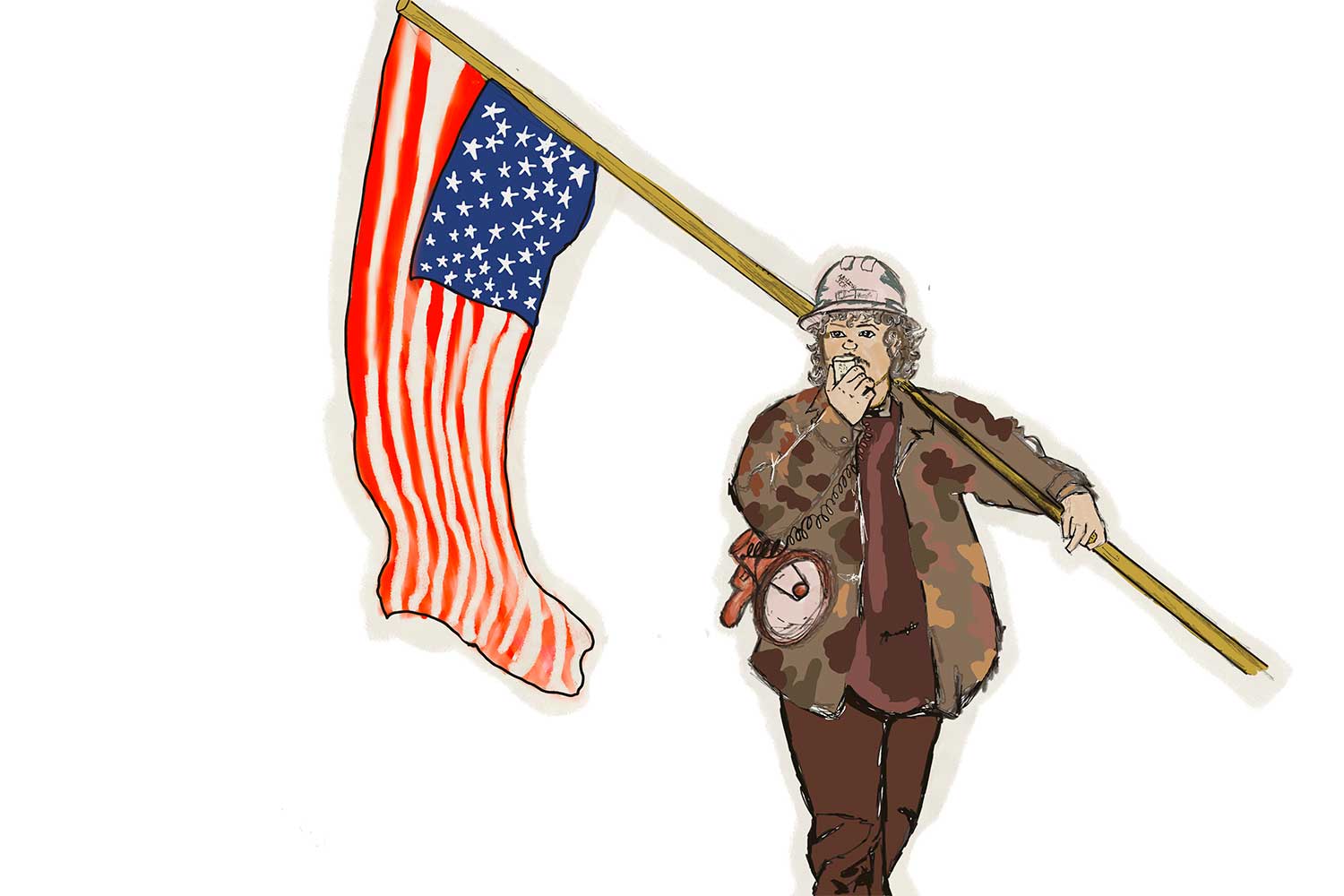
Wearing a white construction helmet and a camouflage jacket, Kelby Alloway stood holding an upside-down American flag mounted on a wooden pole, with a megaphone raised above the crowd. He shouted chants and urged resistance, while also attempting to guide the crowd in protecting themselves.
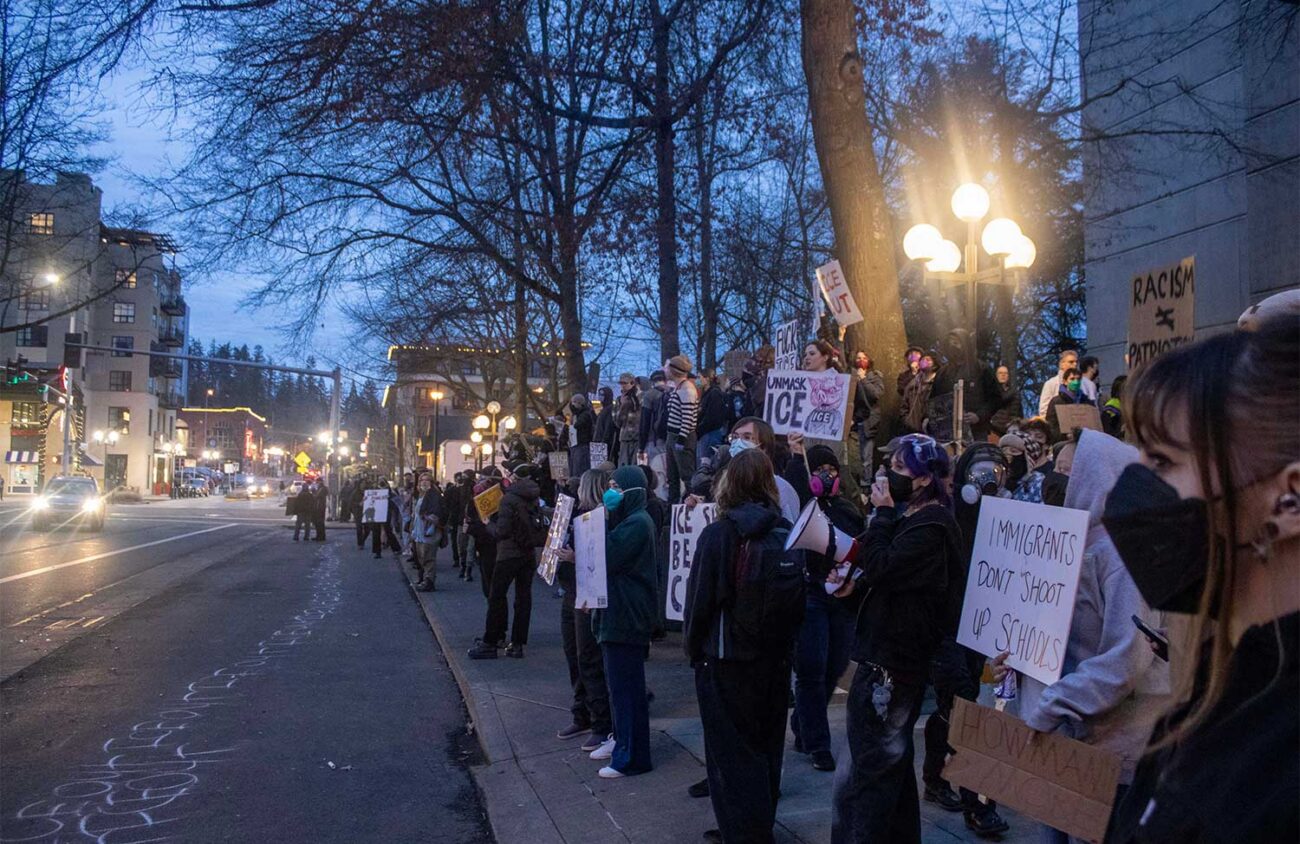
Protests in Eugene have escalated, with federal agents and the Eugene Police Department deploying tear gas and pepperballs amid growing outrage over intensified federal enforcement targeting immigrants. Demonstrators cite ICE actions, allegations of brutality and incidents involving the killing of innocent people.
Alloway, a recent University of Oregon graduate, says his participation in the local Jan. 30 Youth Against ICE protest was driven by frustration with federal spending priorities. He says that billions of dollars allocated elsewhere could instead be used to address urgent domestic needs.
“I’ll tell you why I’m here. $28 billion this year could have gone to health care, housing, infrastructure, education or child care,” Alloway said.
For Alloway, protest is also rooted in what he describes as preventable federal failures. He points to an example of this in the 2021 winter storm in Texas, which he says left residents without power and resulted in deaths, arguing that public funding could instead strengthen infrastructure, expand health care and housing, and support the construction of thousands of single-bedroom apartments.
Beyond funding priorities, Alloway directed sharp criticism toward federal agencies and law enforcement. He accuses them of violence, excessive force and misuse of public funds, alleging that officials and political leaders have failed to hold those responsible accountable. He says he believes civil liberties — including the free speech rights of journalists, protesters and talk show hosts — are being undermined.
Seeing protest as one of the few remaining ways to be heard, Alloway warned that arrests and violence against demonstrators will continue without public resistance.
“I ask Eugene Weekly and their readers to organize, to talk with their neighbors, to get their phone numbers, and to form their own rapid response and community defense networks,” Alloway said. “We must build a community worth defending, and then we must defend it.”
In a sea of protesters, Meredith Newman, a University of Oregon senior who attended the Jan. 30 protest in Eugene, said she was there out of concern for the safety of friends and classmates.
“I just know I have friends who are very afraid of what’s going on right now. Scared to live in this country right now,” Newman said.
As a student of politics, Newman said recent events feel increasingly alarming and reflect patterns she has studied in countries with authoritarian leadership and policies.
“Seeing what’s happening right now is just like what’s happening in authoritarian countries. It’s more serious than it’s ever been and it’s just important to show that people are out here.”
For others, these protests are not new. Ruth Kornfield, who has been demonstrating since she was 18 and is now 82, says she has spent decades fighting for human rights. At the Jan. 30 protest, she reflected on a lifetime of activism.
“I’m a radical, I’ve been participating in [protests about] reproductive health, pro-choice, civil rights. Many, many, many of the issues throughout the years,” she said.
Kornfield said she has always been radicalized and that this protest was no different from those she has attended in the past. She added that the issues motivating her participation are longstanding.
“I started demonstrating against ICE a couple of summers ago,” she said. For Kornfield, the reason for continuing to show up is evident. “It’s very, very clear that ICE is going way, way, way beyond anything that we could have ever expected.”
“It’s become so obvious and clear that we have to be out here all the time now,” Kornfield said.
For some demonstrators, participation is less about speeches and more about simply having a presence. Bill O’Brien attended the Eugene protest because, he said, simply showing up can be an act of solidarity.
“This is a very critical time, you know? All I did was just show up today,” O’Brien said.
He added that sometimes showing up is the best way to support neighbors, even when outcomes feel uncertain.
“I want to see change, but I’m afraid it may not even change,” he said, adding that being there is the only way he knows how to contribute.
Jana Thrift attended both the Jan. 30 Eugene protest and an earlier National Shutdown Day protest in Springfield. Thrift also said she works as the radio station operations coordinator at community radio station KEPW 97.3 FM PeaceWorks Community Radio, but attended the protests as a private citizen.
Standing in solidarity at the protest, Thrift said her concerns center on policing and the erosion of constitutional rights. She said she attempted to speak with Eugene and Springfield police about why they were present and positioned against demonstrators.
“Really feels like the men that are taking up the position of policing us are making a choice to come up against the people that are trying to protect the country from a seriously evil regime that is taking over and destroying multiple constitutional rights,” Thrift said.
Thrift added that due process is one of the central issues motivating people to protest.
“Due process being the thing that is the worst thing that ICE is [not] doing,” she continued. “There is no clause that says due process only belongs to American citizens. It belongs to everyone, according to the Constitution, in my understanding. And so that is why I think a lot of people are here is because they believe that what’s happening with ICE is a destruction of the moral fabric of what we believe in as Americans.”
Find a list of ongoing protests in Eugene Weekly’s Activist Alert every week and at EugeneTogetherStrong.org.