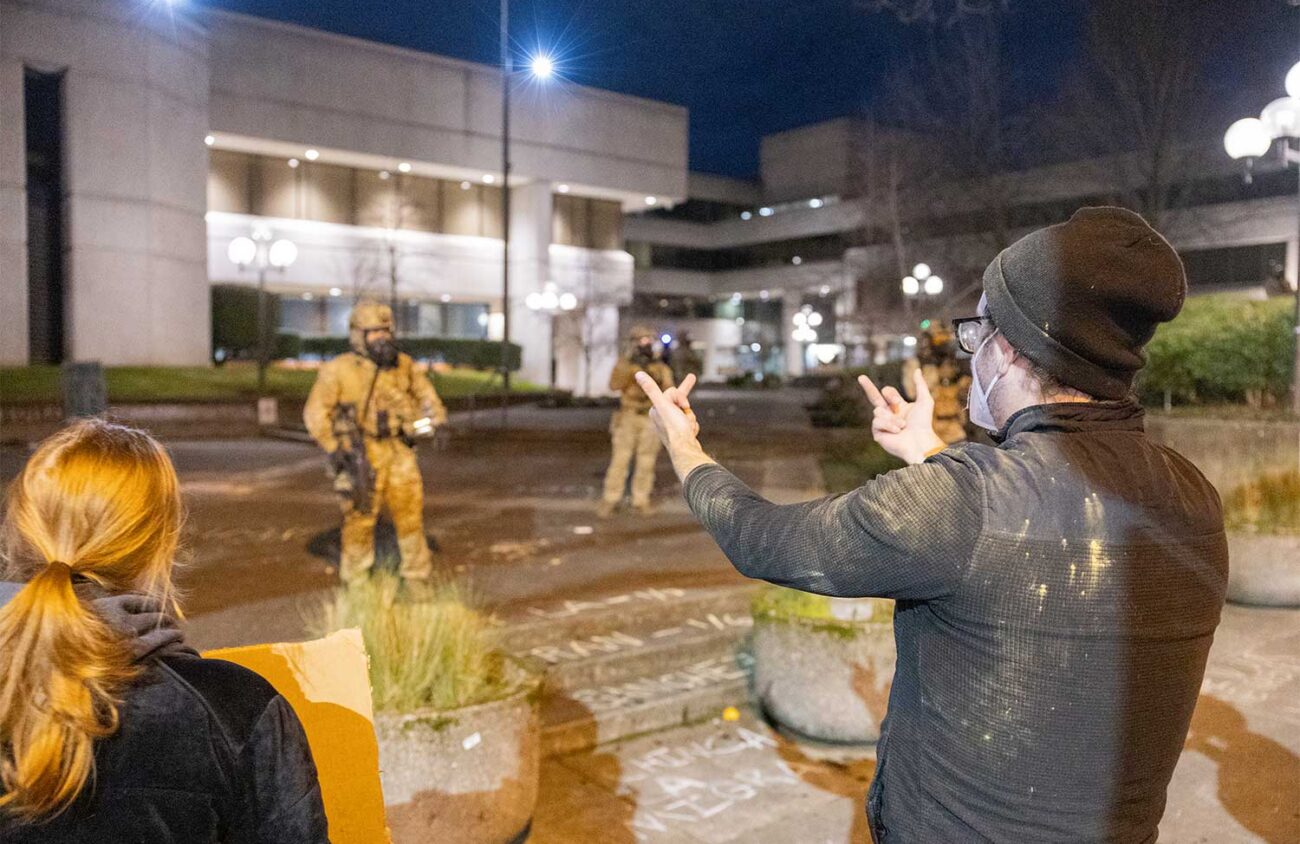
Ever since the Department of Homeland Security adopted new regulations regarding conduct on federal property in November, Eugene has seen a significant increase in the number of people arrested by federal agents at the downtown Eugene Federal Building.
Most recently, arrested protesters have told Eugene Weekly that federal agents may be using the “good cop, bad cop” technique.
The downtown Federal Building is home to Eugene’s ICE field office and since early July, protesters have been gathering outside the building nearly every day to voice their opposition to Immigration and Customs Enforcement detaining and deporting immigrants in Oregon, and local protests have stepped up after the ICE killings of Renee Good and Alex Pretti in Minnesota.
On Jan. 30, during a protest that was declared a riot by the Eugene Police Department, federal agents arrested Jillian Lunyou, a disabled person filming the event, by tackling them to the ground and handcuffing them. “In that moment, I was just thinking, ‘I need to try and not be killed,’” Lunyou tells Eugene Weekly.
Federal agents took Lunyou and their friend William Thaxton, 20, who was also arrested, into the building. Lunyou says they were not told why they were detained for nearly an hour. They say federal agents refused to provide water or saline to wash off the tear gas and pepper spray from their face.
Federal agents offered to call emergency medical services, but Lunyou says they never arrived.
Both Thaxton and Lunyou say they were affected by chemical irritants inside the building and were not provided a safer breathing environment. “The tear gas and pepper spray was on and off,” Lunyou says. “It would dissipate, and then all of a sudden it would get very tear gassy in there and be hard to breathe.”
Thaxton says agents gave Lunyou a chair, but he was forced to stand. Later, an agent told him he could sit. Minutes later, an agent, which he presumed to be a commanding officer, ordered him to stand again.
Thaxton says the commanding officer then ordered him to his knees. “He was very aggressive, in the way he was talking and his body language,” Lunyou says. Later, another agent gave Thaxton water and let him sit back in the chair.
The same commanding officer came back again and got upset at the other agents. “He found the agent who unhandcuffed us, took him into the hall around the corner, and we could hear him berating him,” Thaxton says. “He was like, ‘You can’t unhandcuff these people, this isn’t a fucking daycare.’”
At one point, federal agents allowed Thaxton’s mother into the building, but she was later told to leave after the commanding officer noticed her presence.
Federal agents took Lunyou into a conference room where they were greeted by two FBI agents. It was only at this point that federal agents read Lunyou their Miranda rights.
Lunyou says the FBI agents were overly friendly. “They were trying to be like, ‘We’re the good guys,’” Lunyou says, adding that the FBI agent said, “Look at me, I’m in normal clothes.”
Lunyou says another agent in the room tried to lecture them and tell them that there were no ICE agents in the building and the protest was useless.
Lunyou ignored them and believed they were lying. “I was like, ‘You guys are deploying weapons on people and on unarmed civilians.’”
Thaxton says FBI agents treated him the same way. “The FBI agents were actually kind of chill, they apologized for the way things were handled,” he says.
Both Thaxton and Lunyou were cited and released. Protesters arrested at the Federal Building are almost exclusively being charged under new federal regulations passed by the DHS.
The new regulations include bans on things like posting signs and “obstructing the usual use, enjoyment, or access to Federal property.” Citations under these new regulations result in either a fine or imprisonment of up to 30 days.
In a message to Eugene Weekly, the Civil Liberties Defense Center’s founder and director of litigation and advocacy, Lauren Regan, writes that those arrested in November and early December will have their first court appearance with a U.S. District Court Magistrate judge Feb. 13. Regan expects many of the cases to be dismissed. If the cases are not dismissed, Regan says the CLDC will schedule a trial to allow for litigation or negotiation.
A day later, Jan. 31, protester Donavan Donaworth was arrested during a peaceful demonstration outside the front entrance of the Federal Building. Donaworth says when agents arrested him, they tackled him to the ground and took him inside. “There was one [agent] that was busy lecturing us, saying, ‘This isn’t the path you should take in life,’” Donaworth says.
Donaworth says agents treated him very roughly during his initial arrest, but afterwards were much nicer. “I was scared that my charges would lead to heavier consequences,” he says. Donaworth says he was released with a citation for trespassing and “creating any hazard.”
Donaworth adds that the FBI asked him if he knew about any groups conspiring to cause damage to federal property.
Eugene Weekly reported that federal agents have been visiting journalists and community members seeking information regarding the Jan. 30 protest. Federal agents have not approached Eugene Weekly and the Weekly does not turn over photos or information to law enforcement.
If arrested at a protest: Eugene Jail Support is 541-515-5721 and Civil Liberties Defense Center help line is 541-603-6891. Oregon’s Attorney General has asked those who witness unlawful actions by federal agents to use its Federal Oversight Reporting Form to report them. Find the form at Doj.state.or.us, click the “Federal Oversight” tab.